Musculoskeletal Science and Sports Medicine Research Centre, Manchester Metropolitan University, Manchester, UK.
Research Institute for Sport & Exercise Sciences, Liverpool John Moores University, Liverpool, UK.
Endocrine. 2021 May;72(2):411-422. doi: 10.1007/s12020-020-02601-0. Epub 2021 Jan 23.
We investigated the combined impact of ageing and obesity on Achilles tendon (AT) properties in vivo in men, utilizing three classification methods of obesity.
Forty healthy, untrained men were categorised by age (young (18-49 years); older (50-80 years)), body mass index (BMI; normal weight (≥18.5-<25); overweight (≥25-<30); obese (≥30)), body fat% (normal adipose (<28%); high adiposity (≥28%)) and fat mass index (FMI; normal (3-6); excess fat (>6-9); high fat (>9). Assessment of body composition used dual-energy X-ray absorptiometry, gastrocnemius medialis (GM)/AT properties used dynamometry and ultrasonography and endocrine profiling used multiplex luminometry.
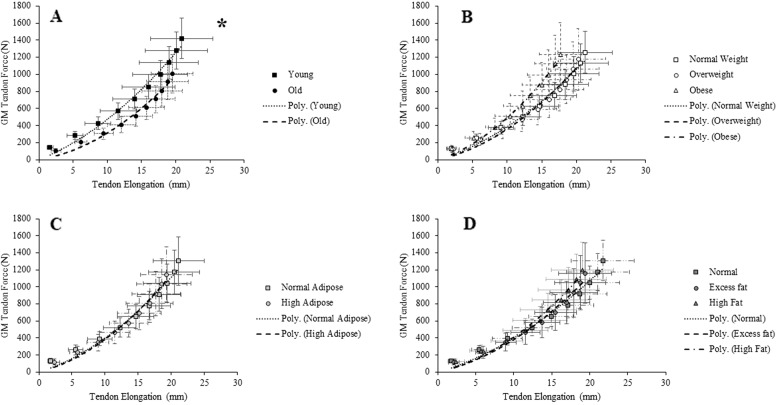
Older men had lower total range of motion (ROM; -11%; P = 0.020), GM AT force (-29%; P < 0.001), stiffness (-18%; P = 0.041), Young's modulus (-22%; P = 0.011) and AT stress (-28%; P < 0.001). All three methods of classifying obesity revealed obesity to be associated with lower total ROM (P = 0.014-0.039). AT cross sectional area (CSA) was larger with higher BMI (P = 0.030). However, after controlling for age, higher BMI only tended to be associated with greater tendon stiffness (P = 0.074). Interestingly, both AT CSA and stiffness were positively correlated with body mass (r = 0.644 and r = 0.520) and BMI (r = 0.541 and r = 0.493) in the young but not older adults. Finally, negative relationships were observed between AT CSA and pro-inflammatory cytokines TNF-α, IL-6 and IL-1β.
This is the first study to provide evidence of positive adaptations in tendon stiffness and size in vivo resulting from increased mass and BMI in young but not older men, irrespective of obesity classification.
本研究旨在利用三种肥胖分类方法,探究年龄增长和肥胖对男性体内跟腱(Achilles tendon,AT)特性的综合影响。
40 名健康、未经训练的男性按照年龄(年轻组:18-49 岁;老年组:50-80 岁)、体重指数(BMI;正常体重:18.5-<25;超重:25-<30;肥胖:≥30)、体脂%(正常脂肪含量:<28%;高脂肪含量:≥28%)和脂肪质量指数(FMI;正常:3-6;脂肪过多:>6-9;高脂肪:>9)进行分类。采用双能 X 射线吸收法评估身体成分,用动态测力法和超声检查评估比目鱼肌-跟腱复合体(gastrocnemius medialis,GM)/AT 特性,采用多指标发光免疫分析法评估内分泌情况。
与年轻男性相比,老年男性的总活动范围(total range of motion,ROM;-11%;P=0.020)、GM/AT 力(-29%;P<0.001)、硬度(-18%;P=0.041)、杨氏模量(-22%;P=0.011)和 AT 张力(-28%;P<0.001)均降低。三种肥胖分类方法均表明肥胖与较低的总 ROM 相关(P=0.014-0.039)。较高的 BMI 与更大的 AT 横截面积(cross sectional area,CSA)相关(P=0.030)。然而,在控制年龄因素后,较高的 BMI 仅与更大的肌腱硬度呈趋势相关(P=0.074)。有趣的是,在年轻人中,AT CSA 和硬度均与体重(r=0.644 和 r=0.520)和 BMI(r=0.541 和 r=0.493)呈正相关,但在老年人中则无此相关性。最后,AT CSA 与促炎细胞因子 TNF-α、IL-6 和 IL-1β呈负相关。
本研究首次提供了体内证据,表明年轻人中,由于体重和 BMI 的增加,肌腱的硬度和大小会发生积极的适应性变化,而在老年人中则不会,且与肥胖的分类无关。