Department of Cellular Biology and Anatomy, Louisiana State University Health Sciences Center, Shreveport, LA, USA.
Brain Behav. 2021 Apr;11(4):e02041. doi: 10.1002/brb3.2041. Epub 2021 Jan 23.
Autism spectrum disorder (ASD) and epilepsy are highly comorbid, suggesting potential overlap in genetic etiology, pathophysiology, and neurodevelopmental abnormalities; however, the nature of this relationship remains unclear. This work investigated how two ion channel mutations, one associated with autism (Scn2a-null) and one with epilepsy (Kcna1-null), interact to modify genotype-phenotype relationships in the context of autism. Previous studies have shown that Scn2a ameliorates epilepsy in Kcna1 mice, improving survival, seizure characteristics, and brain-heart dynamics. Here, we tested the converse, whether Kcna1 deletion modifies ASD-like repetitive and social behaviors in Scn2a mice.
Mice were bred with various combinations of Kcna1 and Scn2a knockout alleles. Animals were assessed for repetitive behaviors using marble burying, grooming, and nestlet shredding tests and for social behaviors using sociability and social novelty preference tests.
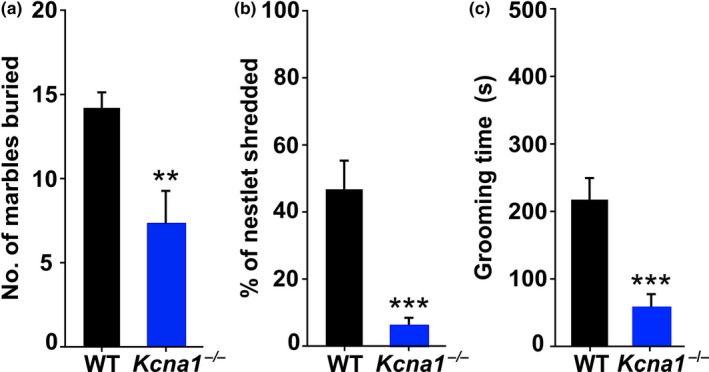
Behavioral testing revealed drastic reductions in all repetitive behaviors in epileptic Kcna1 mice, but relatively normal social interactions. In contrast, mice with partial Kcna1 deletion (Kcna1 ) exhibited increased self-grooming and decreased sociability suggestive of ASD-like features similar to those observed in Scn2a mice. In double-mutant Scn2a ; Kcna1 mice, the two mutations interacted to partially normalize ASD-like behaviors associated with each mutation independently.
Taken together, these findings suggest that Kv1.1 subunits are important in pathways and neural networks underlying ASD and that Kcna1 may be a therapeutic target for treatment of Scn2a-associated ASD.
自闭症谱系障碍 (ASD) 和癫痫高度共患,提示其遗传病因、病理生理学和神经发育异常存在潜在重叠;然而,这种关系的性质尚不清楚。本研究旨在调查两种离子通道突变(一种与自闭症相关(Scn2a-null),另一种与癫痫相关(Kcna1-null))如何相互作用,以改变自闭症背景下的基因型-表型关系。先前的研究表明,Scn2a 改善了 Kcna1 小鼠的癫痫,提高了存活率、癫痫特征和脑心动力学。在这里,我们测试了相反的情况,即 Kcna1 缺失是否会改变 Scn2a 小鼠的 ASD 样重复和社交行为。
通过各种组合的 Kcna1 和 Scn2a 敲除等位基因对小鼠进行繁殖。使用大理石埋藏、梳理和巢垫撕碎试验对动物进行重复行为评估,使用社交性和社交新颖性偏好试验对动物进行社交行为评估。
行为测试显示,癫痫 Kcna1 小鼠的所有重复行为都明显减少,但社交互动相对正常。相比之下,部分 Kcna1 缺失(Kcna1 )的小鼠表现出自我梳理增加和社交性降低,提示存在类似于 Scn2a 小鼠观察到的 ASD 样特征。在 Scn2a ;Kcna1 双突变小鼠中,两种突变相互作用,部分正常化与每个突变独立相关的 ASD 样行为。
综上所述,这些发现表明 Kv1.1 亚基在 ASD 相关的通路和神经网络中很重要,并且 Kcna1 可能是治疗 Scn2a 相关 ASD 的治疗靶点。