Castillo-Laborde Carla, Gajardo Pedro, Nájera-De Ferrari Manuel, Matute Isabel, Hirmas-Adauy Macarena, Aguirre Pablo, Ramírez Héctor, Ramírez Daniel, Aguilera Ximena
Centro de Epidemiología y Políticas de Salud, CEPS. Facultad de Medicina, Clínica Alemana, Universidad del Desarrollo, Av. Las Condes 12438, Lo Barnechea, 7710162, Santiago, Chile.
Departamento de Matemática, Universidad Técnica Federico Santa María, Av. España 1680, Valparaíso, Chile.
Cost Eff Resour Alloc. 2021 Jan 23;19(1):5. doi: 10.1186/s12962-021-00257-9.
Syphilis, together with other sexually transmitted infections, remains a global public health problem that is far from controlled. People deprived of liberty are a vulnerable population. Control activities in prisons rely mostly on passive case detection, despite the existence of affordable alternatives that would allow switching to active case-finding strategies. Our objective was to develop a mathematical modelling framework for cost-effectiveness evaluation, from a health system perspective, of different approaches using rapid tests for the detection of syphilis in inmates' populations and to explore the results based on a Chilean male prison population.
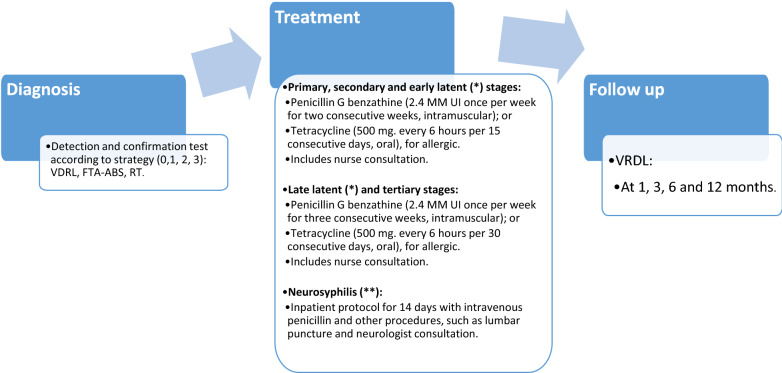
A compartmental model was developed to characterize the transmission dynamics of syphilis inside a prison with the ongoing strategy (passive case detection, with VRDL + FTA-ABS), considering the entrance and exit of inmates over a 40 year period. The model allows simulation of the implementation of a reverse algorithm for the current situation (rapid test + VDRL), different screening strategies (entry point, massive periodically; both with rapid test + VDRL) and treatment of detected cases. The parameters for the exploratory exercise were obtained from systematic searches of indexed and grey literature and field work (EQ-5D questionnaire application and key actors interviews). Probabilistic sensitivity analysis was conducted to account for uncertainty in relevant parameters.
The proposed framework allows the evaluation of different detection strategies. In this study, all the strategies were cost-effective in the baseline scenario when considering an ICER threshold of 1 Chilean GDP per capita (US$15,000). The strategies most likely to be cost-effective (over 80% probability) were: current situation with reverse algorithm, entry point screening and mass screening every two years; the latter was the most effective, achieving the lowest prevalence (0.7% and 1.7% over the period versus the 3% prevalence in the current situation).
Mathematical modelling that considers the performance of different tests and detection strategies could be a useful tool for decision making. The exploratory results show the efficiency of adopting both the use of the rapid tests and performing active case detection to significantly reduce the burden of syphilis in Chilean prisons in the near future.
梅毒与其他性传播感染一样,仍然是一个远未得到控制的全球公共卫生问题。被剥夺自由的人是弱势群体。监狱中的防控活动主要依赖被动病例检测,尽管存在经济实惠的替代方法,可转向主动病例发现策略。我们的目标是从卫生系统角度,开发一个数学建模框架,用于评估在囚犯群体中使用快速检测法检测梅毒的不同方法的成本效益,并基于智利男性监狱人口探索结果。
开发了一个 compartments 模型,以描述监狱内梅毒的传播动态,采用当前策略(被动病例检测,使用 VRDL + FTA - ABS),考虑 40 年内囚犯的进出情况。该模型允许模拟针对当前情况(快速检测 + VDRL)的反向算法的实施、不同的筛查策略(入监点、大规模定期筛查;均使用快速检测 + VDRL)以及对检测出病例的治疗。探索性研究的参数通过对索引文献和灰色文献的系统检索以及实地工作(应用 EQ - 5D 问卷和采访关键参与者)获得。进行了概率敏感性分析,以考虑相关参数的不确定性。
所提出的框架允许评估不同的检测策略。在本研究中,当考虑每智利人均国内生产总值 1(15000 美元)的 ICER 阈值时,所有策略在基线情景下均具有成本效益。最有可能具有成本效益(概率超过 80%)的策略是:采用反向算法的当前情况、入监点筛查以及每两年进行一次大规模筛查;后者最为有效,患病率最低(在此期间为 0.7%和 1.7%,而当前情况为 3%)。
考虑不同检测方法和检测策略性能的数学建模可能是决策的有用工具。探索性结果表明,采用快速检测法并进行主动病例检测,在不久的将来能有效大幅降低智利监狱梅毒负担。