Korpela Sean P, Hinz Trista K, Oweida Ayman, Kim Jihye, Calhoun Jacob, Ferris Robert, Nemenoff Raphael A, Karam Sana D, Clambey Eric T, Heasley Lynn E
Department of Craniofacial Biology, School of Dental Medicine, University of Colorado Anschutz Medical Campus, 12801 E. 17th Ave, Aurora, CO, 80045, USA.
Department of Nuclear Medicine and Radiobiology, Universite de Sherbrooke, Sherbrooke, Québec, Canada.
J Transl Med. 2021 Jan 23;19(1):43. doi: 10.1186/s12967-021-02706-8.
Epidermal growth factor receptor (EGFR) is frequently amplified or overexpressed in head and neck squamous cell carcinoma (HNSCC) and is a clinically validated target for the therapeutic antibody, cetuximab, in the management of this cancer. The degree of response to EGFR inhibitors measured by tumor shrinkage varies widely among HNSCC patients, and the biological mechanisms that underlie therapeutic heterogeneity amongst HNSCC patients remain ill-defined.
EGFR-dependent human and murine HNSCC cell lines were treated with the EGFR/ERBB inhibitors, gefitinib and AZD8931, and submitted to RNAseq, GSEA, and qRT-PCR. Conditioned media was analyzed by ELISA and Luminex assays. Murine HNSCC tumors were stained for T cell markers by immunofluorescence. Primary HSNCC patient specimens treated with single agent cetuximab were stained with Vectra multispectral immunofluorescence.
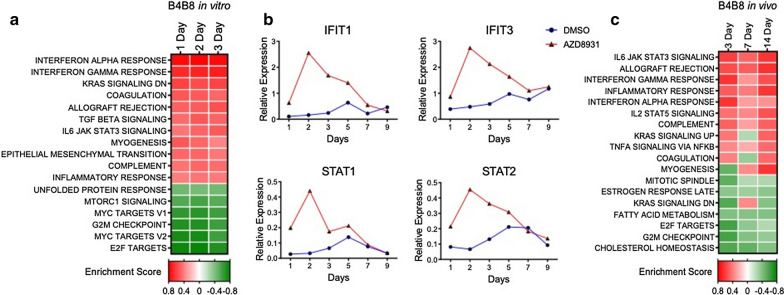
The transcriptional reprogramming response to EGFR/ERBB-specific TKIs was measured in a panel of EGFR-dependent human HNSCC cell lines and interferon (IFN) α and γ responses identified as top-ranked TKI-induced pathways. Despite similar drug sensitivity, responses among 7 cell lines varied quantitatively and qualitatively, especially regarding the induced chemokine and cytokine profiles. Of note, the anti-tumorigenic chemokine, CXCL10, and the pro-tumorigenic factor, IL6, exhibited wide-ranging and non-overlapping induction. Similarly, AZD8931 exerted potent growth inhibition, IFNα/IFNγ pathway activation, and CXCL10 induction in murine B4B8 HNSCC cells. AZD8931 treatment of immune-competent mice bearing orthotopic B4B8 tumors increased CD8 + T cell content and the therapeutic response was abrogated in nu/nu mice relative to BALB/c mice. Finally, Vectra 3.0 analysis of HNSCC patient tumors prior to and after 3-4 weeks of single agent cetuximab treatment revealed increased CD8 + T cell content in specimens from patients exhibiting a therapeutic response relative to non-responders.
The findings reveal heterogeneous, tumor cell-intrinsic, EGFR/ERBB inhibitor-induced IFN pathway activation in HNSCC and suggest that individual tumor responses to oncogene-targeted agents are a sum of direct growth inhibitory effects and variably-induced participation of host immune cells.
表皮生长因子受体(EGFR)在头颈部鳞状细胞癌(HNSCC)中经常发生扩增或过表达,并且是治疗性抗体西妥昔单抗在该癌症治疗中经过临床验证的靶点。通过肿瘤缩小来衡量的对EGFR抑制剂的反应程度在HNSCC患者中差异很大,而HNSCC患者中治疗异质性的生物学机制仍不明确。
用EGFR/ERBB抑制剂吉非替尼和AZD8931处理依赖EGFR的人和小鼠HNSCC细胞系,并进行RNA测序、基因集富集分析(GSEA)和定量逆转录聚合酶链反应(qRT-PCR)。通过酶联免疫吸附测定(ELISA)和Luminex分析对条件培养基进行分析。通过免疫荧光对小鼠HNSCC肿瘤进行T细胞标志物染色。用西妥昔单抗单药治疗的原发性HSNCC患者标本用Vectra多光谱免疫荧光染色。
在一组依赖EGFR的人HNSCC细胞系中测量了对EGFR/ERBB特异性酪氨酸激酶抑制剂(TKIs)的转录重编程反应,并将干扰素(IFN)α和γ反应确定为排名靠前的TKI诱导途径。尽管药物敏感性相似,但7种细胞系之间的反应在数量和质量上存在差异,尤其是在诱导的趋化因子和细胞因子谱方面。值得注意的是,抗肿瘤趋化因子CXCL10和促肿瘤因子IL6表现出广泛且不重叠的诱导。同样,AZD8931在小鼠B4B8 HNSCC细胞中发挥了强大的生长抑制、IFNα/IFNγ途径激活和CXCL10诱导作用。用AZD8931治疗携带原位B4B8肿瘤的免疫活性小鼠增加了CD8 + T细胞含量,并且相对于BALB/c小鼠,裸鼠中的治疗反应被消除。最后,对单药西妥昔单抗治疗3 - 4周前后的HNSCC患者肿瘤进行Vectra 3.0分析,发现相对于无反应者,有治疗反应的患者标本中CD8 + T细胞含量增加。
这些发现揭示了HNSCC中异质性的、肿瘤细胞内在的、EGFR/ERBB抑制剂诱导的IFN途径激活,并表明个体肿瘤对癌基因靶向药物的反应是直接生长抑制作用和宿主免疫细胞可变诱导参与的总和。