Department of Medical Oncology, Leiden University Medical Center, Leiden, The Netherlands.
Department of Otolaryngology, University of Pittsburgh, and the University of Pittsburgh Cancer Institute, Pittsburgh, PA, United States of America.
PLoS One. 2018 Sep 7;13(9):e0203402. doi: 10.1371/journal.pone.0203402. eCollection 2018.
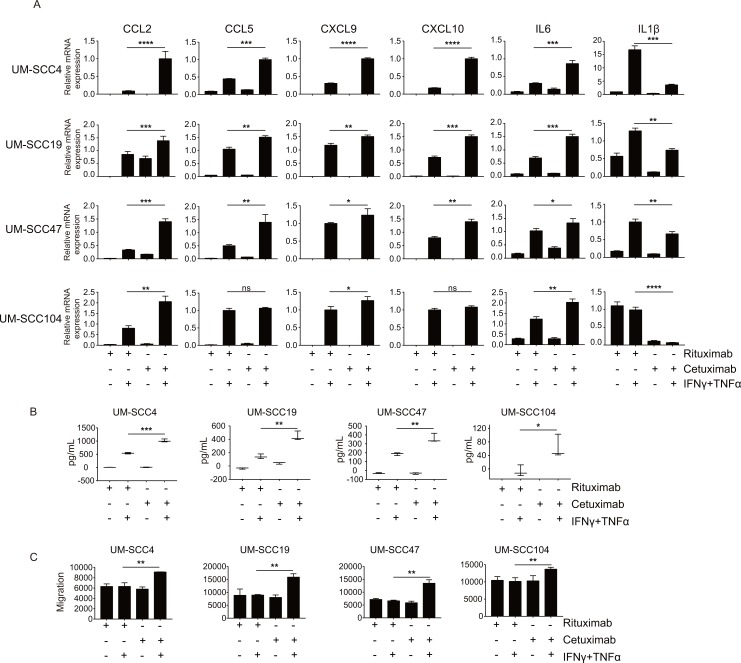
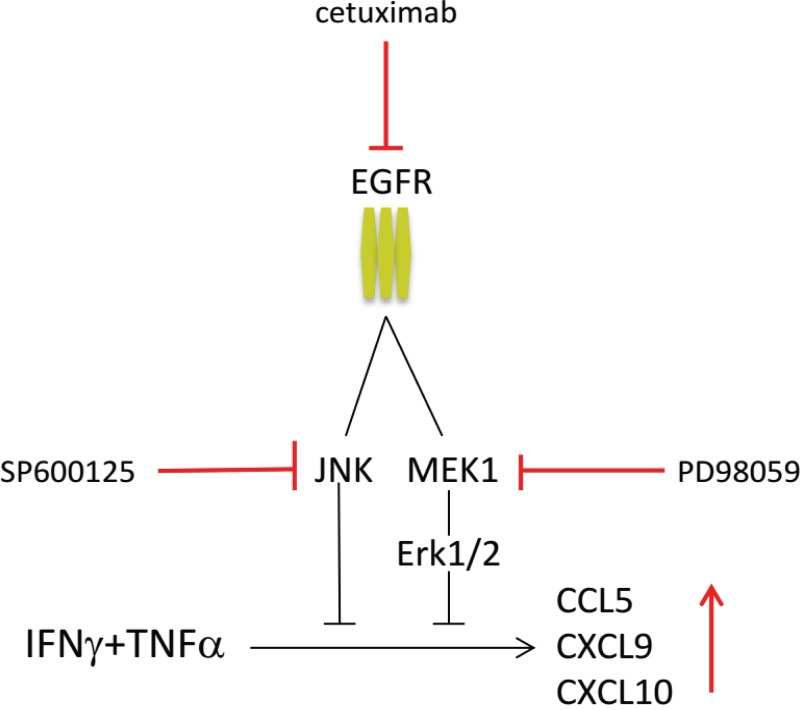
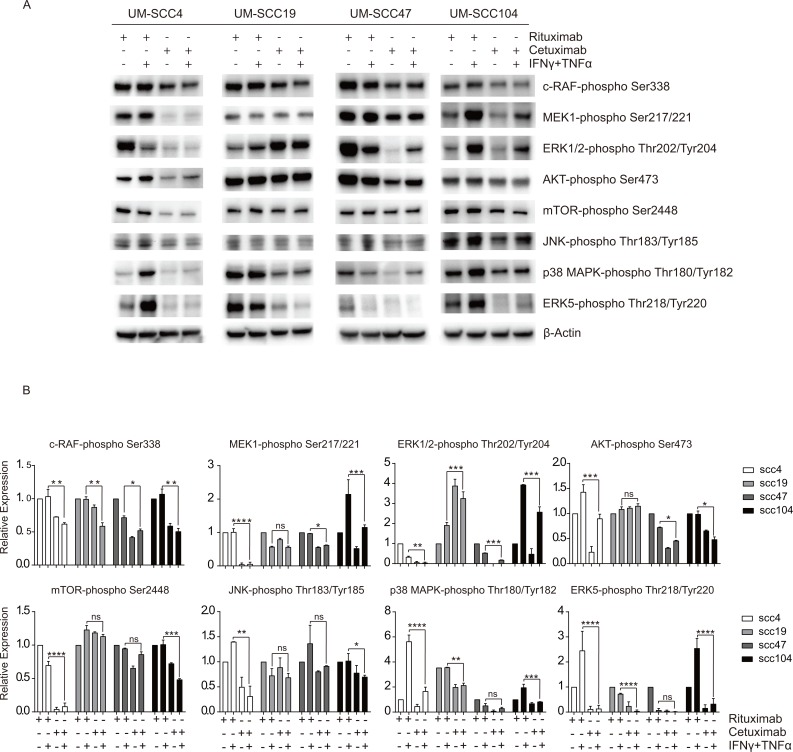
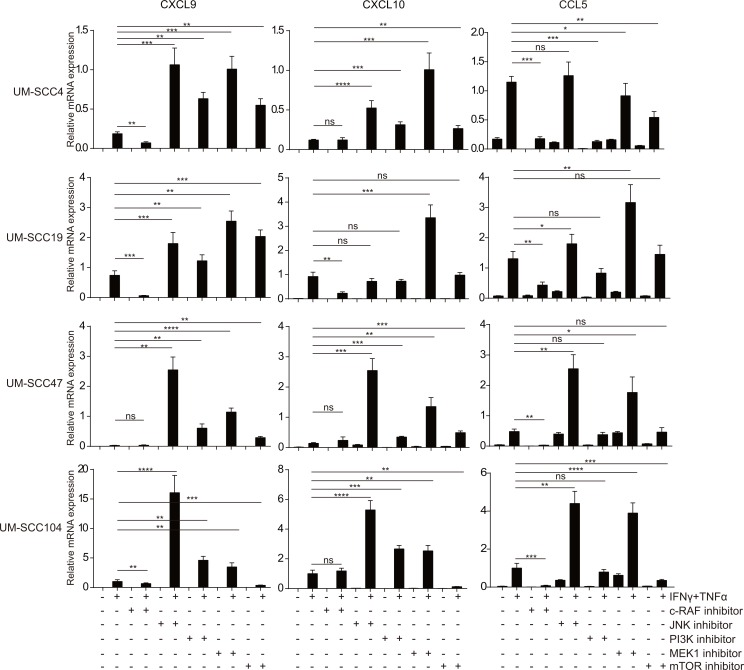
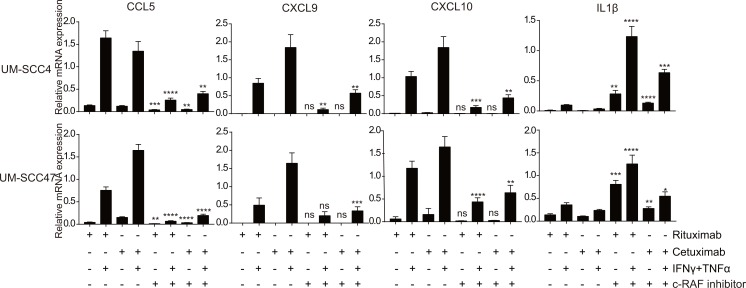
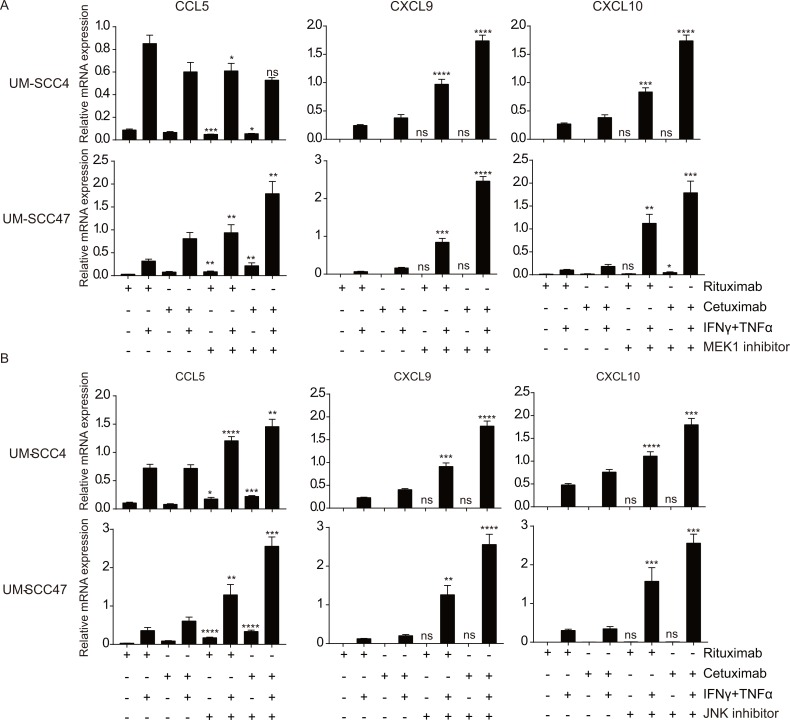
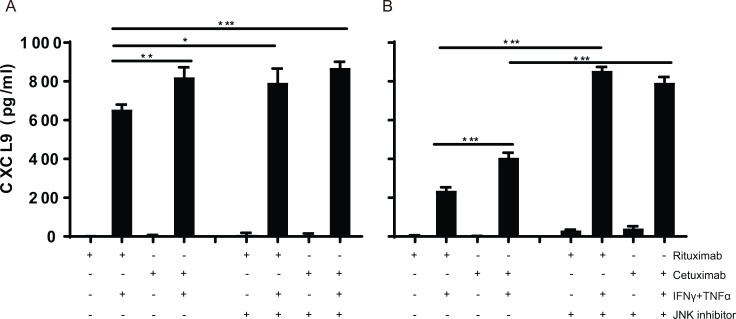
Resistance to antitumor immunity can be promoted by the oncogenic pathways operational in human cancers, including the epidermal growth factor receptor (EGFR) pathway. Here we studied if and how EGFR downstream signaling in head and neck squamous cell carcinoma (HNSCC) can affect the attraction of immune cells. HPV-negative and HPV-positive HNSCC cell lines were analyzed in vitro for CCL2, CCL5, CXCL9, CXCL10, IL-6 and IL-1β expression and the attraction of T cells under different conditions, including cetuximab treatment and stimulation with IFNγ and TNFα using qPCR, ELISA and migration experiments. Biochemical analyses with chemical inhibitors and siRNA transfection were used to pinpoint the underlying mechanisms. Stimulation of HNSCC cells with IFNγ and TNFα triggered the production of T-cell attracting chemokines and required c-RAF activation. Blocking of the EGFR with cetuximab during this stimulation increased chemokine production in vitro, and augmented the attraction of T cells. Mechanistically, cetuximab decreased the phosphorylation of MEK1, ERK1/2, AKT, mTOR, JNK, p38 and ERK5. Chemical inhibition of EGFR signaling showed a consistent and pronounced chemokine production with MEK1/2 inhibitor PD98059 and JNK inhibitor SP600125, but not with inhibitors of p38, PI3K or mTOR. Combination treatment with cetuximab and a MEK1/2 or JNK inhibitor induced the highest chemokine expression. In conclusion, overexpression of EGFR results in the activation of multiple downstream signaling pathways that act simultaneously to suppress type 1 cytokine stimulated production of chemokines required to amplify the attraction of T cells.
肿瘤免疫抵抗可被人类癌症中致癌途径促进,包括表皮生长因子受体(EGFR)途径。在这里,我们研究了头颈部鳞状细胞癌(HNSCC)中 EGFR 下游信号是否以及如何影响免疫细胞的吸引。我们分析了 HPV 阴性和 HPV 阳性的 HNSCC 细胞系,研究了在不同条件下(包括西妥昔单抗治疗和用 IFNγ和 TNFα刺激)CCL2、CCL5、CXCL9、CXCL10、IL-6 和 IL-1β的表达和 T 细胞的吸引,使用 qPCR、ELISA 和迁移实验。用化学抑制剂和 siRNA 转染进行生化分析以确定潜在机制。用 IFNγ和 TNFα刺激 HNSCC 细胞会触发趋化因子吸引 T 细胞的产生,并且需要 c-RAF 激活。在这种刺激过程中用西妥昔单抗阻断 EGFR 会增加体外趋化因子的产生,并增强 T 细胞的吸引。从机制上讲,西妥昔单抗会降低 MEK1、ERK1/2、AKT、mTOR、JNK、p38 和 ERK5 的磷酸化。用 EGFR 信号化学抑制剂显示出一致且明显的趋化因子产生,与 MEK1/2 抑制剂 PD98059 和 JNK 抑制剂 SP600125 一致,但与 p38、PI3K 或 mTOR 抑制剂不一致。西妥昔单抗与 MEK1/2 或 JNK 抑制剂联合治疗会诱导最高的趋化因子表达。总之,EGFR 的过表达导致多种下游信号通路的激活,这些信号通路同时作用以抑制 1 型细胞因子刺激的趋化因子产生,从而增强 T 细胞的吸引。