Alamri Abdulaziz, Shahin Suliman, Bakhurji Eman A, Alsulaiman Ahmed A, Salloot Zainah, Nazir Muhammad
Department of Preventive Dental Sciences, College of Dentistry, Imam Abdulrahman Bin Faisal University, Dammam 31441, Saudi Arabia P. O. Box 1982.
Int J Dent. 2020 Dec 10;2020:8833804. doi: 10.1155/2020/8833804. eCollection 2020.
To assess the prevalence of temporomandibular disorder (TMD) and its association with text anxiety among undergraduate medical, dental, and pharmacy students in Dammam, Saudi Arabia. . This cross-sectional study included health professions students who responded to Fonseca's questionnaire and Test Anxiety Inventory by Spielberger to evaluate TMD and test anxiety, respectively. TMD score was compared in different categories of students, and bivariate and multiple logistic regression analyses evaluated the influence of test anxiety on TMD.
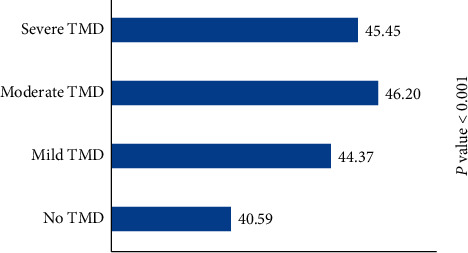
The study included 884 participants (44.8% males and 55.2% females) with a mean age of 21.46 ± 1.36 years. Regarding items of Fonseca's questionnaire, most students reported being tense/nervous (65.7%) and had headaches (57.5%). About 45.8% of the participants reported no TMD, and remaining had mild (40.4%), moderate (11.3%), and severe (2.5%) TMD. The mean TMD score was significantly higher in students with high test anxiety (25.6 ± 18.32) than those with low test anxiety (20.25 ± 16.97) ( < 0.001). Mean test anxiety scores significantly differed among TMD categories ( < 0.001) with the lowest score in the no TMD group and the highest in the moderate TMD group. Female gender (adjusted odds ratio 1.4, P 0.039) and high test anxiety (adjusted odds ratio 1.92, < 0.001) were significantly associated with increased odds of having TMD.
The study revealed a high prevalence of TMD among students. There was a significant association between test anxiety and TMD. The data obtained may guide preventive policies and program on test anxiety and TMD.
评估沙特阿拉伯达曼地区本科医学、牙科和药学专业学生颞下颌关节紊乱病(TMD)的患病率及其与考试焦虑的关联。 这项横断面研究纳入了健康专业学生,他们分别对丰塞卡问卷和斯皮尔伯格的考试焦虑量表做出回应,以评估TMD和考试焦虑。比较了不同类别学生的TMD得分,并通过双变量和多元逻辑回归分析评估考试焦虑对TMD的影响。
该研究纳入了884名参与者(男性占44.8%,女性占55.2%),平均年龄为21.46±1.36岁。关于丰塞卡问卷的项目,大多数学生报告有紧张/焦虑情绪(65.7%)和头痛(57.5%)。约45.8%的参与者报告无TMD,其余有轻度(40.4%)、中度(11.3%)和重度(2.5%)TMD。考试焦虑高的学生的平均TMD得分(25.6±18.32)显著高于考试焦虑低的学生(20.25±16.97)(<0.001)。TMD不同类别之间的平均考试焦虑得分有显著差异(<0.001),无TMD组得分最低,中度TMD组得分最高。女性(调整后的优势比为1.4,P=0.039)和高考试焦虑(调整后的优势比为1.92,<0.001)与患TMD的几率增加显著相关。
该研究显示学生中TMD的患病率较高。考试焦虑与TMD之间存在显著关联。所获得的数据可为考试焦虑和TMD的预防政策及项目提供指导。