Mpakou Vassiliki, Spathis Aris, Bouhla Anthi, Mpazani Efthimia, Papageorgiou Sotirios, Gkontopoulos Konstantinos, Glezou Eirini, Thomopoulos Thomas, Foukas Periklis, Pappa Vasiliki
Second Department of Internal Medicine and Research Institute, National and Kapodistrian University of Athens, Attikon University General Hospital, Athens 12462, Greece.
Second Department of Pathology, National and Kapodistrian University of Athens, Attikon University General Hospital, Athens 12462, Greece.
Exp Ther Med. 2021 Mar;21(3):195. doi: 10.3892/etm.2021.9628. Epub 2021 Jan 8.
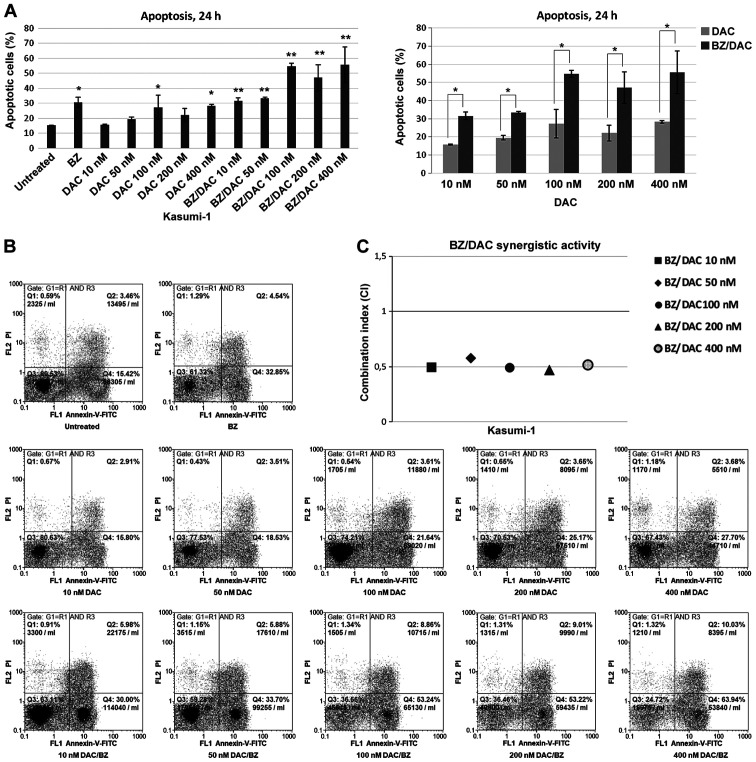
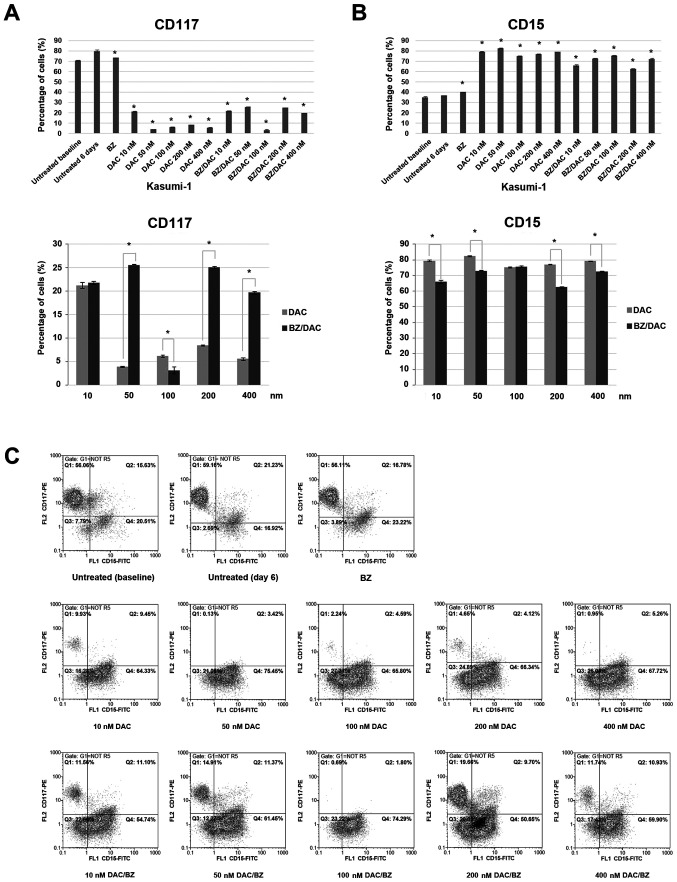
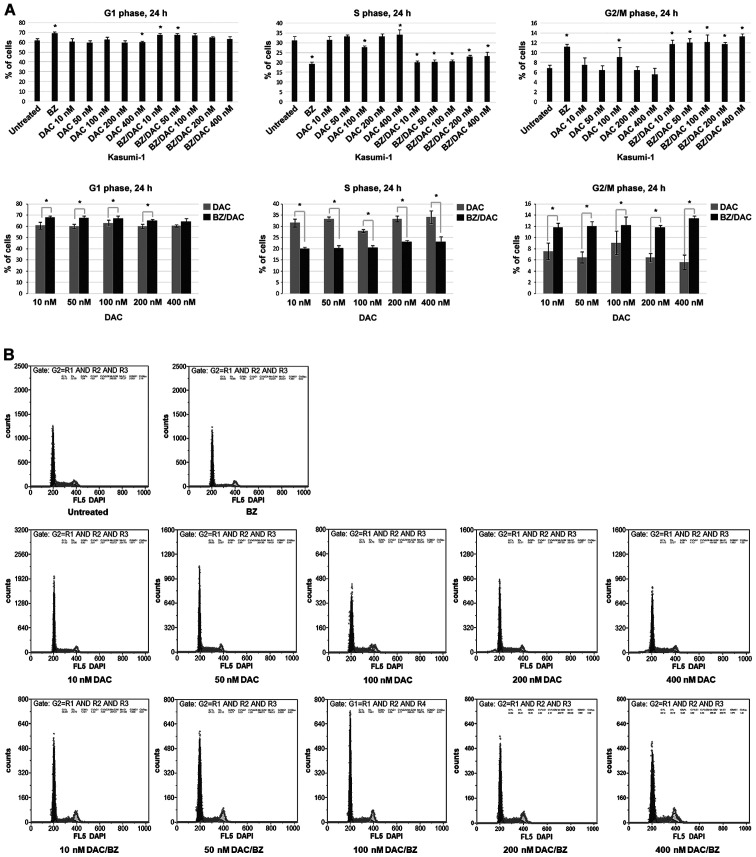
In the present study, the ability of the proteasome inhibitor bortezomib (BZ), an oxidative stress-inducing agent, to sensitize acute myeloid leukemia (AML) cells to decitabine (Dacogen, DAC; a DNA methyltransferase inhibitor), in terms of cell viability and differentiation, was investigated. Kasumi-1 AML (M2) cells were treated with low-dose DAC (10, 50, 100, 200 or 400 nΜ), with or without BZ (10 nM). Apoptosis and the cell cycle were evaluated after 24 h of treatment through fluorescence-assisted cell sorting (FACS) with Annexin V/propidium iodide and DAPI staining, respectively. The expression levels of CD193, CD11b, CD13, CD14, CD15, CD16 and CD117 surface differentiation markers were evaluated by FACS after 6 days of treatment. The results indicated significant alterations in cell death and cell cycle phases in Kasumi-1 cells following DAC and BZ combination treatment compared to untreated cells and cells with single treatments. Low-dose DAC/BZ combinations significantly enhanced apoptosis and decreased the population of live Kasumi-1 cells, with 100 and 200 nM of DAC and 10 nM BZ appearing to have the most potent synergistic effect according to a combination index. Furthermore, cell cycle profiling revealed that DAC/BZ treatment synergistically led to G0/G1- and G2/M-phase arrest. By contrast, DAC appeared to promote monocytic and granulocytic differentiation of Kasumi-1 cells more effectively alone than in combination with BZ. BZ acted synergistically with low-dose DAC , leading to enhanced apoptosis and G0/G1- and G2/M-phase arrest in AML cells, hence prohibiting either DNA synthesis or mitosis. Although further investigation is necessary, these results provide a strong rationale for the implementation of a combination treatment with DAC and bortezomib in AML therapy, followed by DAC alone, which may achieve better clinical responses and possibly partially overcome the frequently encountered DAC resistance of patients with AML.
在本研究中,就细胞活力和分化而言,研究了蛋白酶体抑制剂硼替佐米(BZ,一种氧化应激诱导剂)使急性髓系白血病(AML)细胞对阿扎胞苷(达珂,DAC;一种DNA甲基转移酶抑制剂)敏感的能力。用低剂量DAC(10、50、100、200或400 nM)处理Kasumi-1 AML(M2)细胞,同时或不同时添加BZ(10 nM)。处理24小时后,分别通过Annexin V/碘化丙啶和DAPI染色的荧光辅助细胞分选(FACS)评估细胞凋亡和细胞周期。处理6天后,通过FACS评估CD193、CD11b、CD13、CD14、CD15、CD16和CD117表面分化标志物的表达水平。结果表明,与未处理的细胞和单药处理的细胞相比,DAC和BZ联合处理后Kasumi-1细胞的细胞死亡和细胞周期阶段有显著变化。低剂量DAC/BZ联合用药显著增强了细胞凋亡并减少了存活的Kasumi-1细胞数量,根据联合指数,100和200 nM的DAC与10 nM BZ似乎具有最有效的协同作用。此外,细胞周期分析显示,DAC/BZ处理协同导致G0/G1期和G2/M期阻滞。相比之下,DAC单独作用似乎比与BZ联合作用更有效地促进Kasumi-1细胞的单核细胞和粒细胞分化。BZ与低剂量DAC协同作用,导致AML细胞凋亡增强以及G0/G1期和G2/M期阻滞,从而抑制DNA合成或有丝分裂。尽管有必要进一步研究,但这些结果为在AML治疗中实施DAC和硼替佐米联合治疗,随后单独使用DAC提供了有力的理论依据,这可能会取得更好的临床反应,并可能部分克服AML患者中经常遇到的DAC耐药性。