González Rocío, Barea Luisa, Arruga Ana, Richart Alberto, Soriano Vicente
Regional Transfusion Center, Madrid, Spain.
UNIR Health Sciences School & Medical Center, Calle Almansa 101, Madrid 28040, Spain.
Ther Adv Infect Dis. 2020 Dec 24;7:2049936120982122. doi: 10.1177/2049936120982122. eCollection 2020 Jan-Dec.
The risk of transfusion-transmitted viral infections is very low in developed countries. Recent massive migration flows from highly hepatitis B virus (HBV), hepatitis C virus (HCV) and/or HIV endemic regions to Europe may have changed this scenario.
During 2017 and 2018, a total of 491,753 blood donations (291,762 donors) were evaluated at the Madrid Regional Transfusion Center. All were tested for hepatitis B surface antigen (HBsAg), anti-HCV and anti-HIV, as well as for HBV-DNA, HCV-RNA and HIV-RNA.
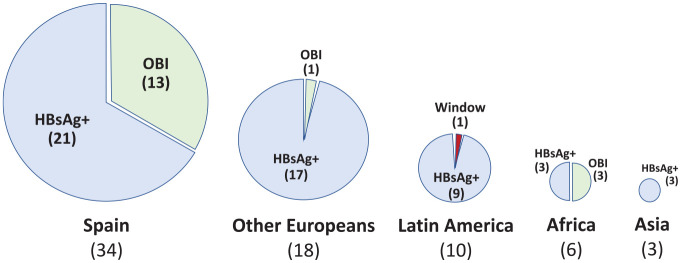
Overall, 35 donors were positive for HIV-RNA and 26 for HCV-RNA. HBV markers were found in 111 (0.022%) donors, split out into three categories: HBsAg+ ( = 93; 0.019%), occult B infection (OBI) ( = 17; 0.003%), and acute HBV window period ( = 1; 0.0002%). All 17 OBI donors were positive for anti-HBc and confirmed as viremic in repeated testing. Viral load amounts were uniformly below 100 IU/mL. Ten OBI donors were repeated donors and look-back studies could be completed for eight of them. Fortunately, none of all prior recipients experienced transfusion transmitted hepatitis B. Compared with HBsAg+ donors, OBI donors were more frequently native Spaniards (76% 40%) and older (median age 52 42 years old).
Active HBV infection is currently found in 0.022% of blood donations (0.038% of donors) in Madrid. This rate is 3-fold greater than for HIV and/or HCV. On the other hand, HBsAg+ donors are 3-fold more frequent than OBI donors and more often immigrants than native Spaniards. No transfusion-transmitted HBV infections were identified during the study period, including retrospective checking of former recipients of OBI donors.
在发达国家,输血传播病毒感染的风险非常低。近期,大量来自乙型肝炎病毒(HBV)、丙型肝炎病毒(HCV)和/或HIV高流行地区的移民涌入欧洲,可能改变了这种情况。
2017年至2018年期间,马德里地区输血中心共评估了491,753份献血(291,762名献血者)。所有样本均检测了乙型肝炎表面抗原(HBsAg)、抗-HCV和抗-HIV,以及HBV-DNA、HCV-RNA和HIV-RNA。
总体而言,3,5名献血者的HIV-RNA呈阳性,26名献血者的HCV-RNA呈阳性。在111名(0.022%)献血者中发现了HBV标志物,分为三类:HBsAg阳性(=93;0.019%)、隐匿性乙型肝炎感染(OBI)(=17;0.003%)和急性HBV窗口期(=1;0.0002%)。所有17名OBI献血者的抗-HBc均呈阳性,且在重复检测中被确认为病毒血症。病毒载量均低于100 IU/mL。10名OBI献血者为重复献血者,其中8名可完成追溯研究。幸运的是,所有先前的受血者均未发生输血传播的乙型肝炎。与HBsAg阳性献血者相比,OBI献血者中西班牙本地人更为常见(76%对40%),且年龄更大(中位年龄52岁对42岁)。
目前在马德里,0.022%的献血(0.038%的献血者)中发现了活动性HBV感染。这一比例比HIV和/或HCV高3倍。另一方面,HBsAg阳性献血者的频率是OBI献血者的3倍,且移民比西班牙本地人更常见。在研究期间未发现输血传播的HBV感染,包括对OBI献血者先前受血者的回顾性检查。