Sasaki Eri, Tomita Yuiri, Kanno Kouta
Laboratory of Neuroscience, Course of Psychology, Department of Humanities, Faculty of Law, Economics and Humanities, Kagoshima University, Kagoshima City, Kagoshima, Japan.
R Soc Open Sci. 2020 Dec 23;7(12):201529. doi: 10.1098/rsos.201529. eCollection 2020 Dec.
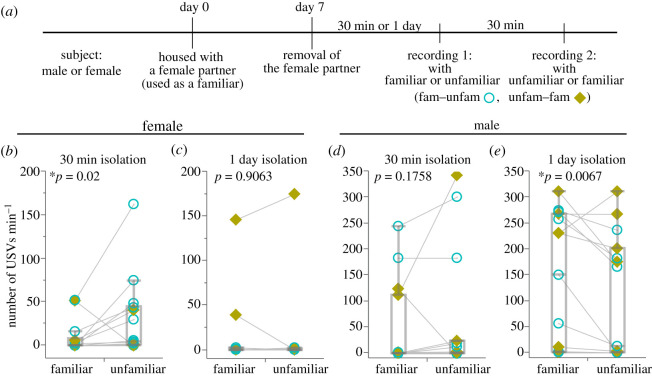
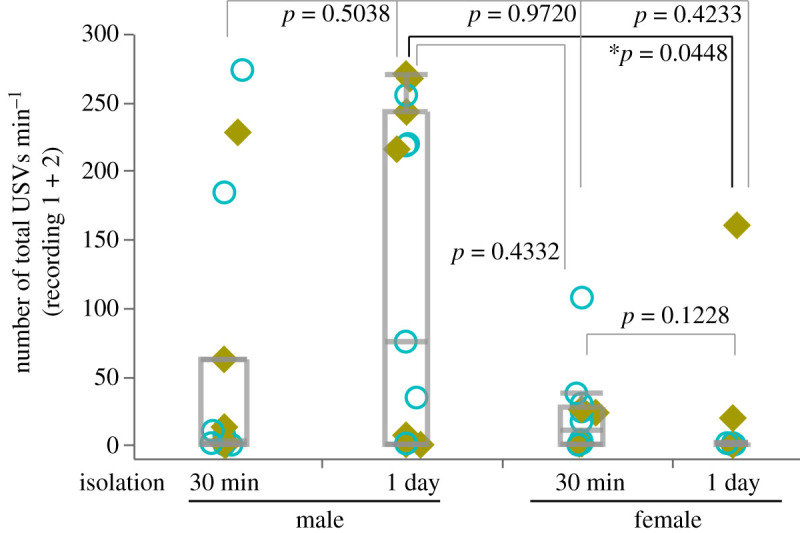
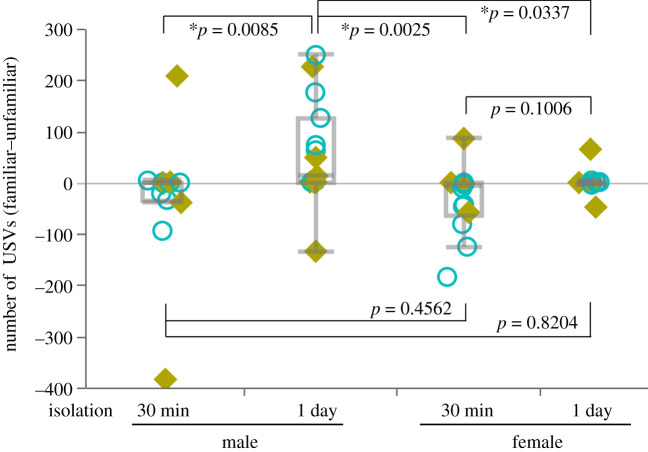
Mice, both wild and laboratory strains, emit ultrasound to communicate. The sex differences between male to female (male-female) and female to female (female-female) ultrasonic vocalizations (USVs) have been discussed for decades. In the present study, we compared the number of USVs emitted to familiar and unfamiliar females by both males (male-female USVs) and females (female-female USVs). We found that females vocalized more to unfamiliar than to familiar females. By contrast, males exhibited more USVs to familiar partners. This sexually dimorphic behaviour suggests that mice change their vocal behaviour in response to the social context, and their perception of the context is based on social cognition and memory. In addition, because males vocalized more to familiar females, USVs appear to be not only a response to novel objects or individuals, but also a social response.
野生和实验室品系的小鼠都会发出超声波来进行交流。雄性与雌性(雄-雌)以及雌性与雌性(雌-雌)之间超声发声(USV)的性别差异已经被讨论了数十年。在本研究中,我们比较了雄性(雄-雌USV)和雌性(雌-雌USV)对熟悉和不熟悉雌性发出的USV数量。我们发现,雌性对不熟悉的雌性比熟悉的雌性发声更多。相比之下,雄性对熟悉的伴侣发出更多的USV。这种性别二态性行为表明,小鼠会根据社会环境改变其发声行为,并且它们对环境的感知是基于社会认知和记忆。此外,由于雄性对熟悉的雌性发声更多,USV似乎不仅是对新物体或个体的反应,也是一种社会反应。