Banakou Domna, Beacco Alejandro, Neyret Solène, Blasco-Oliver Marta, Seinfeld Sofia, Slater Mel
Event Lab, Department of Clinical Psychology and Psychobiology, University of Barcelona, Passeig de la Vall d'Hebron 171, 08035 Barcelona, Spain.
Institute of Neurosciences of the University of Barcelona, Passeig de la Vall d'Hebron 171, 08035 Barcelona, Spain.
R Soc Open Sci. 2020 Dec 9;7(12):201848. doi: 10.1098/rsos.201848. eCollection 2020 Dec.
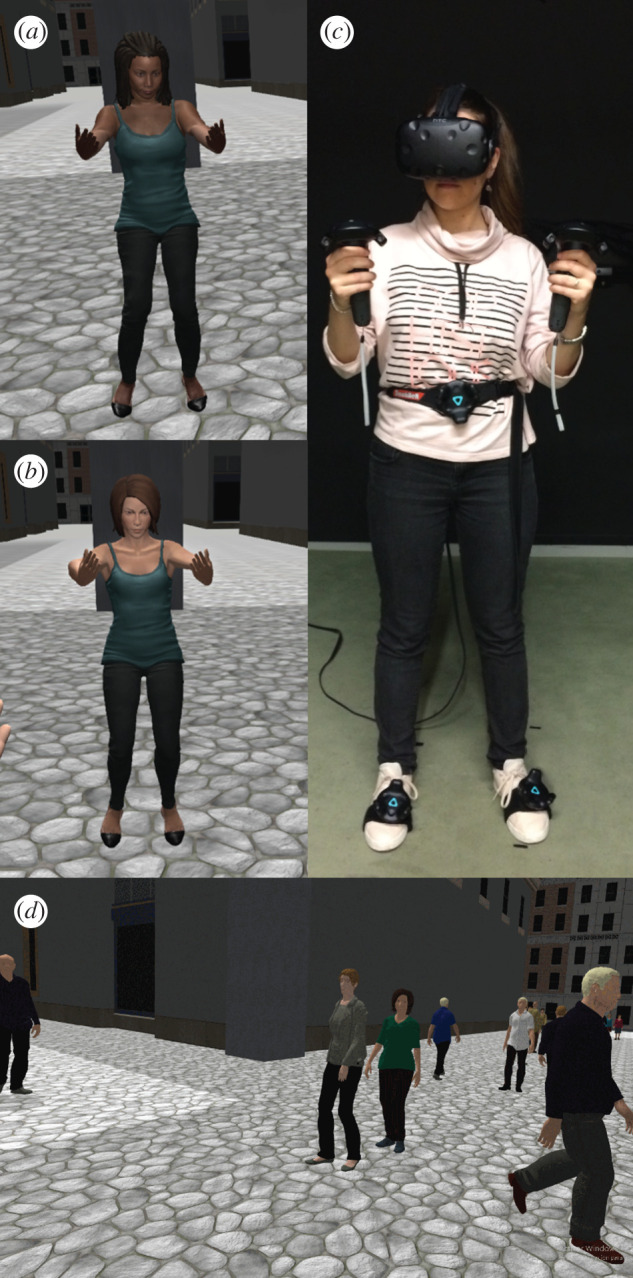
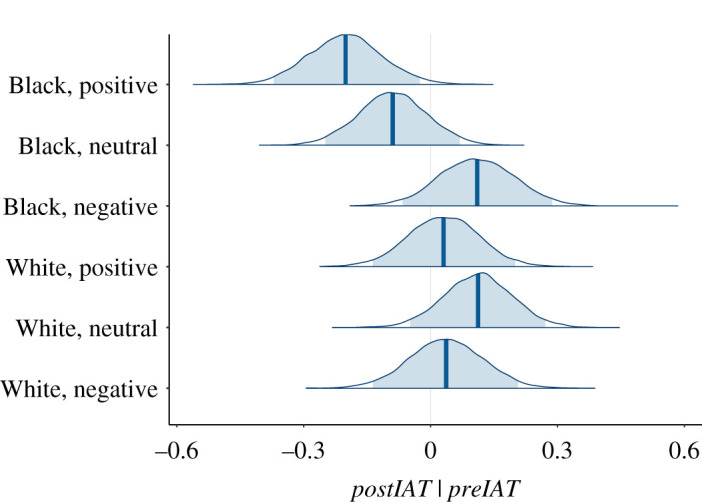
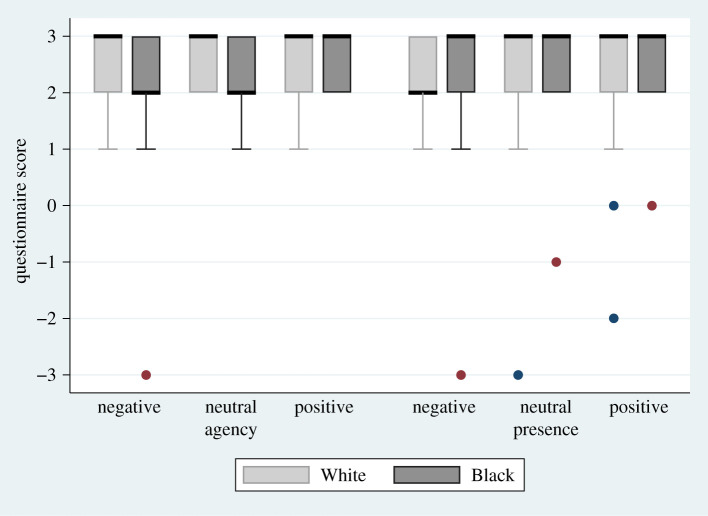
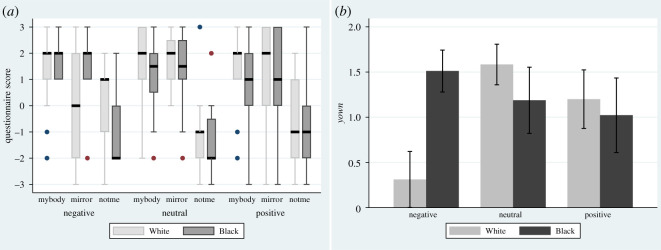
When people hold implicit biases against a group they typically engage in discriminatory behaviour against group members. In the context of the implicit racial bias of 'White' against 'Black' people, it has been shown several times that implicit bias is reduced after a short exposure of embodiment in a dark-skinned body in virtual reality. Embodiment usually leads to the illusion of ownership over the virtual body, irrespective of its skin colour. Previous studies have been carried out in virtual scenarios that are affectively neutral or positive. Here, we show that when the scenario is affectively negative the illusion of body ownership of White participants over a White body is lessened, and implicit bias is higher for White participants in a Black virtual body. The study was carried out with 92 White female participants, in a between-groups design with two factors: BodyType (their virtual body was White or Black) and a surrounding Crowd was Negative, Neutral or Positive towards the participant. We argue that negative affect prevents the formation of new positive associations with Black and distress leads to disownership of the virtual body. Although virtual reality is often thought of as an 'empathy machine' our results suggest caution, that this may not be universally the case.
当人们对某个群体持有隐性偏见时,他们通常会对该群体的成员表现出歧视行为。在“白人”对“黑人”的隐性种族偏见背景下,多次研究表明,在虚拟现实中短暂体验深色皮肤身体后,隐性偏见会有所减少。无论虚拟身体的肤色如何,身体体验通常会导致对虚拟身体的所有权错觉。此前的研究是在情感中性或积极的虚拟场景中进行的。在此,我们表明,当场景情感消极时,白人参与者对白人身体的身体所有权错觉会减弱,而在黑人虚拟身体中,白人参与者的隐性偏见会更高。该研究以92名白人女性参与者为对象,采用组间设计,有两个因素:身体类型(她们的虚拟身体是白人或黑人)以及周围人群对参与者的态度是消极、中性还是积极。我们认为,消极情绪会阻碍与黑人形成新的积极关联,而痛苦会导致对虚拟身体的所有权丧失。尽管虚拟现实常常被视为一台“共情机器”,但我们的研究结果表明,需要谨慎看待,情况可能并非总是如此。