Sharma M B, Argota Perez R, Holm A I S, Korreman S S, Jensen K, Elstrøm U V, Grau C
Department of Oncology, Aarhus University Hospital, Aarhus, Denmark.
Danish Center for Particle Therapy, Aarhus University Hospital, Aarhus, Denmark.
Clin Transl Radiat Oncol. 2021 Jan 1;27:36-43. doi: 10.1016/j.ctro.2020.12.007. eCollection 2021 Mar.
The aim was to characterise patterns and predictability of aeration changes in the ipsilateral maxillary sinus during intensity-modulated radiotherapy (IMRT) for sinonasal cancer (SNC), and in a sample evaluate the dosimetric effects of aeration changes for both photon and proton therapy.
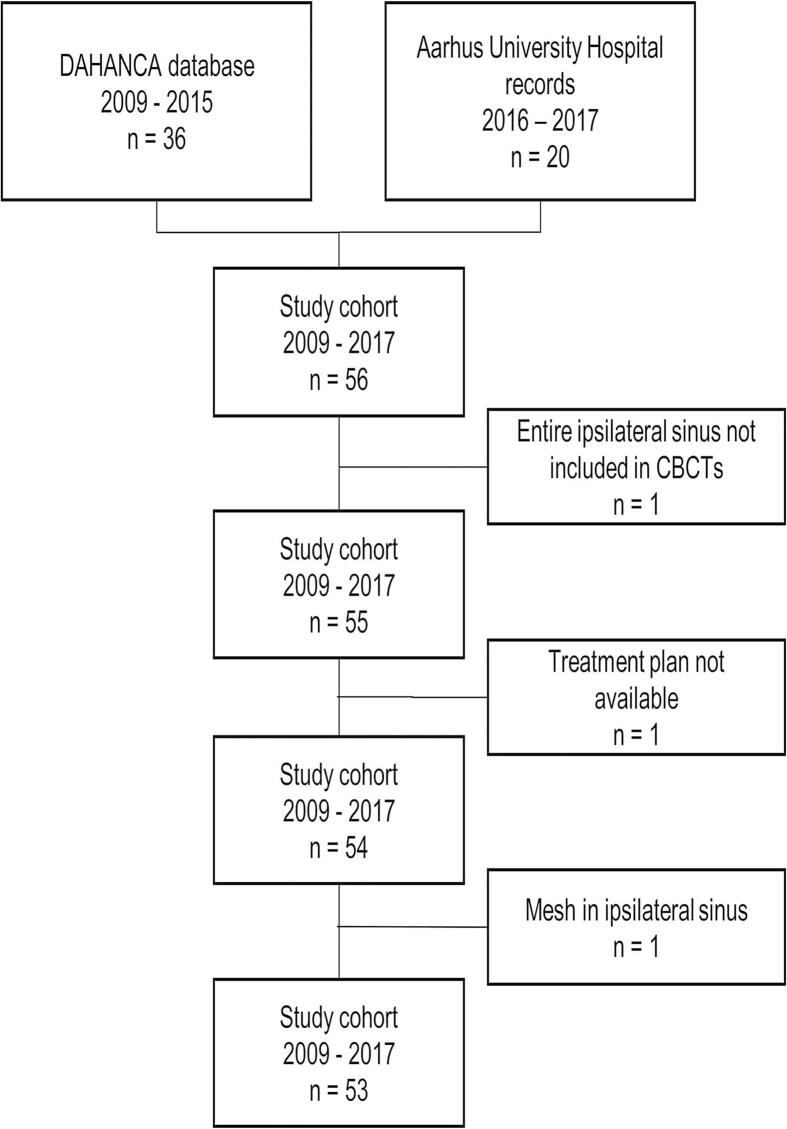
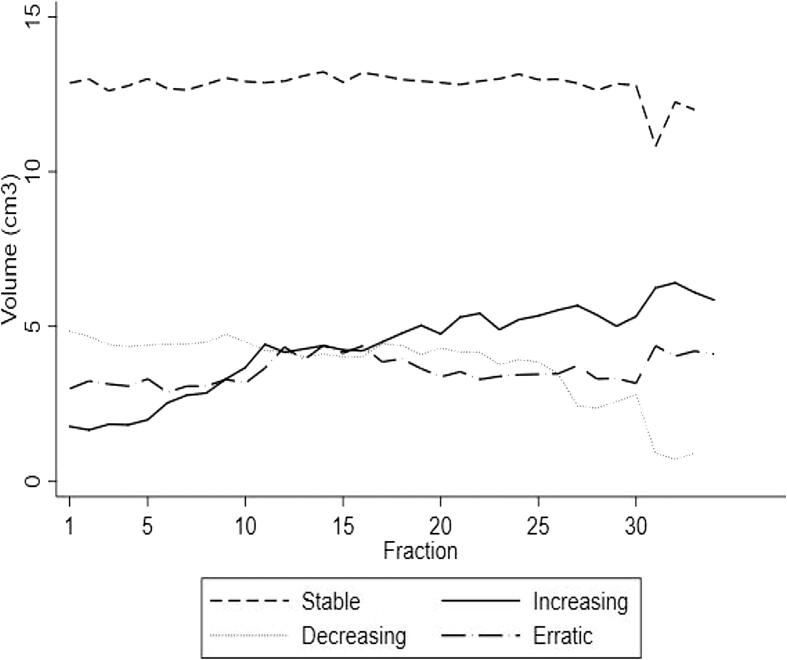
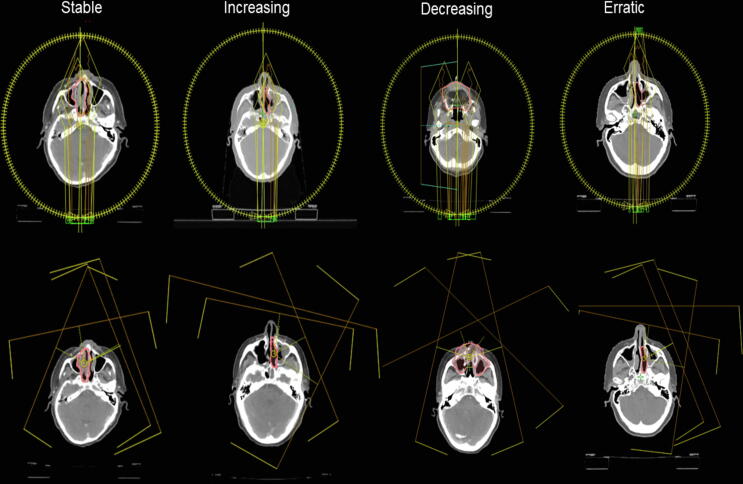
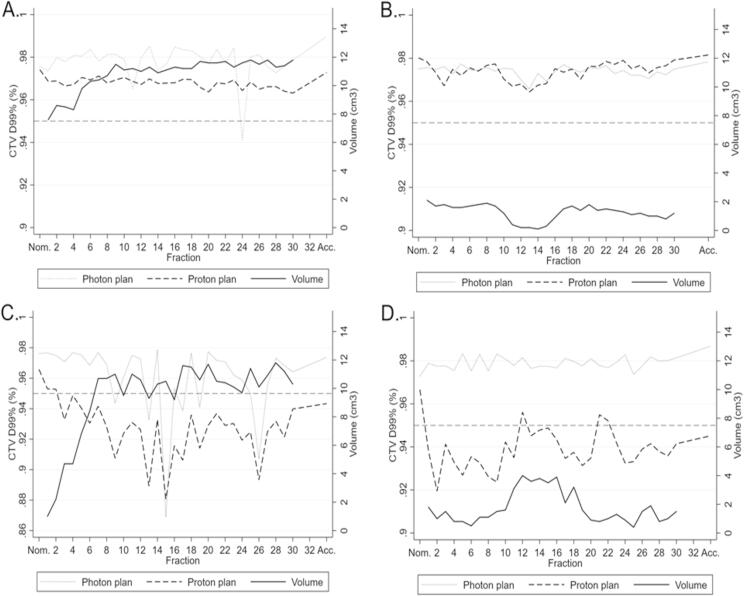
The study included patients treated with IMRT for SNC in a single institution in 2009-2017. The volume of air in the ipsilateral maxillary sinus was recorded in 1578 daily cone beam computer tomography (CBCT) from 53 patients. Patterns of changing air volumes were categorised as '', ', '', or ''. For the prediction analysis, categorisation was performed based both on the entire treatment course and the first five fractions (F1-5). Photon and proton therapy plans were generated for four patients, the one from each category with the largest aeration variation. Synthetic CT images were generated for each CBCT and all plans were recalculated on the daily synthetic CTs.
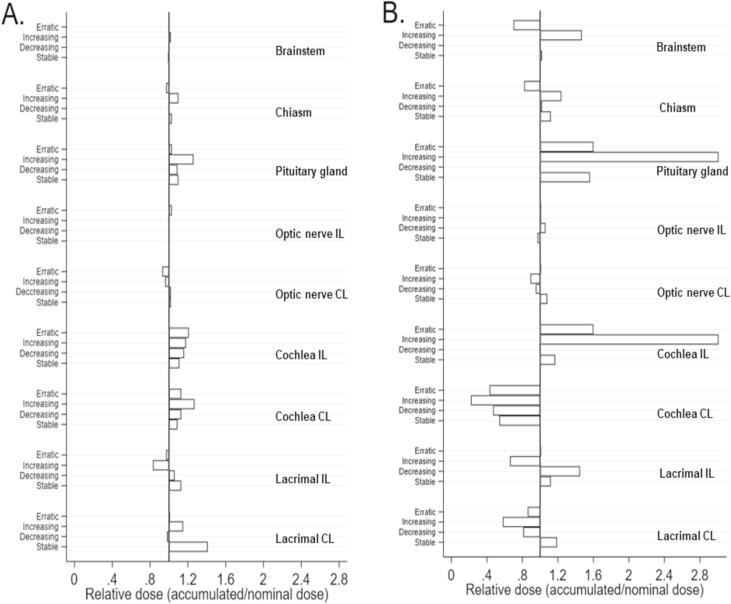
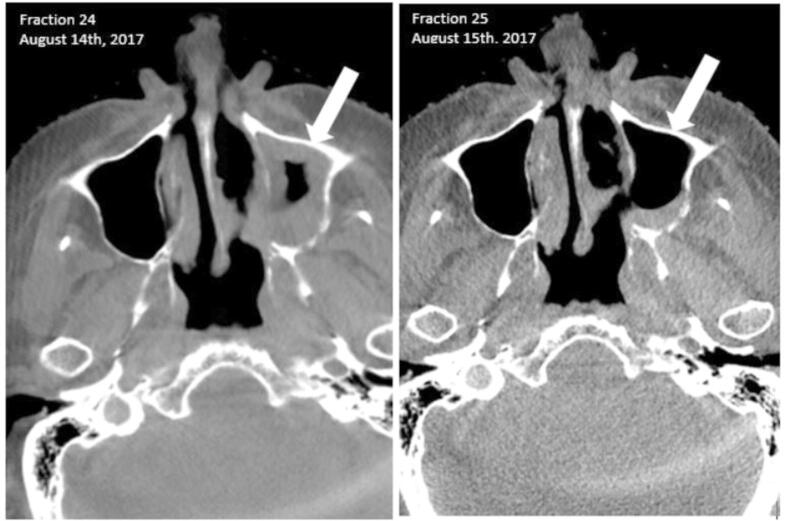
The absolute volume of air varied considerably during the treatment course, ranging from 0 to 25.9 cm. Changes within a single participant varied in the range of 0-18.7 cm. In the categorisation of patterns, most patients had aeration of the sinus. Generally, patterns of aeration could not be predicted from F1-5. Patients categorised as in F1-5 had the best prediction, with 78% predicted correctly as increasing for the entire treatment course. The numeric correlation coefficients for target coverage and air volume were low for 3/4 scenarios (photons 0.03-0.23, protons 0.26-0.48). No straightforward correlation between the dosimetric effect and the volume changes could be detected in the sample test of four patients for neither photon nor proton therapy.
The variation of aeration was large and unpredictable. No clear dosimetric consequences of the aeration variation were evident for neither IMRT nor proton therapy for the patients investigated.
目的是描述鼻窦癌(SNC)调强放射治疗(IMRT)期间同侧上颌窦通气变化的模式和可预测性,并在一个样本中评估通气变化对光子和质子治疗的剂量学影响。
该研究纳入了2009年至2017年在单一机构接受IMRT治疗的SNC患者。记录了53例患者1578次每日锥形束计算机断层扫描(CBCT)中同侧上颌窦的空气体积。空气体积变化模式分为“增加”“减少”或“稳定”。对于预测分析,分类基于整个治疗过程和前五个分次(F1 - 5)。为四名患者生成了光子和质子治疗计划,每个类别中选择通气变化最大的一名患者。为每个CBCT生成合成CT图像,并在每日合成CT上重新计算所有计划。
在治疗过程中,空气的绝对体积变化很大,范围为0至25.9立方厘米。单个参与者内部的变化范围为0至18.7立方厘米。在模式分类中,大多数患者鼻窦通气“增加”。一般来说,从F1 - 5无法预测通气模式。在F1 - 5中分类为“增加”的患者预测效果最佳,整个治疗过程中78%被正确预测为增加。在3/4的情况下(光子治疗为0.03 - 0.23,质子治疗为0.26 - 0.48),靶区覆盖与空气体积的数值相关系数较低。在四名患者的样本测试中,无论是光子治疗还是质子治疗,均未检测到剂量学效应与体积变化之间的直接相关性。
通气变化很大且不可预测。对于所研究的患者,无论是IMRT还是质子治疗,通气变化均未产生明显的剂量学后果。