Robin Tyler P, Jones Bernard L, Gordon Oren M, Phan Andy, Abbott Diana, McDermott Jessica D, Goddard Julie A, Raben David, Lanning Ryan M, Karam Sana D
Department of Radiation Oncology, University of Colorado Cancer Center, Aurora, Colorado.
Department of Biostatistics and Informatics, Colorado Biostatistics Consortium, Colorado School of Public Health, Aurora, Colorado.
Cancer. 2017 Aug 15;123(16):3040-3049. doi: 10.1002/cncr.30686. Epub 2017 Apr 3.
Sinonasal malignancies are a rare and heterogeneous group of tumors for which there is a paucity of robust data with which to guide management decisions. The authors used the National Cancer Data Base to better understand the presenting characteristics of these tumors and to compare outcomes by treatment modality.
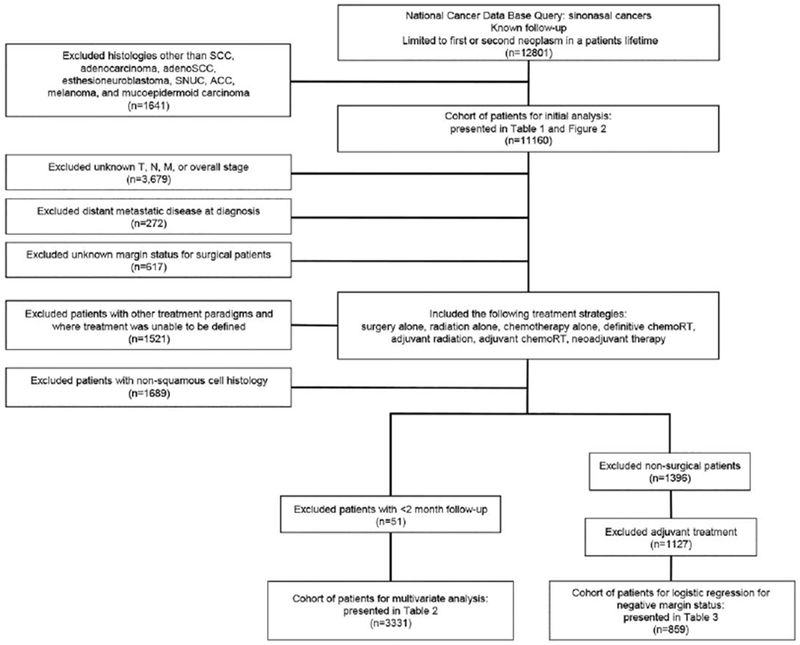
The National Cancer Data Base was queried for sinonasal malignancies diagnosed between 2004 and 2012. Overall survival was assessed using multivariate analyses and propensity score matching.
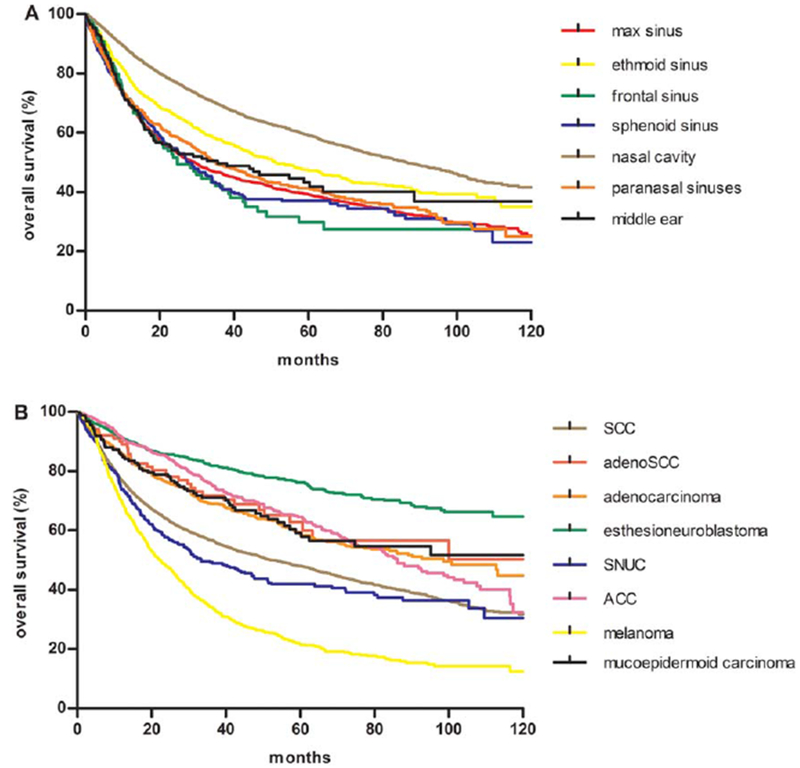
A total of 11,160 patients were identified for the initial analysis. The majority were male, aged 40 to 69 years, with tumors of the nasal cavity or maxillary sinus. Squamous cell histology was most common. The majority of patients presented with advanced tumor stage but without locoregional lymph node or distant metastases. Treatment modalities were compared for squamous cell carcinomas. In multivariate analysis, compared with surgery alone, patients who received adjuvant radiotherapy (hazard ratio [HR], 0.658 [P<.001]), adjuvant chemoradiotherapy (HR, 0.696 [P = .002]), or neoadjuvant therapy (HR, 0.656 [P = .007]) had improved overall survival. Patients who received radiotherapy alone (HR, 1.294 [P = .001]) or chemotherapy alone (HR, 1.834 [P<.001]) had worse outcomes. These findings were validated in propensity score matching. It is important to note that neoadjuvant chemoradiotherapy was associated with achieving a negative surgical margin (odds ratio, 2.641 [P = .045]).
Surgery is the mainstay of therapy for patients with sinonasal malignancies, but multimodality therapy is associated with improved overall survival. Cancer 2017;123:3040-49. © 2017 American Cancer Society.
鼻窦恶性肿瘤是一组罕见且异质性的肿瘤,目前缺乏有力的数据来指导治疗决策。作者利用国家癌症数据库,以更好地了解这些肿瘤的呈现特征,并比较不同治疗方式的疗效。
查询国家癌症数据库中2004年至2012年诊断的鼻窦恶性肿瘤。使用多变量分析和倾向评分匹配评估总生存期。
共识别出11160例患者进行初始分析。大多数为男性,年龄在40至69岁之间,肿瘤位于鼻腔或上颌窦。鳞状细胞组织学最为常见。大多数患者就诊时肿瘤分期较晚,但无局部区域淋巴结转移或远处转移。对鳞状细胞癌的治疗方式进行了比较。在多变量分析中,与单纯手术相比,接受辅助放疗(风险比[HR],0.658[P<0.001])、辅助放化疗(HR,0.696[P = 0.002])或新辅助治疗(HR,0.656[P = 0.007])的患者总生存期得到改善。单纯接受放疗(HR,1.294[P = 0.001])或单纯化疗(HR,1.834[P<0.001])的患者预后较差。这些发现通过倾向评分匹配得到验证。需要注意的是,新辅助放化疗与实现阴性手术切缘相关(优势比,2.641[P = 0.045])。
手术是鼻窦恶性肿瘤患者的主要治疗方法,但多模式治疗与改善总生存期相关。《癌症》2017年;123:3040 - 49。©2017美国癌症协会。