Nagoor Meeran M F, Seenipandi A, Javed Hayate, Sharma Charu, Hashiesh Hebaallah Mamdouh, Goyal Sameer N, Jha Niraj Kumar, Ojha Shreesh
Department of Pharmacology and Therapeutics, College of Medicine and Health Sciences, PO Box - 17666, United Arab Emirates University, Al Ain, United Arab Emirates.
Department of Anatomy, College of Medicine and Health Sciences, PO Box - 17666, United Arab Emirates University, Al Ain, United Arab Emirates.
Heliyon. 2020 Dec 11;7(1):e05703. doi: 10.1016/j.heliyon.2020.e05703. eCollection 2021 Jan.
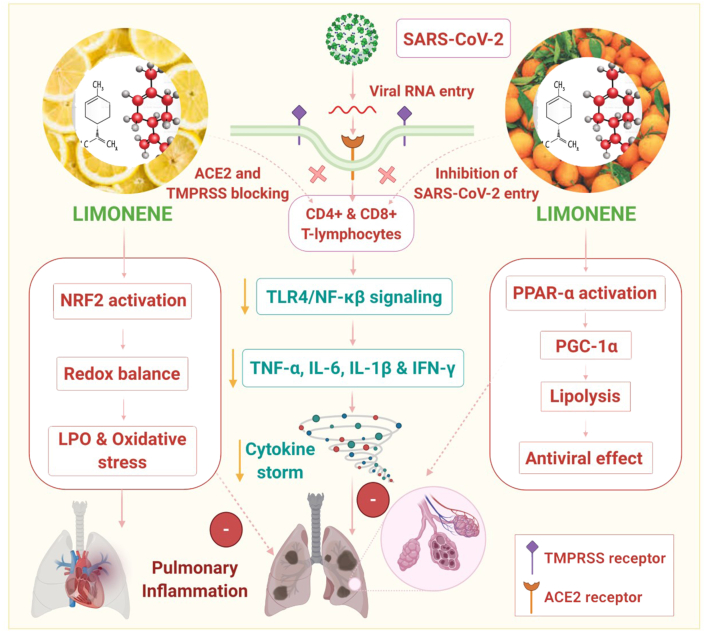
Coronavirus disease (COVID-19) caused by novel severe acute respiratory syndrome coronavirus 2 (SARS-CoV-2) is an ongoing pandemic and presents a public health emergency. It has affected millions of people and continues to affect more, despite the tremendous social preventive measures. The therapeutic strategy relies on suppressing infectivity and inflammation, along with immune modulation. The identification of candidate drugs effective for COVID-19 is crucial, thus many natural products including phytochemicals are also being proposed for repurposing and evaluated for their potential in COVID-19. Among numerous phytochemicals, limonene (LMN), a dietary terpene of natural origin has been recently showed to target viral proteins in the studies. LMN is one of the main compounds identified in many citrus plants, available and accessible in diets and well-studied for its therapeutic benefits. Due to dietary nature, relative safety and efficacy along with favorable physicochemical properties, LMN has been suggested to be a fascinating candidate for further investigation in COVID-19. LMN showed to modulate numerous signaling pathways and inhibits inflammatory mediators, including cytokines, chemokines, adhesion molecules, prostanoids, and eicosanoids. We hypothesized that given the pathogenesis of COVID-19 involving infection, inflammation, and immunity, LMN may have potential to limit the severity and progression of the disease owing to its immunomodulatory, anti-inflammatory, and antiviral properties. The present article discusses the possibilities of LMN in SARS-CoV-2 infections based on its immunomodulatory, anti-inflammatory, and antiviral properties. Though, the suggestion on the possible use of LMN in COVID-19 remains inconclusive until the effects confirmed in the experimental studies and further proof of the concept studies. The candidature of LMN in COVID-19 treatment somewhat appear speculative but cannot be overlooked provided favorable physiochemical and druggable properties. The safety and efficacy of LMN are necessary to be established in preclinical and clinical studies before making suggestions for use in humans.
由新型严重急性呼吸综合征冠状病毒2(SARS-CoV-2)引起的冠状病毒病(COVID-19)是一场持续的大流行疾病,并构成了公共卫生紧急事件。尽管采取了大量社会预防措施,但它已影响了数百万人,并继续影响着更多人。治疗策略依赖于抑制感染性和炎症,以及免疫调节。确定对COVID-19有效的候选药物至关重要,因此许多天然产物(包括植物化学物质)也被提议重新利用,并评估它们在COVID-19中的潜力。在众多植物化学物质中,柠檬烯(LMN),一种天然来源的膳食萜烯,最近在研究中显示可作用于病毒蛋白。LMN是许多柑橘类植物中鉴定出的主要化合物之一,在饮食中可得且易获取,并且对其治疗益处已有充分研究。由于其膳食性质、相对安全性和有效性以及良好的物理化学性质,LMN被认为是在COVID-19中进行进一步研究的一个有吸引力的候选物。LMN显示可调节众多信号通路并抑制炎症介质,包括细胞因子、趋化因子、黏附分子、前列腺素和类二十烷酸。我们假设,鉴于COVID-19的发病机制涉及感染、炎症和免疫,LMN可能因其免疫调节、抗炎和抗病毒特性而有潜力限制疾病的严重程度和进展。本文基于其免疫调节、抗炎和抗病毒特性讨论了LMN在SARS-CoV-2感染中的可能性。不过,在实验研究中证实其效果并进行进一步的概念验证研究之前,关于LMN在COVID-19中可能用途的建议仍无定论。LMN在COVID-19治疗中的候选资格在某种程度上似乎具有推测性,但鉴于其良好的物理化学和可成药特性,不能被忽视。在建议用于人类之前,必须在临床前和临床研究中确定LMN的安全性和有效性。