Department of Neurology, Albert Einstein College of Medicine and Montefiore Medical Center, Bronx, NY, USA.
Department of Statistics, University of Connecticut, CT, USA.
J Alzheimers Dis. 2021;80(1):185-195. doi: 10.3233/JAD-200946.
The ultimate validation of a clinical marker for Alzheimer's disease (AD) is its association with AD neuropathology.
To examine how well the Stages of Objective Memory Impairment (SOMI) system predicts intermediate/high AD neuropathologic change and extent of neurofibrillary tangle (NFT) pathology defined by Braak stage, in comparison to the Clinical Dementia Rating (CDR) Scale sum of boxes (CDR-SB).
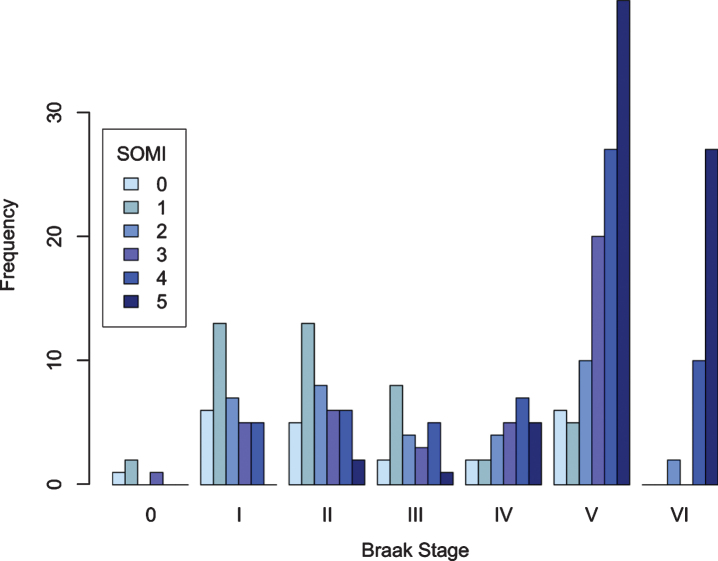
251 well-characterized participants from the Knight ADRC clinicopathologic series were classified into SOMI stage at their last assessment prior to death using the free recall and total recall scores from the picture version of the Free and Cued Selective Reminding Test with Immediate Recall (pFCSRT + IR). Logistic regression models assessed the predictive validity of SOMI and CDR-SB for intermediate/high AD neuropathologic change. Receiver operating characteristics (ROC) analysis evaluated the discriminative validity of SOMI and CDR-SB for AD pathology. Ordinal logistic regression was used to predict Braak stage using SOMI and CDR-SB in separate and joint models.
The diagnostic accuracy of SOMI for AD diagnosis was similar to that of the CDR-SB (AUC: 85%versus 83%). In separate models, both SOMI and CDR-SB predicted Braak stage. In a joint model SOMI remained a significant predictor of Braak stage but CDR-SB did not.
SOMI provides a neuropathologically validated staging system for episodic memory impairment in the AD continuum and should be useful in predicting tau positivity based on its association with Braak stage.
阿尔茨海默病(AD)临床标志物的最终验证是其与 AD 神经病理学的关联。
通过比较临床痴呆评定量表(CDR)总分(CDR-SB),检查 Stages of Objective Memory Impairment(SOMI)系统在预测 AD 神经病理学变化程度和神经纤维缠结(NFT)病理程度方面的表现,其程度由 Braak 阶段定义。
根据死亡前的最后一次评估,使用图片版自由和线索选择性记忆测试的即时回忆(pFCSRT+IR)的自由回忆和总回忆分数,将来自 Knight ADRC 临床病理系列的 251 名特征明确的参与者分为 SOMI 阶段。使用逻辑回归模型评估 SOMI 和 CDR-SB 对 AD 神经病理学变化的预测效力。接受者操作特征(ROC)分析评估 SOMI 和 CDR-SB 对 AD 病理学的判别有效性。使用 SOMI 和 CDR-SB 在单独和联合模型中对 Braak 阶段进行有序逻辑回归预测。
SOMI 对 AD 诊断的准确性与 CDR-SB 相似(AUC:85%与 83%)。在单独的模型中,SOMI 和 CDR-SB 均预测了 Braak 阶段。在联合模型中,SOMI 仍然是 Braak 阶段的重要预测因素,但 CDR-SB 则不然。
SOMI 为 AD 连续体中的情景记忆障碍提供了一种神经病理学验证的分期系统,并且应该能够根据与 Braak 阶段的关联来预测 tau 阳性。