Biomedical Informatics Training Program, Stanford University, Stanford, California, USA.
Department of Bioengineering and Therapeutic Sciences, University of California, San Francisco, San Francisco, California, USA.
Clin Pharmacol Ther. 2021 May;109(5):1197-1202. doi: 10.1002/cpt.2172. Epub 2021 Feb 28.
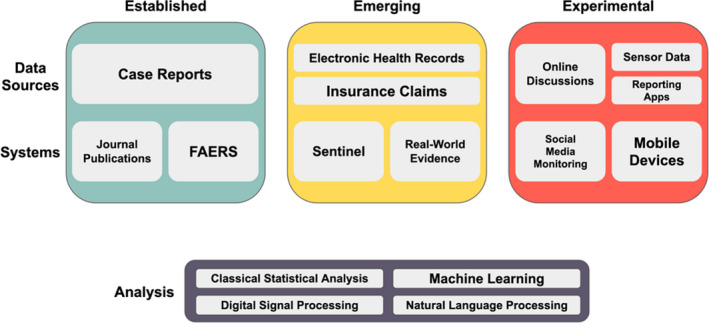
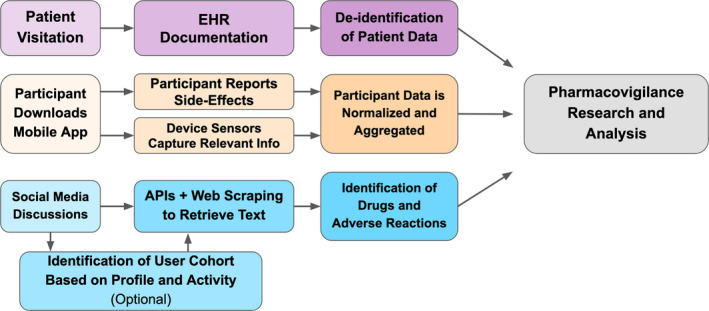
Adverse drug reactions (ADRs) are a major concern for patients, clinicians, and regulatory agencies. The discovery of serious ADRs leading to substantial morbidity and mortality has resulted in mandatory phase IV clinical trials, black box warnings, and withdrawal of drugs from the market. Real-world data, data collected during routine clinical care, is being adopted by innovators, regulators, payors, and providers to inform decision making throughout the product life cycle. We outline several different approaches to modern pharmacovigilance, including spontaneous reporting databases, electronic health record monitoring and research frameworks, social media surveillance, and the use of digital devices. Some of these platforms are well-established while others are still emerging or experimental. We highlight both the potential opportunity, as well as the existing challenges within these pharmacovigilance systems that have already begun to impact the drug development process, as well as the landscape of postmarket drug safety monitoring. Further research and investment into different and complementary pharmacovigilance systems is needed to ensure the continued safety of pharmacotherapy.
药物不良反应(ADRs)是患者、临床医生和监管机构关注的主要问题。严重 ADR 的发现导致了大量的发病率和死亡率,从而导致了强制性的 IV 期临床试验、黑框警告和药物从市场撤出。创新者、监管机构、支付方和提供者正在采用真实世界数据,即常规临床护理期间收集的数据,为整个产品生命周期的决策提供信息。我们概述了几种不同的现代药物警戒方法,包括自发报告数据库、电子健康记录监测和研究框架、社交媒体监测以及数字设备的使用。其中一些平台已经成熟,而另一些仍在出现或处于实验阶段。我们强调了这些药物警戒系统中已经开始影响药物开发过程以及上市后药物安全监测格局的潜在机会和现有挑战。需要进一步研究和投资于不同的、互补的药物警戒系统,以确保药物治疗的持续安全性。