College of Pharmacy, Chungnam National University, Daejeon, Republic of Korea.
College of Pharmacy, Ewha Womans University, Seoul, Republic of Korea.
JMIR Public Health Surveill. 2021 Jun 28;7(6):e30137. doi: 10.2196/30137.
Social media has become a new source for obtaining real-world data on adverse drug reactions. Many studies have investigated the use of social media to detect early signals of adverse drug reactions. However, the trustworthiness of signals derived from social media is questionable. To confirm this, a confirmatory study with a positive control (eg, new black box warnings, labeling changes, or withdrawals) is required.
This study aimed to evaluate the use of social media in detecting new black box warnings, labeling changes, or withdrawals in advance.
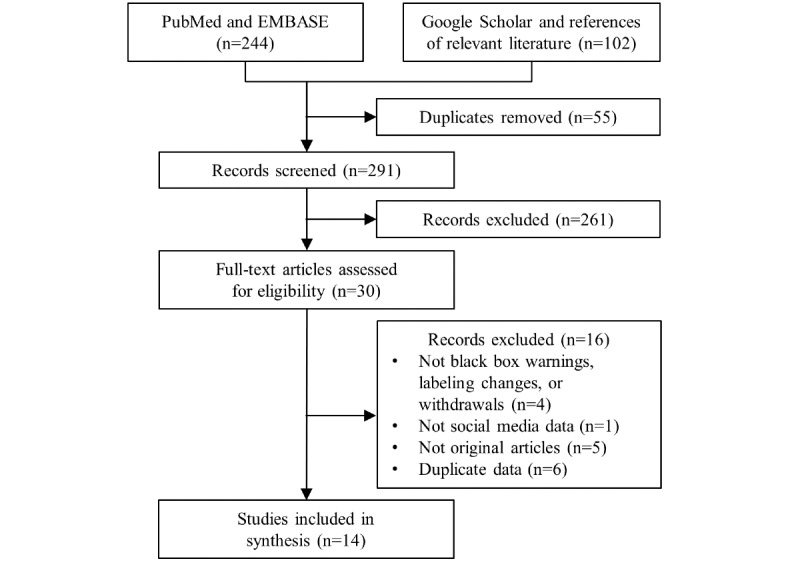
This scoping review adhered to the Preferred Reporting Items for Systematic reviews and Meta-Analyses extension for Scoping Reviews checklist. A researcher searched PubMed and EMBASE in January 2021. Original studies analyzing black box warnings, labeling changes, or withdrawals from social media were selected, and the results of the studies were summarized.
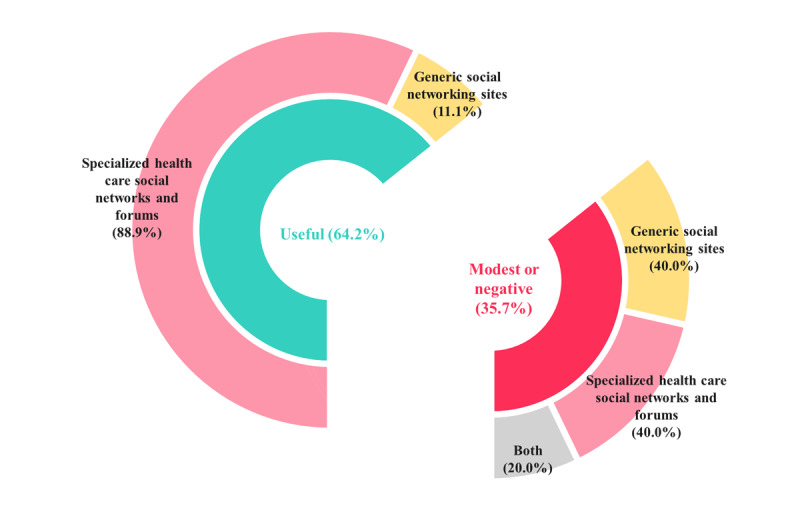
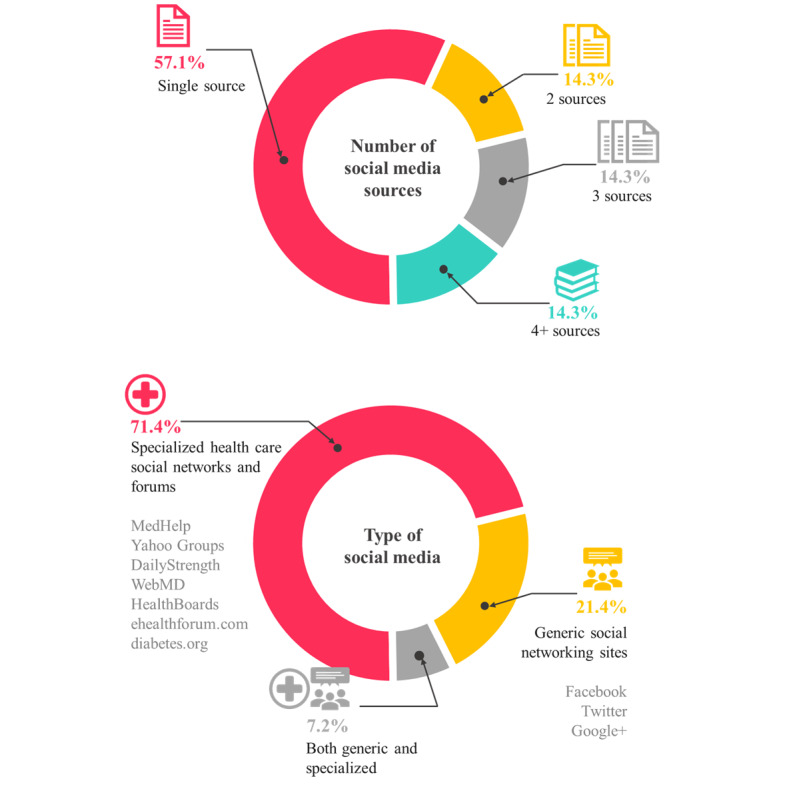
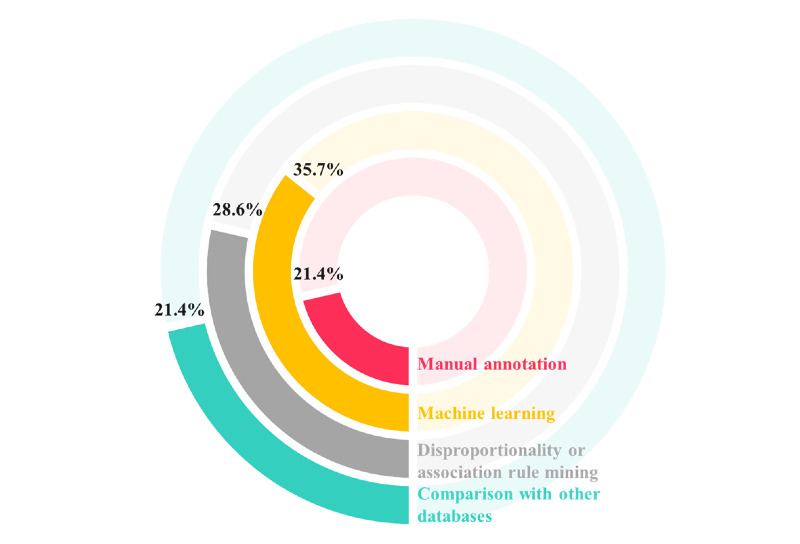
A total of 14 studies were included in this scoping review. Most studies (8/14, 57.1%%) collected data from a single source, and 10 (71.4%) used specialized health care social networks and forums. The analytical methods used in these studies varied considerably. Three studies (21.4%) manually annotated posts, while 5 (35.7%) adopted machine learning algorithms. Nine studies (64.2%) concluded that social media could detect signals 3 months to 9 years before action from regulatory authorities. Most of these studies (8/9, 88.9%) were conducted on specialized health care social networks and forums. On the contrary, 5 (35.7%) studies yielded modest or negative results. Of these, 2 (40%) used generic social networking sites, 2 (40%) used specialized health care networks and forums, and 1 (20%) used both generic social networking sites and specialized health care social networks and forums. The most recently published study recommends not using social media for pharmacovigilance. Several challenges remain in using social media for pharmacovigilance regarding coverage, data quality, and analytic processing.
Social media, along with conventional pharmacovigilance measures, can be used to detect signals associated with new black box warnings, labeling changes, or withdrawals. Several challenges remain; however, social media will be useful for signal detection of frequently mentioned drugs in specialized health care social networks and forums. Further studies are required to advance natural language processing and mine real-world data on social media.
社交媒体已成为获取药物不良反应真实世界数据的新来源。许多研究已经调查了使用社交媒体来检测药物不良反应的早期信号。然而,社交媒体衍生信号的可信度值得怀疑。为了证实这一点,需要进行一项有阳性对照(例如,新的黑框警告、标签更改或撤市)的确证性研究。
本研究旨在评估使用社交媒体提前检测新的黑框警告、标签更改或撤市。
本范围综述遵循《系统评价和荟萃分析扩展的首选报告项目》(Preferred Reporting Items for Systematic reviews and Meta-Analyses extension)的范围综述清单。一名研究人员于 2021 年 1 月在 PubMed 和 EMBASE 中进行了检索。选择了分析来自社交媒体的黑框警告、标签更改或撤市的原始研究,并对研究结果进行了总结。
本范围综述共纳入 14 项研究。大多数研究(8/14,57.1%)仅从单一来源收集数据,10 项(71.4%)使用了专门的医疗保健社交网络和论坛。这些研究中使用的分析方法差异很大。3 项研究(21.4%)对帖子进行了手动标注,而 5 项(35.7%)采用了机器学习算法。9 项研究(64.2%)得出结论,社交媒体可以在监管机构采取行动前 3 个月至 9 年内检测到信号。这些研究大多(8/9,88.9%)是在专门的医疗保健社交网络和论坛上进行的。相反,有 5 项(35.7%)研究得出了适度或负面的结果。其中,2 项(40%)使用了通用社交网站,2 项(40%)使用了专门的医疗保健网络和论坛,1 项(20%)同时使用了通用社交网站和专门的医疗保健社交网络和论坛。最近发表的一项研究建议不要将社交媒体用于药物警戒。在使用社交媒体进行药物警戒方面,仍然存在一些挑战,例如覆盖范围、数据质量和分析处理。
社交媒体与传统药物警戒措施一起,可以用于检测与新的黑框警告、标签更改或撤市相关的信号。然而,仍存在一些挑战;但是,社交媒体对于专门的医疗保健社交网络和论坛中经常提到的药物的信号检测将是有用的。需要进一步的研究来推进自然语言处理并挖掘社交媒体上的真实世界数据。