Key Laboratory of Plant Resources, Institute of Botany, Chinese Academy of Sciences, Beijing, China.
Université Paris-Saclay, CEA, CNRS, Institute for Integrative Biology of the Cell (I2BC), Gif-sur-Yvette, France.
J Biol Chem. 2021 Jan-Jun;296:100322. doi: 10.1016/j.jbc.2021.100322. Epub 2021 Jan 23.
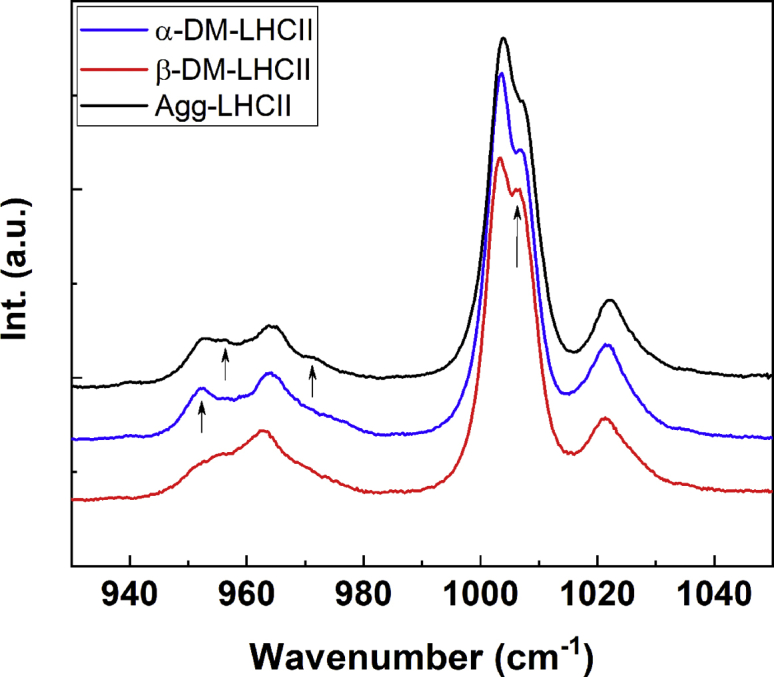
When plants are exposed to high-light conditions, the potentially harmful excess energy is dissipated as heat, a process called non-photochemical quenching. Efficient energy dissipation can also be induced in the major light-harvesting complex of photosystem II (LHCII) in vitro, by altering the structure and interactions of several bound cofactors. In both cases, the extent of quenching has been correlated with conformational changes (twisting) affecting two bound carotenoids, neoxanthin, and one of the two luteins (in site L1). This lutein is directly involved in the quenching process, whereas neoxanthin senses the overall change in state without playing a direct role in energy dissipation. Here we describe the isolation of an intermediate state of LHCII, using the detergent n-dodecyl-α-D-maltoside, which exhibits the twisting of neoxanthin (along with changes in chlorophyll-protein interactions), in the absence of the L1 change or corresponding quenching. We demonstrate that neoxanthin is actually a reporter of the LHCII environment-probably reflecting a large-scale conformational change in the protein-whereas the appearance of excitation energy quenching is concomitant with the configuration change of the L1 carotenoid only, reflecting changes on a smaller scale. This unquenched LHCII intermediate, described here for the first time, provides for a deeper understanding of the molecular mechanism of quenching.
当植物暴露在高光条件下时,潜在的有害多余能量会以热量的形式耗散,这一过程称为非光化学猝灭。通过改变几个结合辅助因子的结构和相互作用,也可以在光合作用系统 II(LHCII)的主要光捕获复合物中体外有效地诱导能量耗散。在这两种情况下,猝灭的程度都与影响两个结合类胡萝卜素(新黄质和两个叶黄素之一(L1 位))的构象变化(扭曲)相关。这种叶黄素直接参与猝灭过程,而新黄质则感知整体状态变化,而不直接参与能量耗散。在这里,我们描述了使用去污剂 n-十二烷基-α-D-麦芽糖苷分离 LHCII 的中间状态,该状态显示新黄质的扭曲(以及叶绿素-蛋白相互作用的变化),而 L1 变化或相应猝灭不存在。我们证明新黄质实际上是 LHCII 环境的报告者——可能反映了蛋白质的大规模构象变化——而激发能量猝灭的出现仅伴随着 L1 类胡萝卜素的构型变化,反映了较小规模的变化。这里首次描述的这种未猝灭的 LHCII 中间态,为猝灭的分子机制提供了更深入的理解。