NORMENT, Institute of Clinical Medicine, University of Oslo & Division of Mental Health and Addiction, Oslo University Hospital, 0450 Oslo, Norway.
Department of Medical Genetics, Oslo University Hospital, 0450 Oslo, Norway.
Cells. 2021 Jan 21;10(2):209. doi: 10.3390/cells10020209.
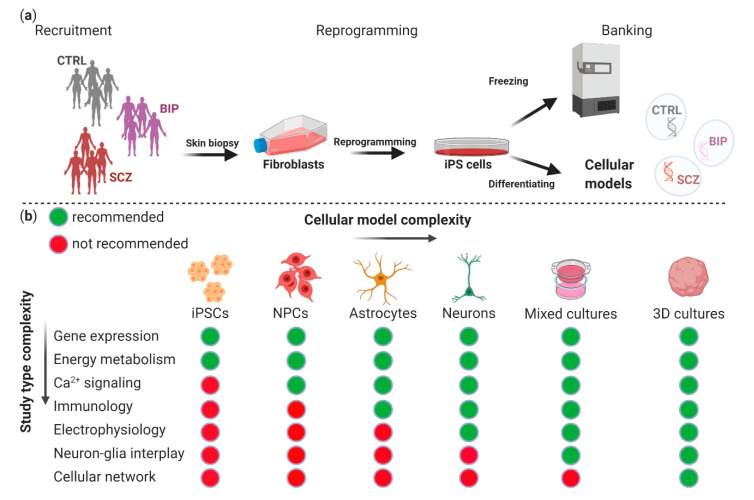
Schizophrenia (SCZ) and bipolar disorder (BIP) are severe mental disorders with a considerable disease burden worldwide due to early age of onset, chronicity, and lack of efficient treatments or prevention strategies. Whilst our current knowledge is that SCZ and BIP are highly heritable and share common pathophysiological mechanisms associated with cellular signaling, neurotransmission, energy metabolism, and neuroinflammation, the development of novel therapies has been hampered by the unavailability of appropriate models to identify novel targetable pathomechanisms. Recent data suggest that neuron-glia interactions are disturbed in SCZ and BIP, and are modulated by estrogen (E2). However, most of the knowledge we have so far on the neuromodulatory effects of E2 came from studies on animal models and human cell lines, and may not accurately reflect many processes occurring exclusively in the human brain. Thus, here we highlight the advantages of using induced pluripotent stem cell (iPSC) models to revisit studies of mechanisms underlying beneficial effects of E2 in human brain cells. A better understanding of these mechanisms opens the opportunity to identify putative targets of novel therapeutic agents for SCZ and BIP. In this review, we first summarize the literature on the molecular mechanisms involved in SCZ and BIP pathology and the beneficial effects of E2 on neuron-glia interactions. Then, we briefly present the most recent developments in the iPSC field, emphasizing the potential of using patient-derived iPSCs as more relevant models to study the effects of E2 on neuron-glia interactions.
精神分裂症 (SCZ) 和双相情感障碍 (BIP) 是严重的精神障碍,由于发病年龄早、慢性和缺乏有效治疗或预防策略,在全球范围内造成了相当大的疾病负担。虽然我们目前的认识是,SCZ 和 BIP 具有高度遗传性,并与细胞信号转导、神经递质传递、能量代谢和神经炎症等相关的共同病理生理机制有关,但由于缺乏合适的模型来识别新的可靶向病理机制,新疗法的开发一直受到阻碍。最近的数据表明,神经元-胶质细胞相互作用在 SCZ 和 BIP 中受到干扰,并受雌激素 (E2) 调节。然而,我们迄今为止对 E2 的神经调节作用的了解主要来自于动物模型和人类细胞系的研究,并且可能无法准确反映仅在人类大脑中发生的许多过程。因此,在这里我们强调使用诱导多能干细胞 (iPSC) 模型来重新研究 E2 对人类脑细胞有益作用的机制的优势。更好地了解这些机制为识别 SCZ 和 BIP 新型治疗药物的潜在靶点提供了机会。在这篇综述中,我们首先总结了涉及 SCZ 和 BIP 病理学的分子机制以及 E2 对神经元-胶质细胞相互作用的有益作用的文献。然后,我们简要介绍了 iPSC 领域的最新进展,强调了使用患者来源的 iPSC 作为更相关模型来研究 E2 对神经元-胶质细胞相互作用的影响的潜力。