Ferastraoaru Denisa, Hudes Golda, Jerschow Elina, Jariwala Sunit, Karagic Merhunisa, de Vos Gabriele, Rosenstreich David, Ramesh Manish
Albert Einstein College of Medicine/Montefiore Medical Center, Bronx, NY.
Albert Einstein College of Medicine/Montefiore Medical Center, Bronx, NY.
J Allergy Clin Immunol Pract. 2021 Mar;9(3):1152-1162.e3. doi: 10.1016/j.jaip.2020.12.045. Epub 2021 Jan 23.
There is a paucity of information on coronavirus disease 2019 (COVID-19) outcomes in asthmatics.
To identify risk factors associated with admission and subsequent mortality among COVID-19-infected asthmatics.
Adults at our institution with a positive polymerase chain reaction for COVID-19 between March 14 and April 27, 2020, were retrospectively identified. Comorbidities, laboratory results, and mortality rates during hospitalization were recorded.
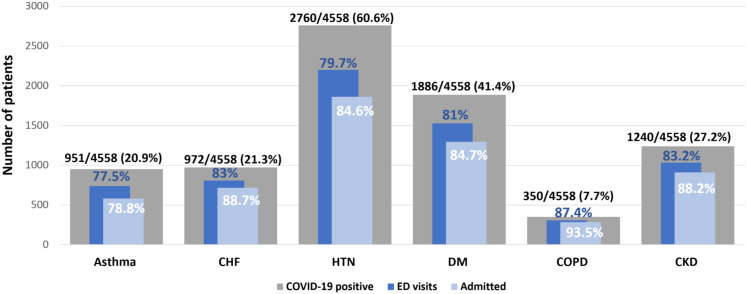
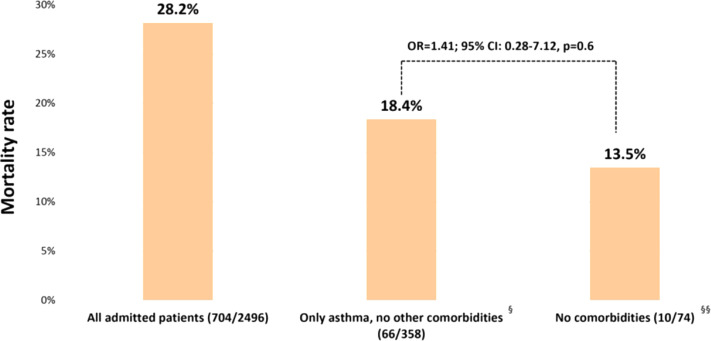
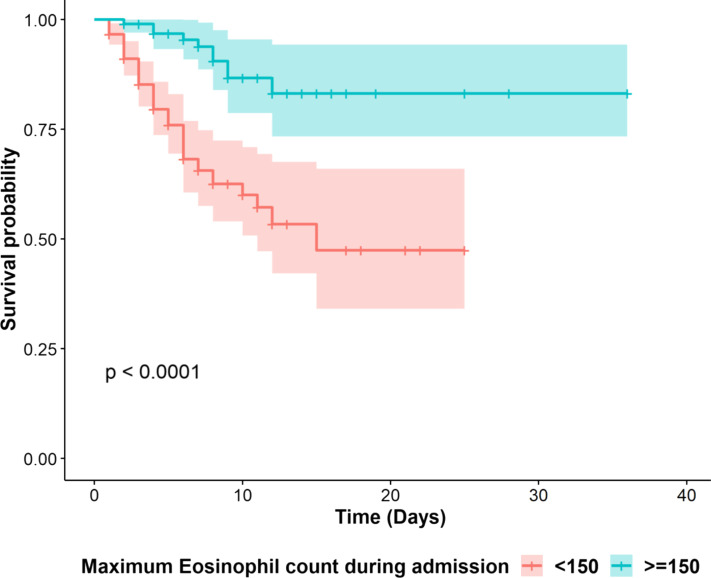
In total, 737 of 951 (77.5%) asthma patients with COVID-19 were seen in the emergency department (ED), and 78.8% of these ED patients (581 of 737) were admitted. Individuals with previously measured mean absolute eosinophil counts (AEC) ≥150 cells/μL were less likely to be admitted (odds ratio [OR] = 0.46, 95% confidence interval [CI]: 0.21-0.98, P = .04), whereas concomitant heart failure (CHF), chronic kidney disease (CKD), and chronic obstructive pulmonary disease (COPD) were risk factors for admission. Hospitalized patients with asthma with peak hospital-measured AEC ≥150 cells/μL (n = 104) were less likely to die compared with those whose AEC remained <150 cells/μL (n = 213) (mortality rate 9.6% vs 25.8%; OR = 0.006, 95% CI: 0.0001-0.64, P = .03). This group had also higher preadmission mean AEC (237 ± 181 vs 163 ± 147 cells/μL, P = .001, OR = 2012, 95% CI: 27.3-14,816). The mortality rate in patients with asthma alone (no associated CHF, CKD, COPD, diabetes, or hypertension) was similar to that of patients without asthma or any of these comorbidities.
In asthmatics, pre-existing eosinophilia (AEC ≥150 cells/μL) was protective from COVID-19-associated admission, and development of eosinophilia (AEC ≥150 cells/μL) during hospitalization was associated with decreased mortality. Preadmission AEC influenced the AEC trend during hospitalization. Having a Th2-asthma phenotype might be an important predictor for reduced COVID-19 morbidity and mortality that should be further explored in prospective and mechanistic studies.
关于2019冠状病毒病(COVID-19)在哮喘患者中的转归情况,相关信息较少。
确定COVID-19感染的哮喘患者中与入院及后续死亡相关的危险因素。
回顾性确定2020年3月14日至4月27日期间在本机构经聚合酶链反应检测COVID-19呈阳性的成年人。记录合并症、实验室检查结果及住院期间的死亡率。
在951例COVID-19哮喘患者中,共有737例(77.5%)在急诊科就诊,其中78.8%(737例中的581例)入院。既往测得的平均绝对嗜酸性粒细胞计数(AEC)≥150个细胞/μL的个体入院可能性较小(比值比[OR]=0.46,95%置信区间[CI]:0.21-0.98,P=0.04),而合并心力衰竭(CHF)、慢性肾脏病(CKD)和慢性阻塞性肺疾病(COPD)是入院的危险因素。与AEC仍<150个细胞/μL的哮喘住院患者(n=213)相比,住院期间测得的AEC峰值≥150个细胞/μL的哮喘住院患者(n=104)死亡可能性较小(死亡率9.6%对25.8%;OR=0.006,95%CI:0.0001-0.64,P=0.03)。该组患者入院前的平均AEC也较高(237±181对163±147个细胞/μL,P=0.001,OR=2012,95%CI:27.3-14816)。单纯哮喘患者(无合并CHF、CKD、COPD、糖尿病或高血压)的死亡率与无哮喘或无上述任何合并症的患者相似。
在哮喘患者中,既往存在的嗜酸性粒细胞增多(AEC≥150个细胞/μL)对COVID-19相关入院具有保护作用,住院期间嗜酸性粒细胞增多(AEC≥150个细胞/μL)的出现与死亡率降低相关。入院前AEC影响住院期间的AEC变化趋势。具有Th2型哮喘表型可能是COVID-19发病率和死亡率降低的重要预测因素,应在前瞻性和机制研究中进一步探索。