Department of Medical Biochemistry and Microbiology, Uppsala University, Uppsala, Sweden.
Department of Molecular Biology, Umeå University, Umeå, Sweden.
Infect Immun. 2021 Mar 17;89(4). doi: 10.1128/IAI.00710-20.
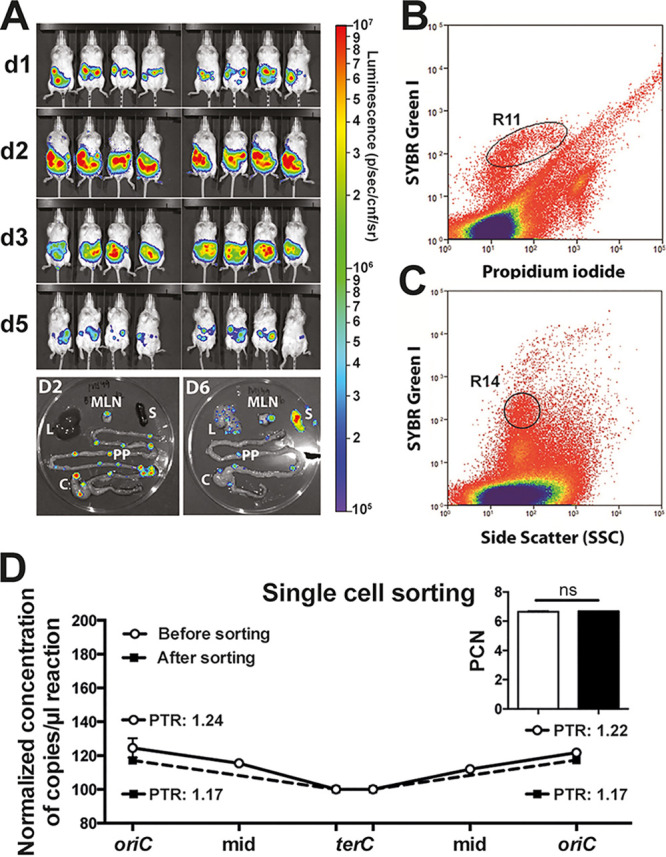
Pathogenic spp. depend on the activity of a potent virulence plasmid-encoded / type 3 secretion system (T3SS) to colonize hosts and cause disease. It was recently shown that upregulates the virulence plasmid copy number (PCN) during infection and that the resulting elevated gene dose of plasmid-encoded T3SS genes is essential for virulence. When and how this novel regulatory mechanism is deployed and regulates the replication of the virulence plasmid during infection is unknown. In the present study, we applied droplet digital PCR (ddPCR) to investigate the dynamics of virulence PCN variations and growth rates in infected mouse organs. We demonstrated that both PCN and growth varied in different tissues and over time throughout the course of infection, indicating that the bacteria adapted to discrete microenvironments during infection. The PCN was highest in Peyer's patches and cecum during the clonal invasive phase of the infection, while the highest growth rates were found in the draining mesenteric lymph nodes. In deeper, systemic organs, the PCN was lower and more modest growth rates were recorded. Our study indicates that increased gene dosage of the plasmid-encoded T3SS genes is most important early in the infection during invasion of the host. The described ddPCR approach will greatly simplify analyses of PCN, growth dynamics, and bacterial loads in infected tissues and will be readily applicable to other infection models.
病原菌依赖于一种强效的毒力质粒编码的/III 型分泌系统(T3SS)来定殖宿主并引起疾病。最近的研究表明,在感染过程中,上调了毒力质粒拷贝数(PCN),而质粒编码的 T3SS 基因的高基因剂量对于毒力是必不可少的。这种新的调控机制何时以及如何被部署,并在感染过程中调控毒力质粒的复制尚不清楚。在本研究中,我们应用液滴数字 PCR(ddPCR)来研究感染小鼠器官中毒力 PCN 变化和生长速率的动力学。我们证明了 PCN 和生长在不同组织和不同时间都存在变化,这表明细菌在感染过程中适应了不同的微环境。在感染的克隆侵袭阶段,PCN 在派尔集合淋巴结和盲肠中最高,而在引流的肠系膜淋巴结中生长速率最高。在更深的系统性器官中,PCN 较低,记录到的生长速率也较低。我们的研究表明,在感染早期宿主侵袭期间,质粒编码的 T3SS 基因的高基因剂量最为重要。所描述的 ddPCR 方法将极大地简化感染组织中 PCN、生长动力学和细菌负荷的分析,并且易于应用于其他感染模型。