Schubert Katherine, Braly Micah, Zhang Jessica, Muscolo Michele E, Lam Hanh N, Hug Karen, Moore Henry, McCausland Joshua W, Terciano Derfel, Lowe Todd, Lesser Cammie F, Jacobs-Wagner Christine, Wang Helen, Auerbuch Victoria
Department of Molecular, Cell, and Developmental Biology, UC Santa Cruz, Santa Cruz, CA 95064, United States.
Department of Microbiology and Environmental Toxicology, UC Santa Cruz, Santa Cruz, CA 95064, United States.
bioRxiv. 2024 Nov 8:2024.10.11.617751. doi: 10.1101/2024.10.11.617751.
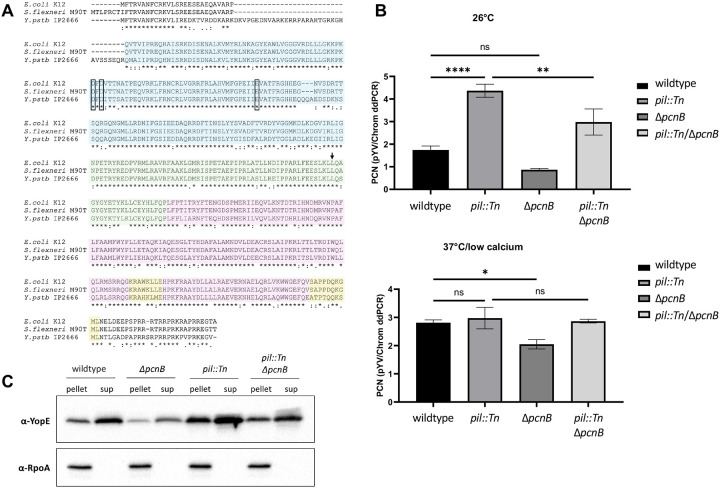
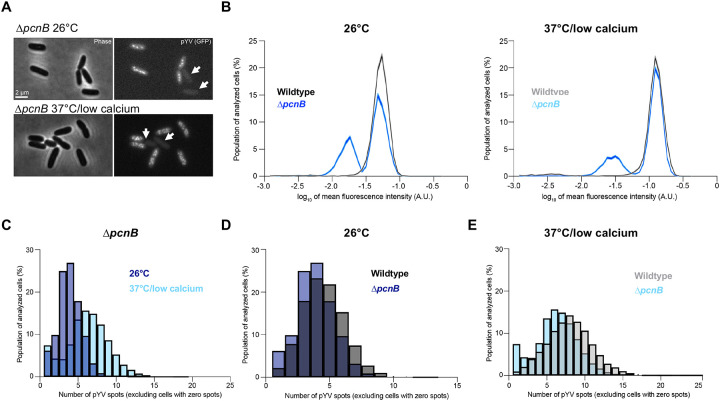
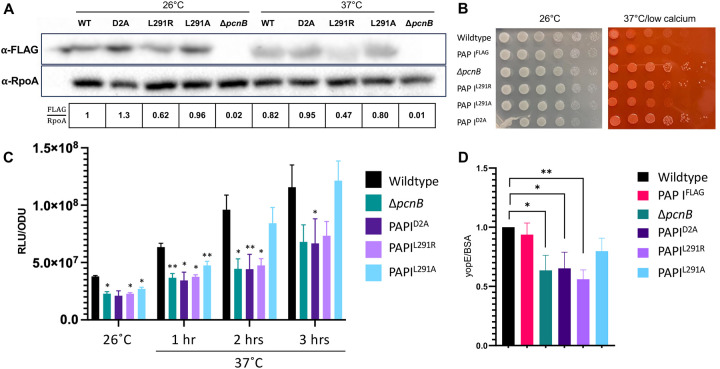
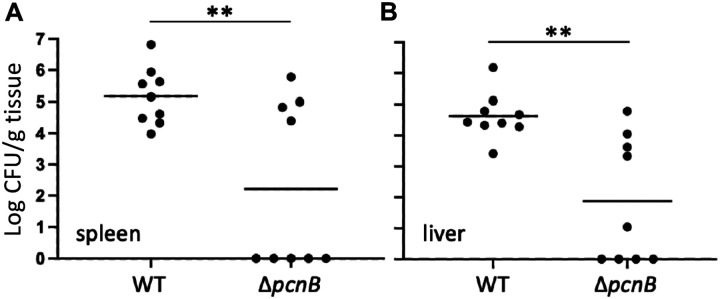
Many species of pathogenic bacteria harbor critical plasmid-encoded virulence factors, and yet the regulation of plasmid replication is often poorly understood despite playing a critical role in plasmid-encoded gene expression. Human pathogenic , including the plague agent and its close relative , require the type III secretion system (T3SS) virulence factor to subvert host defense mechanisms and colonize host tissues. The T3SS is encoded on the IncFII plasmid for virulence (pYV). Several layers of gene regulation enables a large increase in expression of T3SS genes at mammalian body temperature. Surprisingly, T3SS expression is also controlled at the level of gene dosage. The number of pYV molecules relative to the number of chromosomes per cell, referred to as plasmid copy number, increases with temperature. The ability to increase and maintain elevated pYV plasmid copy number, and therefore T3SS gene dosage, at 37°C is important for virulence. In addition, pYV is highly stable in at all temperatures, despite being dispensable for growth outside the host. Yet how reinforces elevated plasmid replication and plasmid stability remains unclear. In this study, we show that the chromosomal gene encoding the polyadenylase PAP I is required for regulation of pYV plasmid copy number (PCN), maintenance of pYV in the bacterial population outside the host, robust T3SS activity, and virulence in a mouse infection model. Likewise, /PAP I is also required for robust expression of the virulence plasmid-encoded T3SS. Furthermore, and /PAP I is required for maintaining normal PCN of model antimicrobial resistance (AMR) plasmids whose replication is regulated by sRNA, thereby increasing antibiotic resistance by ten-fold. These data suggest that /PAP I contributes to the spread and stabilization of virulence and AMR plasmids in bacterial pathogens, and is essential in maintaining the gene dosage required to mediate plasmid-encoded traits. Importantly /PAP I has been bioinformatically identified in many species of bacteria despite being studied in only a few species to date. Our work highlights the potential importance of /PAP I in antibiotic resistance, and shows for the first time that /PAP I reinforces PCN and virulence plasmid stability in natural pathogenic hosts with a direct impact on bacterial virulence.
许多病原菌都携带着关键的质粒编码毒力因子,然而,尽管质粒复制调控在质粒编码基因表达中起着关键作用,但人们对其了解往往甚少。人类病原菌,包括鼠疫杆菌及其近亲,需要III型分泌系统(T3SS)毒力因子来颠覆宿主防御机制并在宿主组织中定殖。鼠疫杆菌的T3SS由用于鼠疫杆菌毒力的IncFII质粒(pYV)编码。多层基因调控使得T3SS基因在哺乳动物体温下的表达大幅增加。令人惊讶的是,T3SS表达也在基因剂量水平受到控制。相对于每个细胞的染色体数量,pYV分子的数量,即质粒拷贝数,会随着温度升高而增加。在37°C时增加并维持pYV质粒拷贝数升高,进而维持T3SS基因剂量的能力对鼠疫杆菌的毒力很重要。此外,pYV在所有温度下在鼠疫杆菌中都高度稳定,尽管在宿主外生长时并非必需。然而,鼠疫杆菌如何加强质粒复制增强和质粒稳定性仍不清楚。在本研究中,我们表明,编码聚腺苷酸酶PAP I的染色体基因对于调控pYV质粒拷贝数(PCN)、在宿主外细菌群体中维持pYV、强大的T3SS活性以及在小鼠感染模型中的鼠疫杆菌毒力是必需的。同样,鼠疫杆菌/PAP I对于毒力质粒编码的T3SS的强大表达也是必需的。此外,鼠疫杆菌和鼠疫杆菌/PAP I对于维持其复制受sRNA调控的模型抗菌抗性(AMR)质粒的正常PCN是必需的,从而使抗生素抗性提高了十倍。这些数据表明,鼠疫杆菌/PAP I有助于毒力和AMR质粒在病原菌中的传播和稳定,并且对于维持介导质粒编码性状所需的基因剂量至关重要。重要的是,尽管迄今为止仅在少数物种中对鼠疫杆菌/PAP I进行了研究,但通过生物信息学方法已在许多细菌物种中鉴定出该基因。我们的工作突出了鼠疫杆菌/PAP I在抗生素抗性中的潜在重要性,并首次表明鼠疫杆菌/PAP I在天然病原菌宿主中增强PCN和毒力质粒稳定性,对细菌毒力有直接影响。