Brown Peter, Fawzi Hamza, Fawzi Omar
Univ Lyon, ENS Lyon, UCBL, CNRS, LIP, F-69342, Lyon, Cedex 07, France.
DAMTP, University of Cambridge, Cambridge, UK.
Nat Commun. 2021 Jan 25;12(1):575. doi: 10.1038/s41467-020-20018-1.
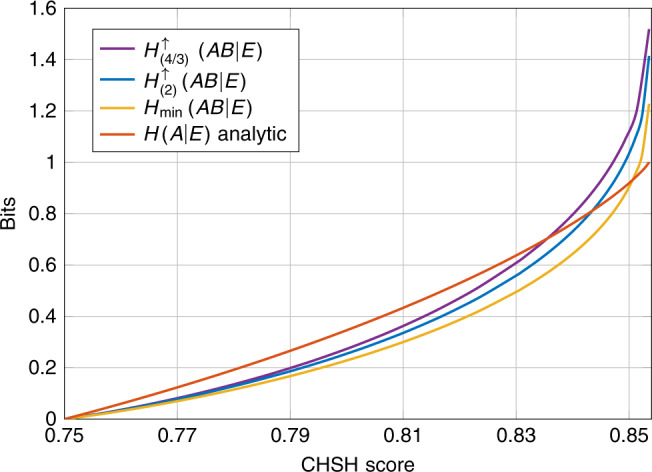
The rates of quantum cryptographic protocols are usually expressed in terms of a conditional entropy minimized over a certain set of quantum states. In particular, in the device-independent setting, the minimization is over all the quantum states jointly held by the adversary and the parties that are consistent with the statistics that are seen by the parties. Here, we introduce a method to approximate such entropic quantities. Applied to the setting of device-independent randomness generation and quantum key distribution, we obtain improvements on protocol rates in various settings. In particular, we find new upper bounds on the minimal global detection efficiency required to perform device-independent quantum key distribution without additional preprocessing. Furthermore, we show that our construction can be readily combined with the entropy accumulation theorem in order to establish full finite-key security proofs for these protocols.
量子密码协议的速率通常用在某组量子态上最小化的条件熵来表示。特别地,在与设备无关的设定中,最小化是在对手和各方共同持有的、与各方所观察到的统计数据一致的所有量子态上进行的。在此,我们引入一种方法来近似此类熵量。应用于与设备无关的随机性生成和量子密钥分发的设定中,我们在各种情况下提高了协议速率。特别地,我们找到了在无需额外预处理的情况下执行与设备无关的量子密钥分发所需的最小全局检测效率的新上限。此外,我们表明我们的构造可以很容易地与熵积累定理相结合,以便为这些协议建立完整的有限密钥安全性证明。