University of Notre Dame, Notre Dame, IN, 46556, USA.
IBM Thomas J. Watson Research Center, Yorktown Heights, NY, 10598, USA.
Nat Commun. 2021 Jan 25;12(1):579. doi: 10.1038/s41467-020-20729-5.
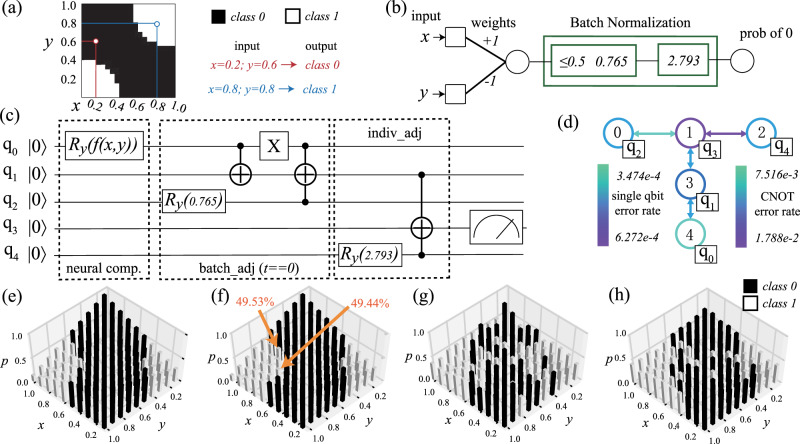
Despite the pursuit of quantum advantages in various applications, the power of quantum computers in executing neural network has mostly remained unknown, primarily due to a missing tool that effectively designs a neural network suitable for quantum circuit. Here, we present a neural network and quantum circuit co-design framework, namely QuantumFlow, to address the issue. In QuantumFlow, we represent data as unitary matrices to exploit quantum power by encoding n = 2 inputs into k qubits and representing data as random variables to seamlessly connect layers without measurement. Coupled with a novel algorithm, the cost complexity of the unitary matrices-based neural computation can be reduced from O(n) in classical computing to O(polylog(n)) in quantum computing. Results show that on MNIST dataset, QuantumFlow can achieve an accuracy of 94.09% with a cost reduction of 10.85 × against the classical computer. All these results demonstrate the potential for QuantumFlow to achieve the quantum advantage.
尽管在各种应用中都追求量子优势,但由于缺少一种有效设计适合量子电路的神经网络的工具,量子计算机在执行神经网络方面的能力在很大程度上仍然未知。在这里,我们提出了一个神经网络和量子电路的联合设计框架,即 QuantumFlow,以解决这个问题。在 QuantumFlow 中,我们将数据表示为幺正矩阵,通过将 n = 2 的输入编码到 k 个量子位中,并将数据表示为随机变量,从而在不进行测量的情况下无缝连接层,以利用量子的能力。结合一种新的算法,基于幺正矩阵的神经网络计算的成本复杂度可以从经典计算中的 O(n)降低到量子计算中的 O(polylog(n))。结果表明,在 MNIST 数据集上,与经典计算机相比,QuantumFlow 可以实现 94.09%的准确率,成本降低了 10.85 倍。所有这些结果都表明了 QuantumFlow 实现量子优势的潜力。