Zhou Min-Gang, Liu Zhi-Ping, Yin Hua-Lei, Li Chen-Long, Xu Tong-Kai, Chen Zeng-Bing
National Laboratory of Solid State Microstructures, School of Physics, Collaborative Innovation Center of Advanced Microstructures, Nanjing University, Nanjing 210093, China.
MatricTime Digital Technology Co. Ltd., Nanjing 211899, China.
Research (Wash D C). 2023 May 8;6:0134. doi: 10.34133/research.0134. eCollection 2023.
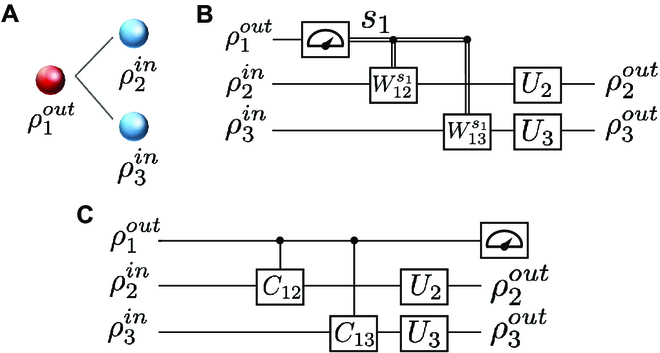
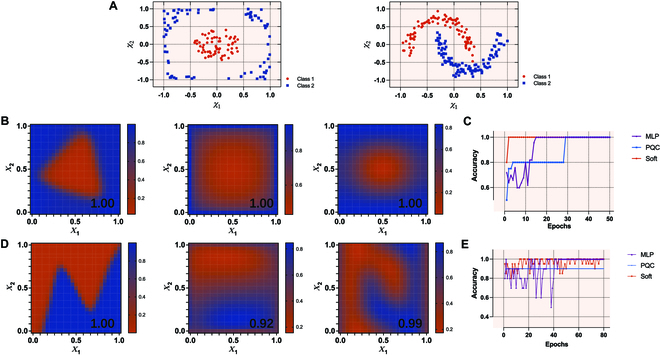
Neural networks have achieved impressive breakthroughs in both industry and academia. How to effectively develop neural networks on quantum computing devices is a challenging open problem. Here, we propose a new quantum neural network model for quantum neural computing using (classically controlled) single-qubit operations and measurements on real-world quantum systems with naturally occurring environment-induced decoherence, which greatly reduces the difficulties of physical implementations. Our model circumvents the problem that the state-space size grows exponentially with the number of neurons, thereby greatly reducing memory requirements and allowing for fast optimization with traditional optimization algorithms. We benchmark our model for handwritten digit recognition and other nonlinear classification tasks. The results show that our model has an amazing nonlinear classification ability and robustness to noise. Furthermore, our model allows quantum computing to be applied in a wider context and inspires the earlier development of a quantum neural computer than standard quantum computers.
神经网络在工业界和学术界都取得了令人瞩目的突破。如何在量子计算设备上有效地开发神经网络是一个具有挑战性的开放问题。在此,我们提出了一种新的量子神经网络模型用于量子神经计算,该模型使用(经典控制的)单量子比特操作以及对具有自然环境诱导退相干的真实世界量子系统进行测量,这极大地降低了物理实现的难度。我们的模型规避了状态空间大小随神经元数量呈指数增长的问题,从而大大降低了内存需求,并允许使用传统优化算法进行快速优化。我们对手写数字识别和其他非线性分类任务对我们的模型进行了基准测试。结果表明,我们的模型具有惊人的非线性分类能力和对噪声的鲁棒性。此外,我们的模型使量子计算能够在更广泛的背景下得到应用,并比标准量子计算机更早地推动量子神经计算机的发展。