Smart Cities Research Institute, Department of Land Surveying and Geo-Informatics, The Hong Kong Polytechnic University, 999077, Hong Kong, China.
College of Oceanography and Space Informatics, China University of Petroleum, 266580, Qingdao, China.
Commun Biol. 2021 Jan 25;4(1):126. doi: 10.1038/s42003-021-01677-2.
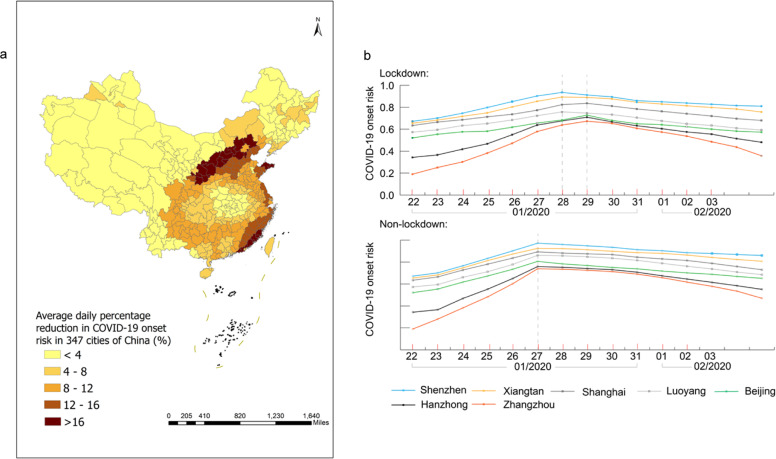
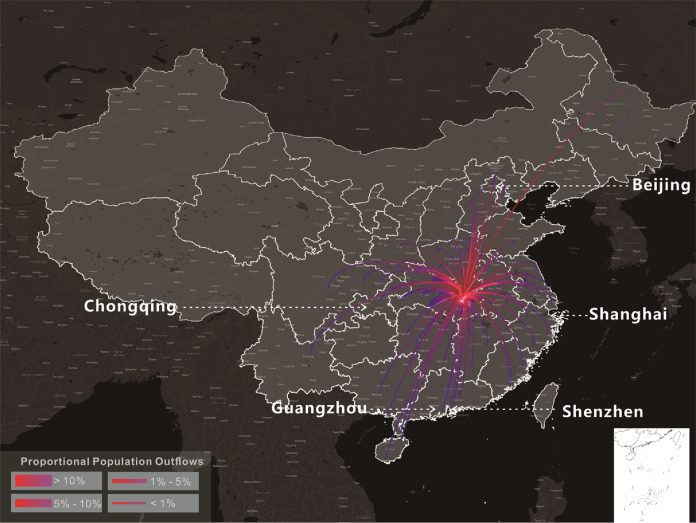
It is important to forecast the risk of COVID-19 symptom onset and thereby evaluate how effectively the city lockdown measure could reduce this risk. This study is a first comprehensive, high-resolution investigation of spatiotemporal heterogeneities on the effect of the Wuhan lockdown on the risk of COVID-19 symptom onset in all 347 Chinese cities. An extended Weight Kernel Density Estimation model was developed to predict the COVID-19 onset risk under two scenarios (i.e., with and without the Wuhan lockdown). The Wuhan lockdown, compared with the scenario without lockdown implementation, in general, delayed the arrival of the COVID-19 onset risk peak for 1-2 days and lowered risk peak values among all cities. The decrease of the onset risk attributed to the lockdown was more than 8% in over 40% of Chinese cities, and up to 21.3% in some cities. Lockdown was the most effective in areas with medium risk before lockdown.
预测 COVID-19 症状发作的风险非常重要,从而评估城市封锁措施能在多大程度上降低这种风险。本研究首次全面、高分辨率地调查了武汉封锁对中国 347 个城市 COVID-19 症状发作风险的影响的时空异质性。开发了一种扩展的加权核密度估计模型,以预测两种情况下(即有武汉封锁和无武汉封锁)的 COVID-19 发病风险。与不实施封锁的情况相比,武汉封锁通常会使 COVID-19 发病风险高峰延迟 1-2 天,并降低所有城市的风险高峰值。由于封锁,发病风险下降了 8%以上的城市超过 40%,有些城市甚至高达 21.3%。封锁在封锁前风险中等的地区最有效。