School of Public Health, Fudan University, Key Laboratory of Public Health Safety, Ministry of Education, Shanghai, China.
ISI Foundation, Turin, Italy.
Lancet Infect Dis. 2020 Jul;20(7):793-802. doi: 10.1016/S1473-3099(20)30230-9. Epub 2020 Apr 2.
The coronavirus disease 2019 (COVID-19) epidemic, caused by severe acute respiratory syndrome coronavirus 2 (SARS-CoV-2), began in Wuhan city, Hubei province, in December, 2019, and has spread throughout China. Understanding the evolving epidemiology and transmission dynamics of the outbreak beyond Hubei would provide timely information to guide intervention policy.
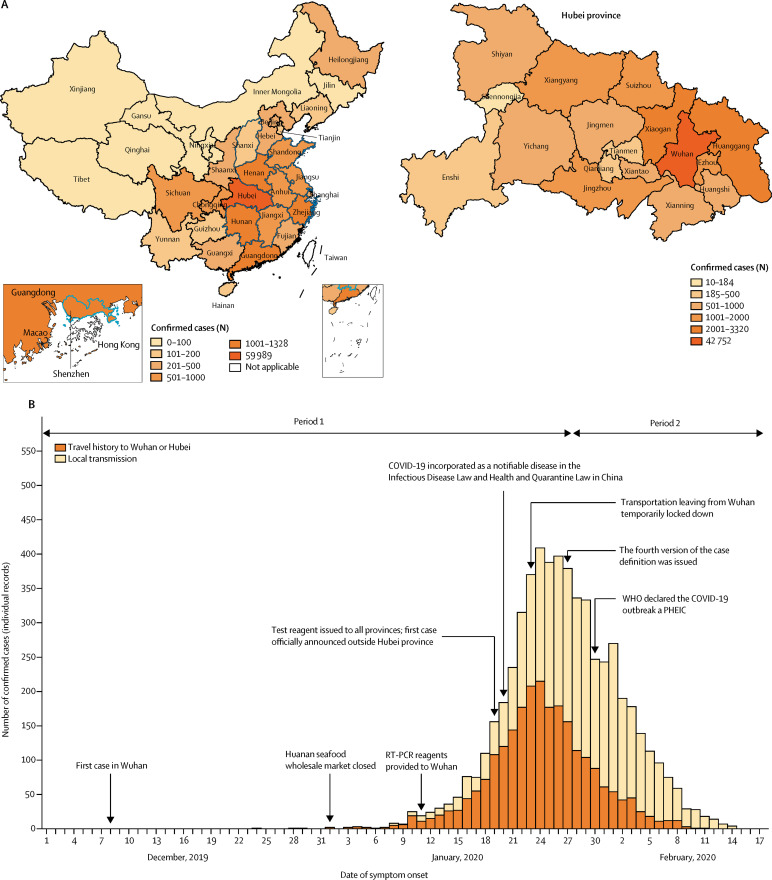
We collected individual information from official public sources on laboratory-confirmed cases reported outside Hubei in mainland China for the period of Jan 19 to Feb 17, 2020. We used the date of the fourth revision of the case definition (Jan 27) to divide the epidemic into two time periods (Dec 24 to Jan 27, and Jan 28 to Feb 17) as the date of symptom onset. We estimated trends in the demographic characteristics of cases and key time-to-event intervals. We used a Bayesian approach to estimate the dynamics of the net reproduction number (R) at the provincial level.
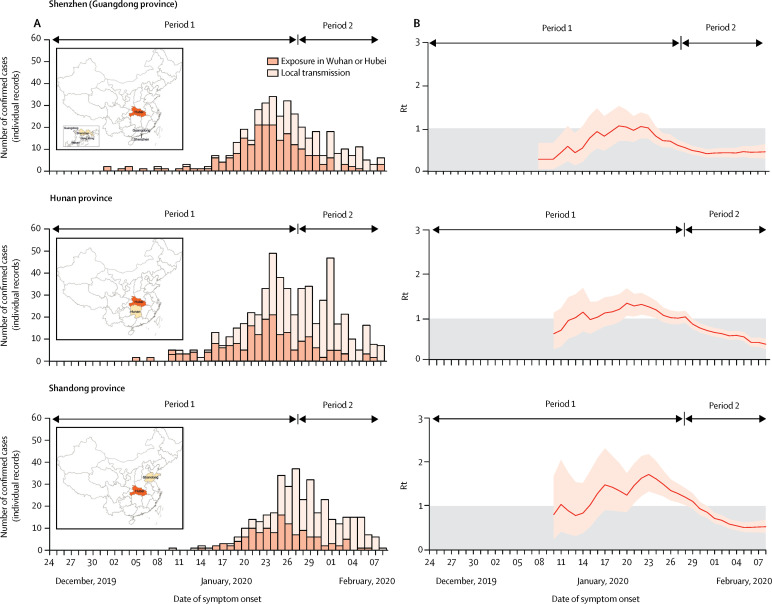
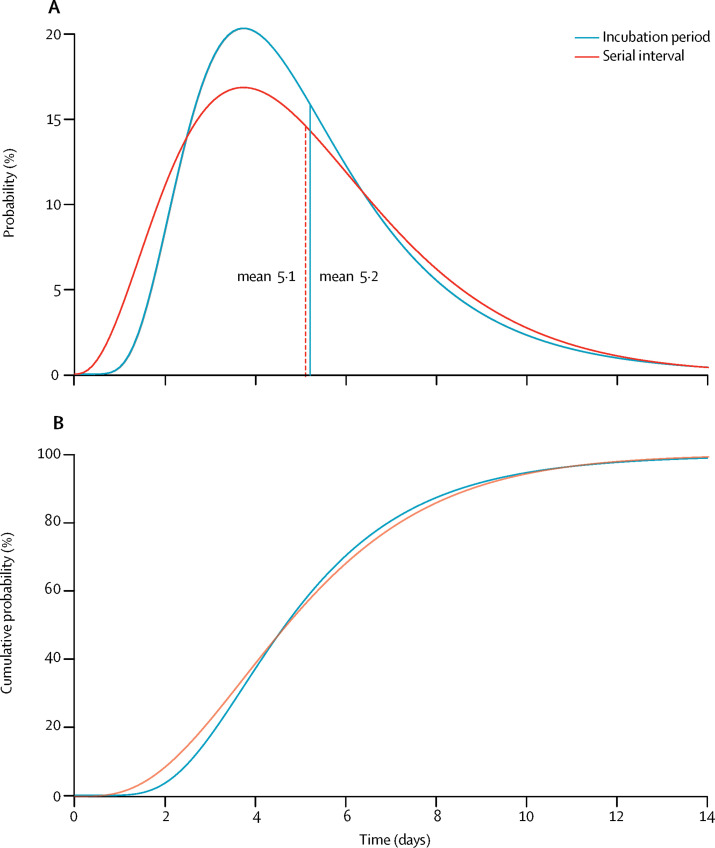
We collected data on 8579 cases from 30 provinces. The median age of cases was 44 years (33-56), with an increasing proportion of cases in younger age groups and in elderly people (ie, aged >64 years) as the epidemic progressed. The mean time from symptom onset to hospital admission decreased from 4·4 days (95% CI 0·0-14·0) for the period of Dec 24 to Jan 27, to 2·6 days (0·0-9·0) for the period of Jan 28 to Feb 17. The mean incubation period for the entire period was estimated at 5·2 days (1·8-12·4) and the mean serial interval at 5·1 days (1·3-11·6). The epidemic dynamics in provinces outside Hubei were highly variable but consistently included a mixture of case importations and local transmission. We estimated that the epidemic was self-sustained for less than 3 weeks, with mean Rt reaching peaks between 1·08 (95% CI 0·74-1·54) in Shenzhen city of Guangdong province and 1·71 (1·32-2·17) in Shandong province. In all the locations for which we had sufficient data coverage of Rt, Rt was estimated to be below the epidemic threshold (ie, <1) after Jan 30.
Our estimates of the incubation period and serial interval were similar, suggesting an early peak of infectiousness, with possible transmission before the onset of symptoms. Our results also indicate that, as the epidemic progressed, infectious individuals were isolated more quickly, thus shortening the window of transmission in the community. Overall, our findings indicate that strict containment measures, movement restrictions, and increased awareness of the population might have contributed to interrupt local transmission of SARS-CoV-2 outside Hubei province.
National Science Fund for Distinguished Young Scholars, National Institute of General Medical Sciences, and European Commission Horizon 2020.
由严重急性呼吸系统综合症冠状病毒 2 型(SARS-CoV-2)引起的 2019 年冠状病毒病(COVID-19)疫情于 2019 年 12 月在湖北省武汉市开始,并已蔓延至中国各地。了解湖北省以外地区疫情的演变流行病学和传播动力学将为指导干预政策提供及时的信息。
我们从中国大陆官方公共来源收集了截至 2020 年 1 月 19 日至 2 月 17 日报告的湖北省以外地区实验室确诊病例的个人信息。我们使用病例定义第四次修订的日期(1 月 27 日)将疫情分为两个时间段(12 月 24 日至 1 月 27 日和 1 月 28 日至 2 月 17 日)作为发病日期。我们估计了病例的人口统计学特征和关键时间到事件间隔的趋势。我们使用贝叶斯方法估计了省级净繁殖数(R)的动态。
我们从 30 个省收集了 8579 例病例的数据。病例的中位年龄为 44 岁(33-56 岁),随着疫情的发展,年轻人群和老年人群(即>64 岁)的病例比例不断增加。从症状出现到住院的平均时间从 12 月 24 日至 1 月 27 日的 4.4 天(95%CI 0.0-14.0)减少到 1 月 28 日至 2 月 17 日的 2.6 天(0.0-9.0)。整个期间的平均潜伏期估计为 5.2 天(1.8-12.4),平均间隔时间为 5.1 天(1.3-11.6)。湖北省以外省份的疫情动态变化很大,但始终包括病例输入和本地传播的混合。我们估计,疫情持续不到 3 周,平均 Rt 在广东省深圳市达到 1.08(95%CI 0.74-1.54)和山东省达到 1.71(1.32-2.17)的峰值。在我们有足够 Rt 数据覆盖的所有地点,Rt 在 1 月 30 日之后估计都低于疫情阈值(即<1)。
我们对潜伏期和间隔时间的估计相似,这表明传染性的早期高峰,可能在症状出现前就有传播。我们的结果还表明,随着疫情的发展,传染性个体被更快地隔离,从而缩短了社区传播的窗口期。总体而言,我们的研究结果表明,严格的遏制措施、行动限制和提高公众意识可能有助于阻止湖北省以外地区 SARS-CoV-2 的本地传播。
国家杰出青年科学基金、国家医学科学基金会和欧盟地平线 2020 计划。