Othman Murnira, Latif Mohd Talib
Institute for Environment and Development (LESTARI), Universiti Kebangsaan Malaysia, 43600, Bangi, Selangor, Malaysia.
Department of Earth Sciences and Environment, Faculty of Science and Technology, Universiti Kebangsaan Malaysia, 43600, Bangi, Selangor, Malaysia.
J Clean Prod. 2021 Apr 1;291:125992. doi: 10.1016/j.jclepro.2021.125992. Epub 2021 Jan 16.
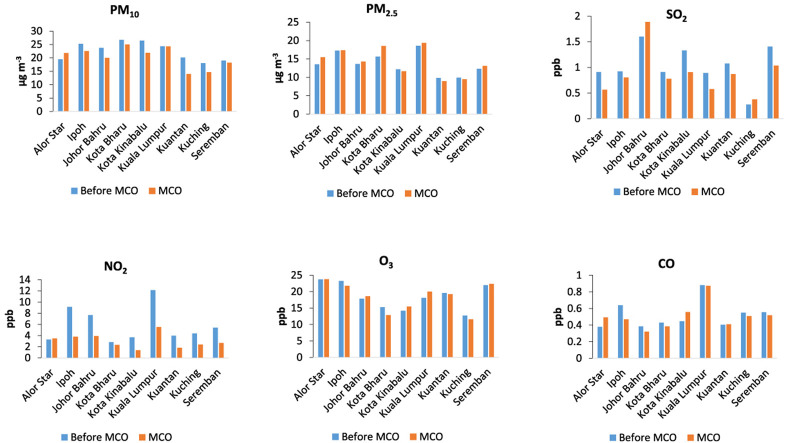
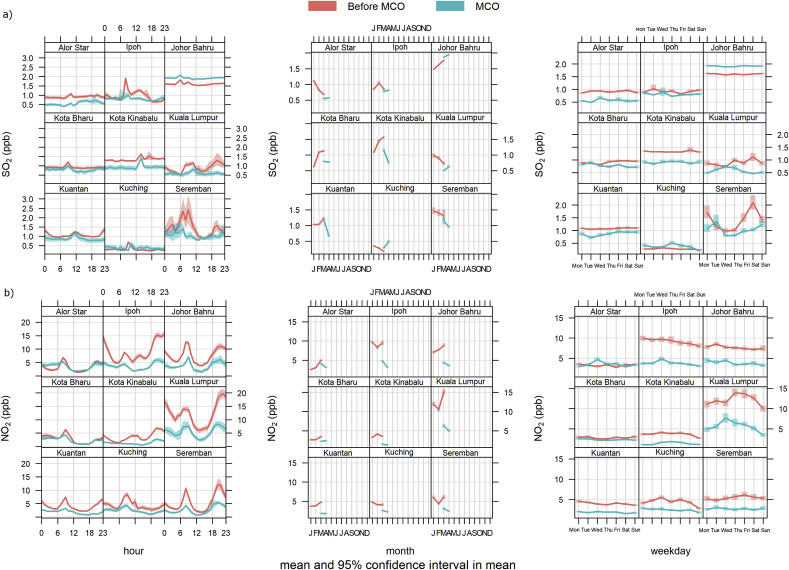
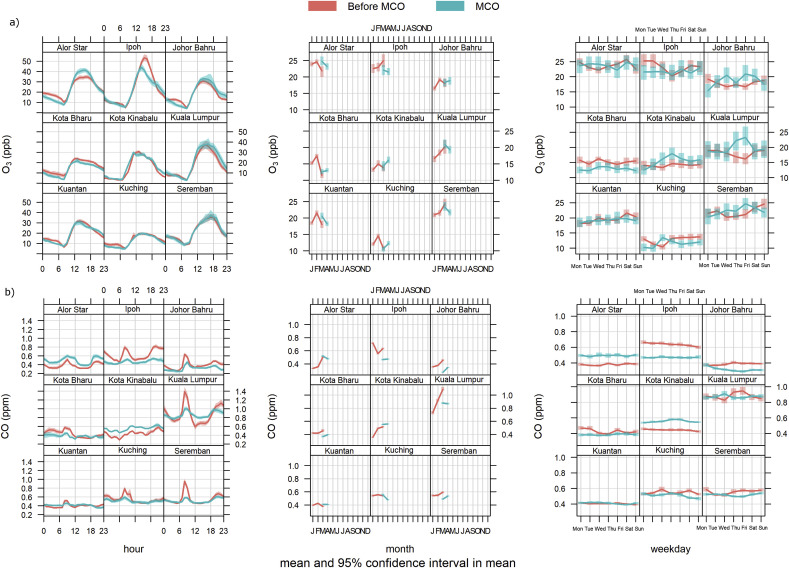
Mitigation measures and control strategies relating to novel coronavirus disease 2019 (COVID-19) have been widely applied in many countries in order to reduce the transmission of this pandemic disease. A Movement Control Order (MCO) was implemented in Malaysia starting from the March 18, 2020 as a pandemic control strategy which restricted all movement and daily outdoor activities. To investigate the impact of MCO, air pollutants: particulate matter with an aerodynamic diameter less than 10 μm (PM), particulate matter with an aerodynamic diameter less than 2.5 μm (PM), sulphur dioxide (SO), nitrogen dioxide (NO), ozone (O) and carbon monoxide (CO) in nine major cities in Malaysia were measured before and during the implementation of the MCO. The non-carcinogenic health risk assessments of the air pollutants are also determined using the United States Environmental Protection Agency (USEPA) Health Risk Assessment method. Overall, NO recorded an average percentage reduction of 40% with the highest reduction observed at Kota Kinabalu (62%). The largest reductions of PM, PM, SO, O and CO were recorded at Kota Kinabalu (17%), Kuantan (9.5%), Alor Star (38%), Kota Bharu (15%), and Ipoh (27%) respectively. All cities had hazard quotient (HQ) values of <1 suggesting no non-carcinogenic health effects. The highest HQ was observed for PM during the MCO period (4.53E-02) in Kuala Lumpur. An average hazard index (HI) value of 1.44E-01 (before the MCO) and 1.40E-01 (during the MCO) showed higher human health risks before the MCO than during the MCO. This study gives confidence to regulatory bodies that the reduction of human activities significantly reduces air pollution and increases human health and so good air pollution control strategies can provide crucial impacts, especially in reducing air pollution and improving human health.
为减少新型冠状病毒肺炎(COVID-19)这一流行性疾病的传播,许多国家已广泛应用了相关缓解措施和控制策略。马来西亚自2020年3月18日起实施行动管制令(MCO),作为一项疫情控制策略,该命令限制了所有出行及日常户外活动。为调查行动管制令的影响,对马来西亚九个主要城市在行动管制令实施前及实施期间的空气污染物进行了测量,这些污染物包括:空气动力学直径小于10微米的颗粒物(PM)、空气动力学直径小于2.5微米的颗粒物(PM)、二氧化硫(SO)、二氧化氮(NO)、臭氧(O)和一氧化碳(CO)。同时,还采用美国环境保护局(USEPA)的健康风险评估方法对空气污染物的非致癌健康风险进行了评估。总体而言,NO的平均降幅为40%,其中哥打基纳巴卢的降幅最高,达62%。PM、PM、SO、O和CO的最大降幅分别出现在哥打基纳巴卢(17%)、关丹(9.5%)、亚罗士打(38%)、哥打巴鲁(15%)和怡保(27%)。所有城市的危害商数(HQ)值均<1,表明不存在非致癌健康影响。在行动管制令期间,吉隆坡的PM的HQ值最高(4.53E-02)。行动管制令实施前的平均危害指数(HI)值为1.44E-01,实施期间为1.40E-01,表明行动管制令实施前的人类健康风险高于实施期间。这项研究让监管机构相信,减少人类活动可显著降低空气污染并增进人类健康,因此良好的空气污染控制策略可产生关键影响,尤其是在减少空气污染和改善人类健康方面。