Clinical Division of Hematology and Hemostaseology, Department of Medicine I.
Department of Blood Group Serology and Transfusion Medicine.
Blood Adv. 2021 Jan 26;5(2):391-398. doi: 10.1182/bloodadvances.2020003464.
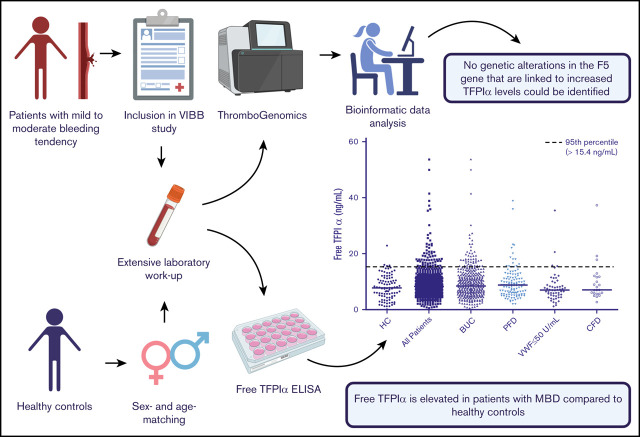
High levels of tissue factor pathway inhibitor (TFPI), caused by a longer TFPIα half-life after binding to a factor V splice variant and variants in the F5 gene, were recently identified in 2 families with an as-yet-unexplained bleeding tendency. This study aimed to investigate free TFPIα in a well-characterized cohort of 620 patients with mild to moderate bleeding tendencies and its association to genetic alterations in the F5 gene. TFPIα levels were higher in patients with bleeding compared with healthy controls (median [interquartile range], 8.2 [5.5-11.7] vs 7.8 [4.3-11.1]; P = .026). A higher proportion of patients had free TFPIα levels more than or equal to the 95th percentile compared with healthy controls (odds ratio [OR] [95% confidence interval (CI)], 2.82 [0.98-8.13]). This was pronounced in the subgroup of patients in whom no bleeding disorder could be identified (bleeding of unknown cause [BUC; n = 420]; OR [95% CI], 3.03 [1.02-8.98]) and in platelet function defects (PFDs) (n = 121; OR [95% CI], 3.47 [1.09-11.08]). An increase in free TFPIα was associated with a mild delay in thrombin generation (prolonged lag time and time to peak), but not with alterations in routinely used global clotting tests. We could neither identify new or known genetic variations in the F5 gene that are associated with free TFPIα levels, nor an influence of the single-nucleotide variant rs10800453 on free TFPIα levels in our patient cohort. An imbalance of natural coagulation inhibitors such as TFPIα could be an underlying cause or contributor for unexplained bleeding, which is most probably multifactorial in a majority of patients.
高水平的组织因子途径抑制剂(TFPI)是由于 TFPIα 与因子 V 剪接变异体结合后半衰期延长,以及 F5 基因中的变异所致,最近在 2 个具有尚未解释的出血倾向的家族中被发现。本研究旨在调查在一个特征明确的 620 名有轻至中度出血倾向的患者中游离 TFPIα 的情况,并研究其与 F5 基因遗传改变的关系。与健康对照组相比,出血患者的 TFPIα 水平更高(中位数[四分位间距],8.2[5.5-11.7]比 7.8[4.3-11.1];P=.026)。与健康对照组相比,有更高比例的患者游离 TFPIα 水平超过或等于第 95 百分位数(比值比[OR] [95%置信区间(CI)],2.82[0.98-8.13])。在无法确定出血性疾病的患者亚组中,这种情况更为明显(不明原因出血[BUC;n=420];OR[95%CI],3.03[1.02-8.98])和血小板功能缺陷(PFDs)患者中更为明显(n=121;OR[95%CI],3.47[1.09-11.08])。游离 TFPIα 的增加与凝血酶生成的轻微延迟相关(延长的Lag 时间和达到峰值的时间),但与常规凝血试验的改变无关。我们既不能确定与游离 TFPIα 水平相关的 F5 基因中的新或已知遗传变异,也不能确定单核苷酸变异 rs10800453 对我们患者队列中游离 TFPIα 水平的影响。天然凝血抑制剂如 TFPIα 的失衡可能是不明原因出血的潜在原因或促成因素,在大多数患者中,这很可能是多因素的。