Clinical Division of Hematology and Hemostaseology, Department of Medicine I, Medical University of Vienna, Vienna, Austria.
Department of Blood Group Serology and Transfusion Medicine, Medical University of Vienna, Vienna, Austria.
Haemophilia. 2021 Nov;27(6):1028-1036. doi: 10.1111/hae.14433. Epub 2021 Oct 10.
A massive increase of soluble thrombomodulin (sTM) due to variants in the thrombomodulin gene (THBD) has recently been identified as a novel bleeding disorder.
To investigate sTM levels and underlying genetic variants as a cause for haemostatic impairment and bleeding in a large number of patients with a mild to moderate bleeding disorder (MBD), including patients with bleeding of unknown cause (BUC).
In 507 MBD patients, sTM levels, thrombin generation and plasma clot formation were measured and compared to 90 age- and sex-matched healthy controls. In patients, genetic analysis of the THBD gene was performed.
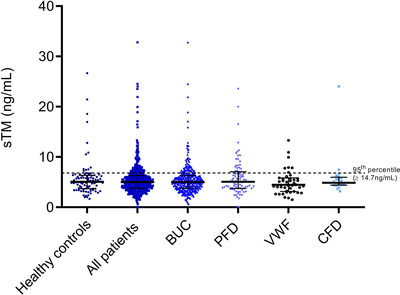
No difference in sTM levels between patients and controls was found overall (median ([IQR] 5.0 [3.8-6.3] vs. 5.1 [3.7-6.4] ng/ml, p = .762), and according to specific diagnoses of MBD or BUC, and high sTM levels (≥95th percentile of healthy controls) were not overrepresented in patients. Soluble TM levels had no impact on bleeding severity or global tests of haemostasis, including thrombin generation or plasma clot formation. In the THBD gene, no known pathogenic or novel disease-causing variants affecting sTM plasma levels were identified in our patient cohort.
TM-associated coagulopathy appears to be rare, as it was not identified in our large cohort of patients with MBD. Soluble TM did not arise as a risk factor for bleeding or altered haemostasis in these patients.
最近发现,由于血栓调节蛋白基因(THBD)的变异,可溶性血栓调节蛋白(sTM)大量增加,这是一种新型的出血性疾病。
在大量有轻度至中度出血性疾病(MBD)的患者中,包括出血原因不明(BUC)的患者,调查 sTM 水平和潜在的遗传变异是否是止血功能障碍和出血的原因。
在 507 例 MBD 患者中,测量了 sTM 水平、凝血酶生成和血浆凝块形成,并与 90 名年龄和性别匹配的健康对照进行了比较。对患者的 THBD 基因进行了遗传分析。
总体而言,患者与对照组之间 sTM 水平无差异(中位数([IQR]5.0 [3.8-6.3] vs. 5.1 [3.7-6.4]ng/ml,p=0.762),并且根据 MBD 或 BUC 的具体诊断,高 sTM 水平(高于健康对照组第 95 百分位数)在患者中并未过多出现。sTM 水平对出血严重程度或包括凝血酶生成或血浆凝块形成在内的整体止血试验没有影响。在 THBD 基因中,在我们的患者队列中未发现影响 sTM 血浆水平的已知致病性或新的致病变异。
TM 相关的凝血功能障碍似乎很少见,因为在我们的大量 MBD 患者中未发现。可溶性 TM 不是这些患者出血或凝血功能改变的危险因素。