Shiba Reiko, Kinutani Masayuki, Okano S Hinichiro, Ikeda Maki, Fukunaga Emi, Harada Yoshihisa, Kawano Reo, Kikkawa Yuko
Kinutani Women's Clinic, 4F 8-23 Hondori, Naka-ku, Hiroshima-city, Hiroshima-Prefecture, Japan. Email:
Kinutani Women's Clinic, 4F 8-23 Hondori, Naka-ku, Hiroshima-city, Hiroshima-Prefecture, Japan.
Int J Fertil Steril. 2021 Jan;15(1):34-39. doi: 10.22074/ijfs.2021.6235. Epub 2021 Jan 19.
Luteal phase support (LPS) is essential for hormone replacement therapy (HRT) for frozen-thawed embryo transfer (FET). However, the optimal dose and serum progesterone (P4) levels required for pregnancy are controversial. We attempted to determine the association between pregnancy outcomes and serum P4 levels administered via vaginal suppository for HRT-FET cycles on embryo transfer day.
This was a secondary analysis of the dataset from the EXCULL trial, which prospectively investigated pregnancy outcomes of four different P4 vaginal suppositories (Lutinus, Utrogestan, Luteum, and Crinone) for HRT-FET. It was conducted at a private fertility clinic between December 2016 to December 2017. During this trial, 235 cycles were divided into four groups based on serum P4 values (quartile [Q] 1 group: <7.8 ng/mL; Q2 group: 7.8-10.8 ng/mL; Q3 group: 10.8-13.7 ng/mL; Q4 group: >13.7 ng/mL). We investigated clinical pregnancy rate (CPR), positive fetal heart rate (FHR), live birth rate (LBR), and miscarriage rate (MR) for each group. A logistic regression analysis was performed using age, body mass index (BMI), and transferred embryos as covariates.
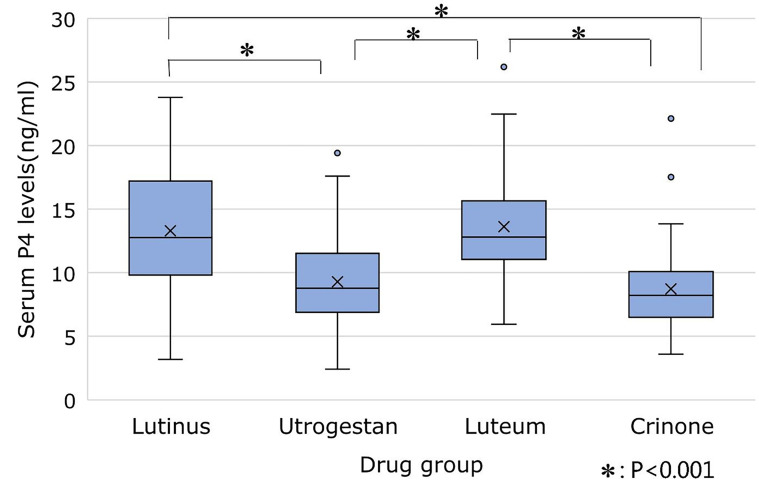
Serum P4 values (ng/mL) of each drug were as follows: Lutinus, 13.3 ± 4.9; Utrogestan, 9.3 ± 3.3; Luteum, 13.6 ± 4.2; and Crinone, 8.7 ± 3.2 (mean ± standard deviation, P<0.001).The percentages of Utrogestan and Crinone were higher in the Q1 group, while the percentages of Lutinus and Luteum were higher in the Q4 group. Nonetheless, there were no statistical differences between the Q1 and Q4 groups in CPR, FHR, LBR, and MR.
When vaginal P4 was used for FET, although serum P4 levels on transfer day differed based on the drug that was administered, no relationship was observed between serum progesteronelevels and pregnancy outcomes (Registration number: UMIN000032997).
黄体期支持(LPS)对于冻融胚胎移植(FET)的激素替代疗法(HRT)至关重要。然而,妊娠所需的最佳剂量和血清孕酮(P4)水平仍存在争议。我们试图确定胚胎移植日通过阴道栓剂进行HRT-FET周期时,妊娠结局与血清P4水平之间的关联。
这是对EXCULL试验数据集的二次分析,该试验前瞻性地研究了四种不同的P4阴道栓剂(Lutinus、Utrogestan、Luteum和Crinone)用于HRT-FET的妊娠结局。研究于2016年12月至2017年12月在一家私立生育诊所进行。在该试验期间,根据血清P4值将235个周期分为四组(四分位数[Q]1组:<7.8 ng/mL;Q2组:7.8-10.8 ng/mL;Q3组:10.8-13.7 ng/mL;Q4组:>13.7 ng/mL)。我们调查了每组的临床妊娠率(CPR)、胎心阳性率(FHR)、活产率(LBR)和流产率(MR)。使用年龄、体重指数(BMI)和移植胚胎作为协变量进行逻辑回归分析。
每种药物的血清P4值(ng/mL)如下:Lutinus,13.3±4.9;Utrogestan,9.3±3.3;Luteum,13.6±4.2;Crinone,8.7±3.2(平均值±标准差,P<0.001)。Q1组中Utrogestan和Crinone的百分比更高,而Q4组中Lutinus和Luteum的百分比更高。尽管如此,Q1组和Q4组在CPR、FHR、LBR和MR方面没有统计学差异。
当阴道使用P4进行FET时,尽管移植日的血清P4水平因所用药物而异,但未观察到血清孕酮水平与妊娠结局之间的关系(注册号:UMIN000032997)。