Centre for Clinical Brain Sciences, Dementia Research Institute, University of Edinburgh, Edinburgh EH16 4SB, UK.
School of Engineering, University of Edinburgh, Edinburgh EH9 3FB, UK.
Neuroimage. 2021 Apr 15;230:117786. doi: 10.1016/j.neuroimage.2021.117786. Epub 2021 Jan 23.
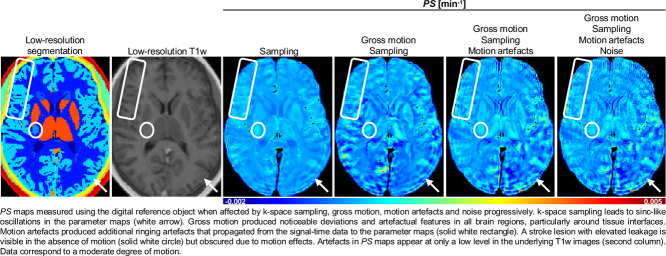
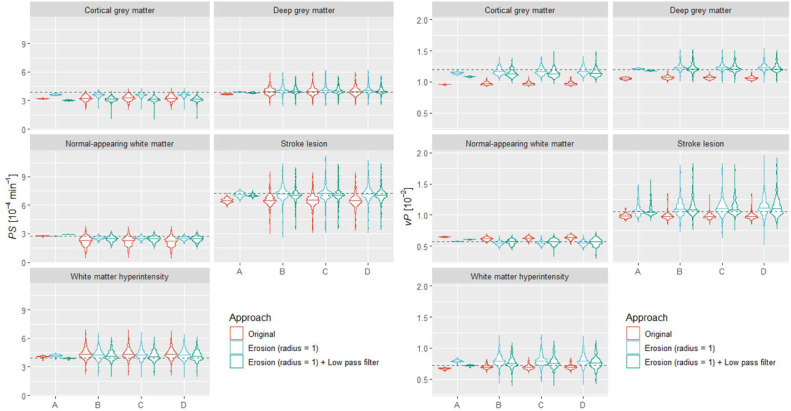
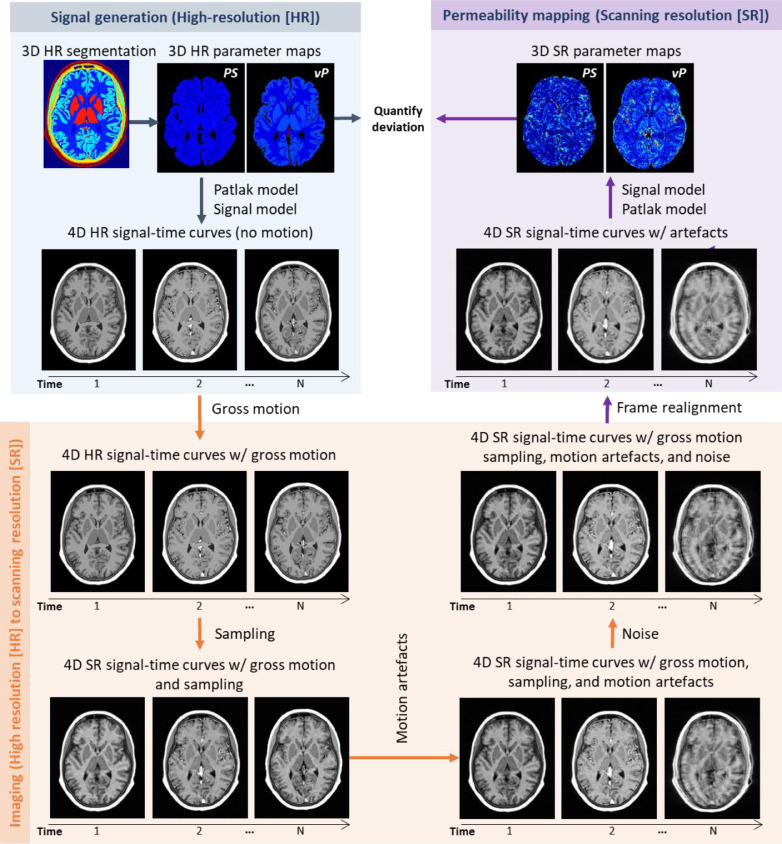
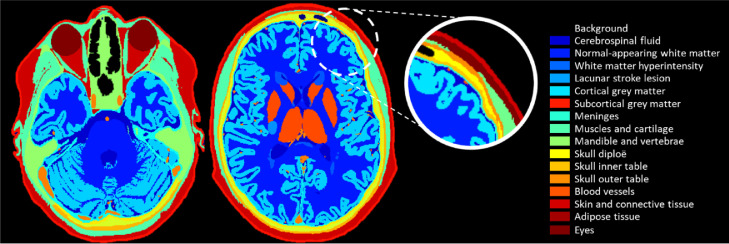
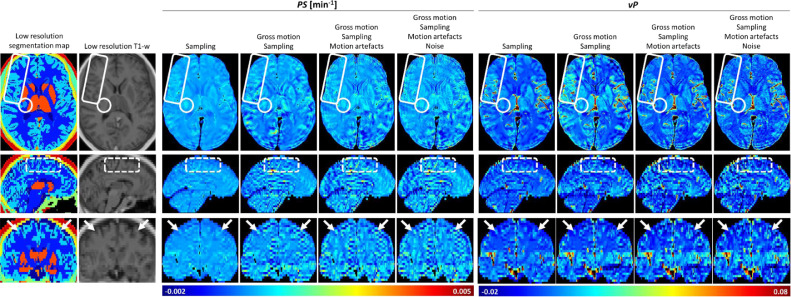
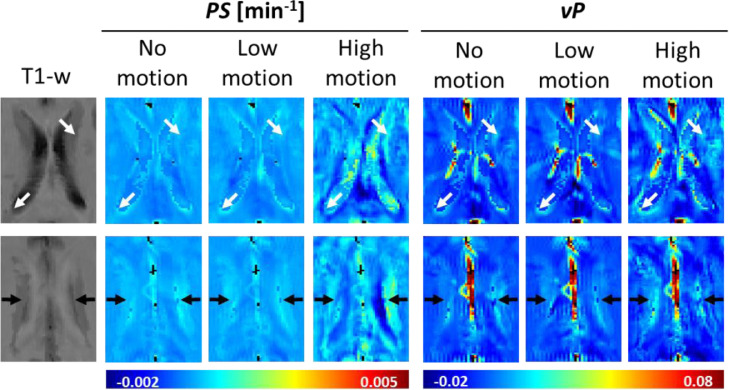
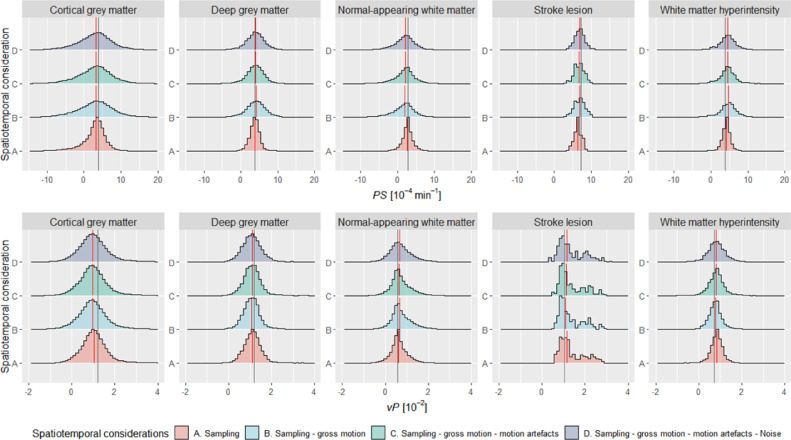
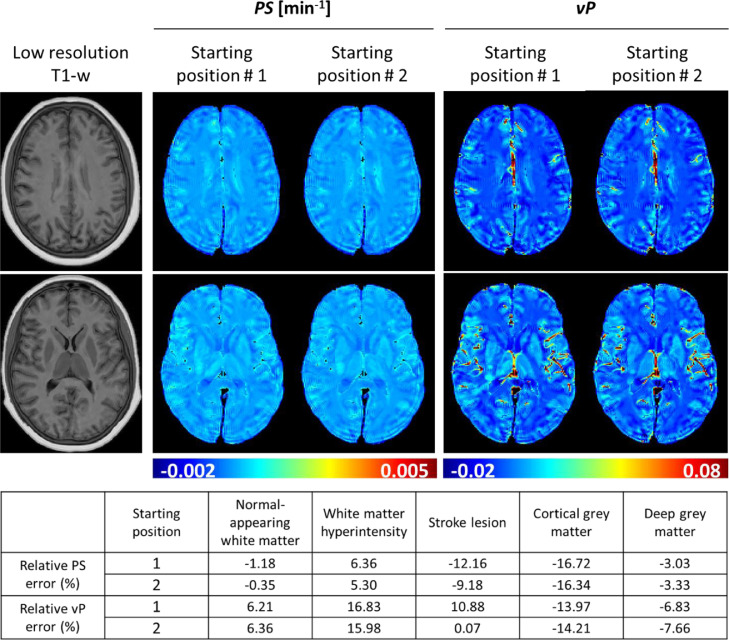
Dynamic contrast-enhanced MRI (DCE-MRI) is increasingly used to quantify and map the spatial distribution of blood-brain barrier (BBB) leakage in neurodegenerative disease, including cerebral small vessel disease and dementia. However, the subtle nature of leakage and resulting small signal changes make quantification challenging. While simplified one-dimensional simulations have probed the impact of noise, scanner drift, and model assumptions, the impact of spatio-temporal effects such as gross motion, k-space sampling and motion artefacts on parametric leakage maps has been overlooked. Moreover, evidence on which to base the design of imaging protocols is lacking due to practical difficulties and the lack of a reference method. To address these problems, we present an open-source computational model of the DCE-MRI acquisition process for generating four dimensional Digital Reference Objects (DROs), using a high-resolution brain atlas and incorporating realistic patient motion, extra-cerebral signals, noise and k-space sampling. Simulations using the DROs demonstrated a dominant influence of spatio-temporal effects on both the visual appearance of parameter maps and on measured tissue leakage rates. The computational model permits greater understanding of the sensitivity and limitations of subtle BBB leakage measurement and provides a non-invasive means of testing and optimising imaging protocols for future studies.
动态对比增强磁共振成像(DCE-MRI)越来越多地用于量化和绘制神经退行性疾病(包括脑小血管疾病和痴呆)中血脑屏障(BBB)渗漏的空间分布。然而,渗漏的细微性质和由此产生的小信号变化使得定量变得具有挑战性。虽然简化的一维模拟已经探究了噪声、扫描仪漂移和模型假设的影响,但像大幅运动、k 空间采样和运动伪影等时空效应对参数渗漏图的影响尚未得到关注。此外,由于实际困难和缺乏参考方法,缺乏设计成像方案的依据。为了解决这些问题,我们提出了一种用于生成四维数字参考对象(DRO)的 DCE-MRI 采集过程的开源计算模型,该模型使用高分辨率脑图谱并纳入现实患者运动、脑外信号、噪声和 k 空间采样。使用 DRO 进行的模拟表明,时空效应对参数图的视觉外观和测量的组织渗漏率都有主要影响。该计算模型可以更好地理解对细微 BBB 渗漏测量的敏感性和局限性,并为未来的研究提供了一种非侵入性的测试和优化成像方案的手段。