Piqueras Anabel, Ganapathi Lakshmi, Carpenter Jane F, Rubio Thomas, Sandora Thomas J, Flett Kelly B, Köhler Julia R
Pediatric Infectious Disease Unit, Pediatrics Department, University & Polytechnic Hospital La Fe, E-46026 Valencia, Spain.
Division of Infectious Diseases, Boston Children's Hospital and Harvard Medical School, Boston, MA 02115, USA.
J Fungi (Basel). 2021 Jan 22;7(2):78. doi: 10.3390/jof7020078.
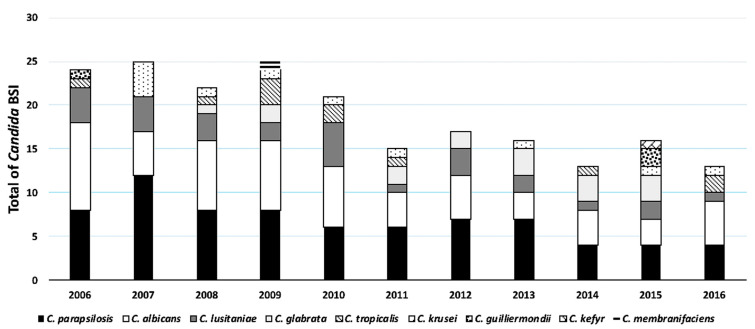
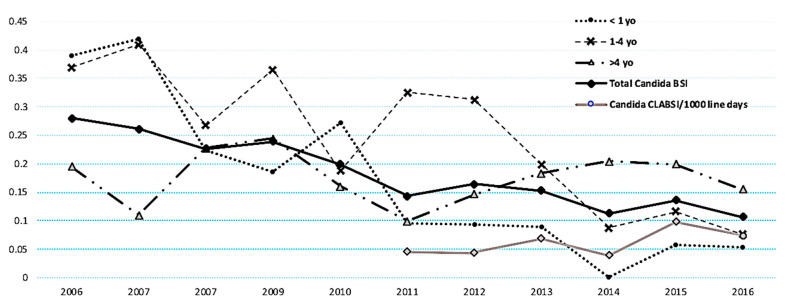
bloodstream infections (CBSIs) have decreased among pediatric populations in the United States, but remain an important cause of morbidity and mortality. Species distributions and susceptibility patterns of CBSI isolates diverge widely between children and adults. The awareness of these patterns can inform clinical decision-making for empiric or pre-emptive therapy of children at risk for candidemia. CBSIs occurring from 2006-2016 among patients in a large children's hospital were analyzed for age specific trends in incidence rate, risk factors for breakthrough-CBSI, and death, as well as underlying conditions. species distributions and susceptibility patterns were evaluated in addition to the anti-fungal agent use. The overall incidence rate of CBSI among this complex patient population was 1.97/1000 patient-days. About half of CBSI episodes occurred in immunocompetent children and 14% in neonatal intensive care unit (NICU) patients. Anti-fungal resistance was minimal: 96.7% of isolates were fluconazole, 99% were micafungin, and all were amphotericin susceptible. Liposomal amphotericin was the most commonly prescribed anti-fungal agent included for NICU patients. Overall, CBSI-associated mortality was 13.7%; there were no deaths associated with CBSI among NICU patients after 2011. Pediatric CBSI characteristics differ substantially from those in adults. The improved management of underlying diseases and antimicrobial stewardship may further decrease morbidity and mortality from CBSI, while continuing to maintain low resistance rates among isolates.
在美国,儿科人群中的血流感染(CBSIs)有所减少,但仍然是发病和死亡的重要原因。儿童与成人CBSI分离株的菌种分布和药敏模式差异很大。了解这些模式可为有念珠菌血症风险儿童的经验性或抢先性治疗的临床决策提供依据。对一家大型儿童医院2006年至2016年期间患者发生的CBSIs进行了分析,以了解发病率的年龄特异性趋势、突破性CBSI的危险因素、死亡情况以及基础疾病。除了抗真菌药物的使用外,还评估了菌种分布和药敏模式。在这一复杂患者群体中,CBSI的总体发病率为1.97/1000患者日。约一半的CBSI发作发生在免疫功能正常的儿童中,14%发生在新生儿重症监护病房(NICU)患者中。抗真菌耐药性极低:96.7%的分离株对氟康唑敏感,99%对米卡芬净敏感,所有分离株对两性霉素均敏感。脂质体两性霉素是NICU患者最常用的抗真菌药物。总体而言,CBSI相关死亡率为13.7%;2011年后NICU患者中没有与CBSI相关的死亡病例。儿科CBSI的特征与成人有很大不同。改善基础疾病的管理和抗菌药物管理可能会进一步降低CBSI的发病率和死亡率,同时继续保持分离株的低耐药率。