School of Economics and Finance, Xi'an Jiaotong University, Xi'an, China.
Institute for Health Care & Public Management, University of Hohenheim, 70599, Stuttgart, Germany.
BMC Geriatr. 2021 Jan 27;21(1):78. doi: 10.1186/s12877-021-02026-y.
This study tentatively constructs a composite measure of Chinese Healthy Ageing Index (CHAI) among older adults aged 60+ and investigates change of CHAI during 2011-2015 and its association with sociodemographic characteristics.
Data collected from 8182 old adults aged 60+ in the 2011 and 2015 China Health and Retirement Longitudinal Study (CHARLS, a nationally representative sample) were used. Six medical measures of blood pressure, peak expiratory flow, cognitive status score, fasting glucose, kidney function and C-reactive function were used to construct CHAI (range 0-12, 0-2 = healthiest, 7-12 = unhealthiest). Ordinary least squares, logistic and random effects models examined social and spatial determinants of CHAI score and the prevalence of the ideal CHAI. Unconditional quantile regression tested heterogeneous impacts of sociodemographic determinants of CHAI score.
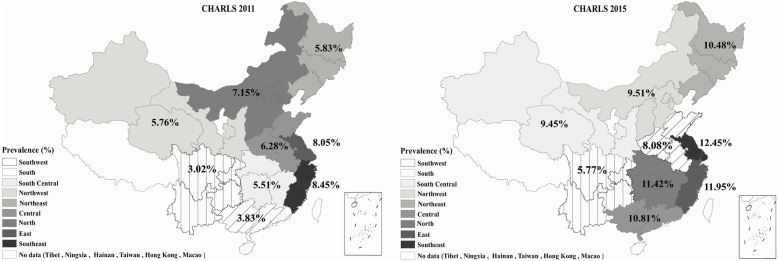
Mean CHAI score declined from 5.7 to 5.2, and the proportion of the ideal CHAI (CHAI score = 0-2) increased from 5.6 to 9.4% during 2011-2015, indicating an improvement in healthy ageing over time. During 2011-2015, the highest rates of the ideal CHAI were in Southeast and East of China. Older adults, male, living in the Center and West, smoking, obesity/overweight and having chronic diseases were positively associated with total CHAI score and negatively with a higher prevalence of the ideal CHAI. Being married, having high education and regular social activities were associated with a higher rate of the ideal CHAI. The positive predictors for total CHAI were stronger in those with worse CHAI status.
In China healthy ageing has improved during 2011-2015, but substantial geographical and sociodemographic heterogeneities exist in the improvements, suggesting health equality remains a challenge in China. Future policies and interventions should especially focus on men, those in Central and West China, and combat health problems like obesity, chronic diseases and unhealthy behaviors.
本研究在 60 岁及以上老年人中初步构建了中国健康老龄化指数(CHAI)的综合指标,并探讨了 2011-2015 年 CHAI 的变化及其与社会人口特征的关系。
本研究使用了来自 2011 年和 2015 年中国健康与退休纵向研究(CHARLS,一个全国代表性样本)的 8182 名 60 岁及以上老年人的数据。血压、呼气峰值流量、认知状态评分、空腹血糖、肾功能和 C 反应蛋白功能的 6 项医学指标用于构建 CHAI(范围 0-12,0-2=最健康,7-12=最不健康)。普通最小二乘法、逻辑和随机效应模型考察了 CHAI 评分和理想 CHAI 患病率的社会和空间决定因素。无条件分位数回归检验了社会人口决定因素对 CHAI 评分的异质影响。
CHAI 评分的平均值从 5.7 下降到 5.2,理想 CHAI(CHAI 评分=0-2)的比例从 2011 年的 5.6%增加到 2015 年的 9.4%,表明随着时间的推移健康老龄化状况有所改善。2011-2015 年期间,CHAI 评分最高的地区为中国东南部和东部。年龄较大、男性、居住在中心和西部、吸烟、肥胖/超重和患有慢性病与总 CHAI 评分呈正相关,与更高的理想 CHAI 患病率呈负相关。已婚、高学历和定期参加社会活动与更高的理想 CHAI 患病率相关。在 CHAI 状况较差的人群中,总 CHAI 的正向预测因素更强。
2011-2015 年期间,中国健康老龄化状况有所改善,但改善存在显著的地理和社会人口差异,表明健康公平在中国仍是一个挑战。未来的政策和干预措施应特别关注男性、中西部地区以及肥胖、慢性病和不健康行为等健康问题。