The LIFEPHARM Centre, Department of Veterinary and Animal Sciences, Faculty of Health and Medical Sciences, University of Copenhagen, Ridebanevej 9, 1870, Frederiksberg, Denmark.
Xlab, Center for Healthy Aging, Department of Biomedical Sciences, Faculty of Health and Medical Sciences, University of Copenhagen, Blegdamsvej 3B, 2200, Copenhagen, Denmark.
Sci Rep. 2021 Jan 26;11(1):2167. doi: 10.1038/s41598-021-81846-9.
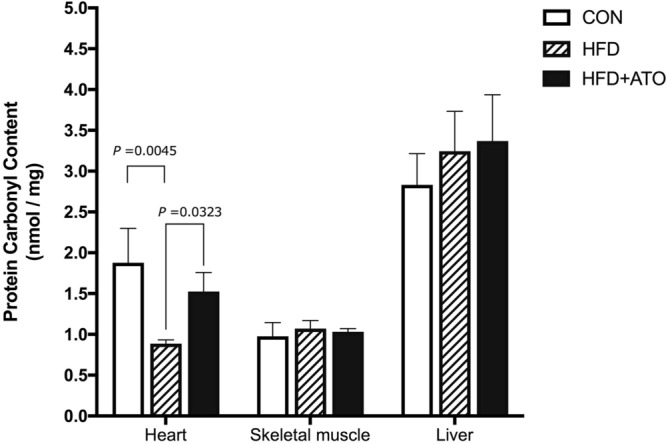
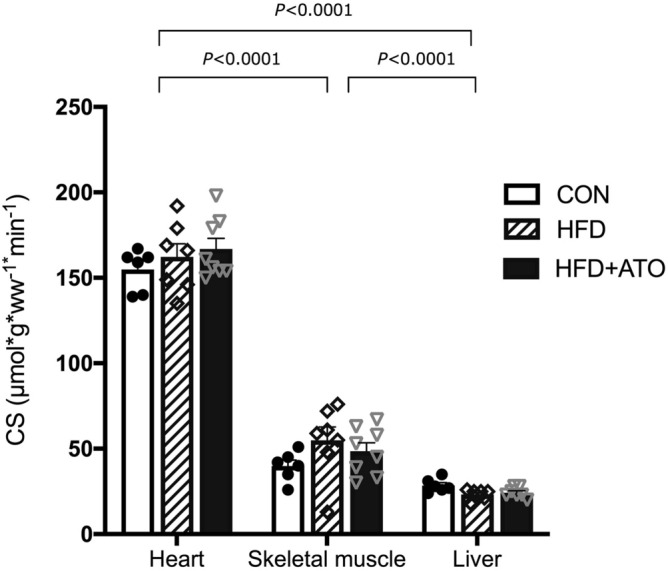
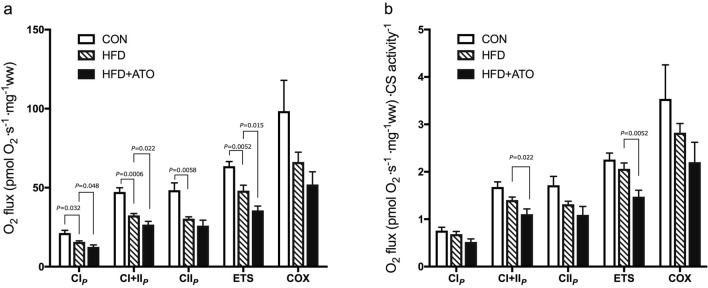
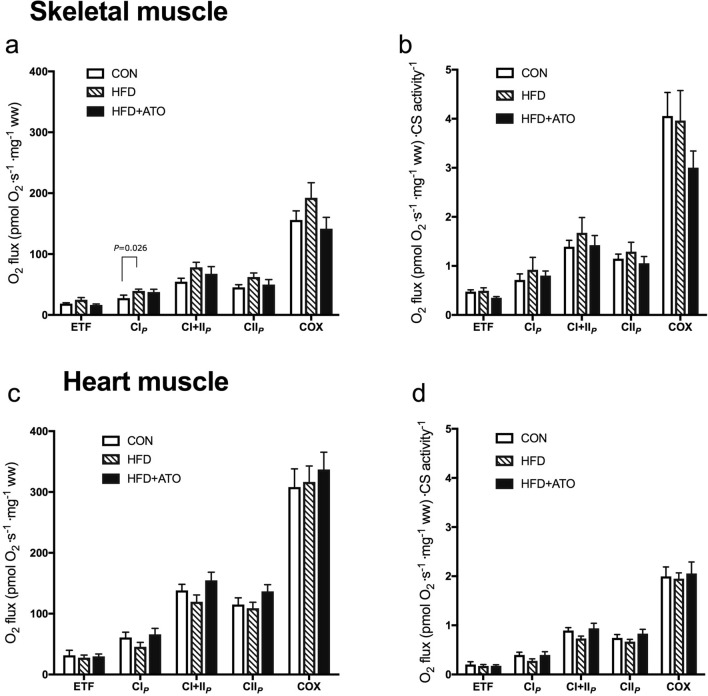
Statins lower the risk of cardiovascular events but have been associated with mitochondrial functional changes in a tissue-dependent manner. We investigated tissue-specific modifications of mitochondrial function in liver, heart and skeletal muscle mediated by chronic statin therapy in a Göttingen Minipig model. We hypothesized that statins enhance the mitochondrial function in heart but impair skeletal muscle and liver mitochondria. Mitochondrial respiratory capacities, citrate synthase activity, coenzyme Q10 concentrations and protein carbonyl content (PCC) were analyzed in samples of liver, heart and skeletal muscle from three groups of Göttingen Minipigs: a lean control group (CON, n = 6), an obese group (HFD, n = 7) and an obese group treated with atorvastatin for 28 weeks (HFD + ATO, n = 7). Atorvastatin concentrations were analyzed in each of the three tissues and in plasma from the Göttingen Minipigs. In treated minipigs, atorvastatin was detected in the liver and in plasma. A significant reduction in complex I + II-supported mitochondrial respiratory capacity was seen in liver of HFD + ATO compared to HFD (P = 0.022). Opposite directed but insignificant modifications of mitochondrial respiratory capacity were seen in heart versus skeletal muscle in HFD + ATO compared to the HFD group. In heart muscle, the HFD + ATO had significantly higher PCC compared to the HFD group (P = 0.0323). In the HFD group relative to CON, liver mitochondrial respiration decreased whereas in skeletal muscle, respiration increased but these changes were insignificant when normalizing for mitochondrial content. Oral atorvastatin treatment in Göttingen Minipigs is associated with a reduced mitochondrial respiratory capacity in the liver that may be linked to increased content of atorvastatin in this organ.
他汀类药物降低心血管事件的风险,但与组织依赖性的线粒体功能变化有关。我们在哥廷根小型猪模型中研究了慢性他汀类药物治疗引起的肝、心和骨骼肌中线粒体功能的组织特异性变化。我们假设他汀类药物增强心脏的线粒体功能,但损害骨骼肌和肝脏的线粒体。分析了来自三组哥廷根小型猪的肝、心和骨骼肌样本中的线粒体呼吸能力、柠檬酸合酶活性、辅酶 Q10 浓度和蛋白羰基含量 (PCC):一组瘦对照组 (CON,n=6)、一组肥胖组 (HFD,n=7) 和一组肥胖组用阿托伐他汀治疗 28 周 (HFD+ATO,n=7)。分析了三种组织和哥廷根小型猪血浆中的阿托伐他汀浓度。在治疗的小型猪中,在肝脏和血浆中检测到阿托伐他汀。与 HFD 相比,HFD+ATO 组的肝脏中复合物 I+II 支持的线粒体呼吸能力显著降低 (P=0.022)。在 HFD+ATO 组中,与 HFD 组相比,心与骨骼肌的线粒体呼吸能力呈现相反但无统计学意义的变化。与 HFD 组相比,HFD+ATO 组的心肌中 PCC 显著升高 (P=0.0323)。与 CON 相比,HFD 组的肝脏线粒体呼吸减少,而骨骼肌的呼吸增加,但当按线粒体含量进行归一化时,这些变化无统计学意义。口服阿托伐他汀治疗哥廷根小型猪与肝脏线粒体呼吸能力降低有关,这可能与该器官中阿托伐他汀含量增加有关。