Mantle David, Dybring Alex
Pharma Nord (UK) Ltd., Telford Court, Morpeth, Northumberland NE61 2DB, UK.
Pharma Nord (DK) ApS, Sadelmagervej 30-32, DK-7100 Vejle, Denmark.
Antioxidants (Basel). 2020 May 5;9(5):386. doi: 10.3390/antiox9050386.
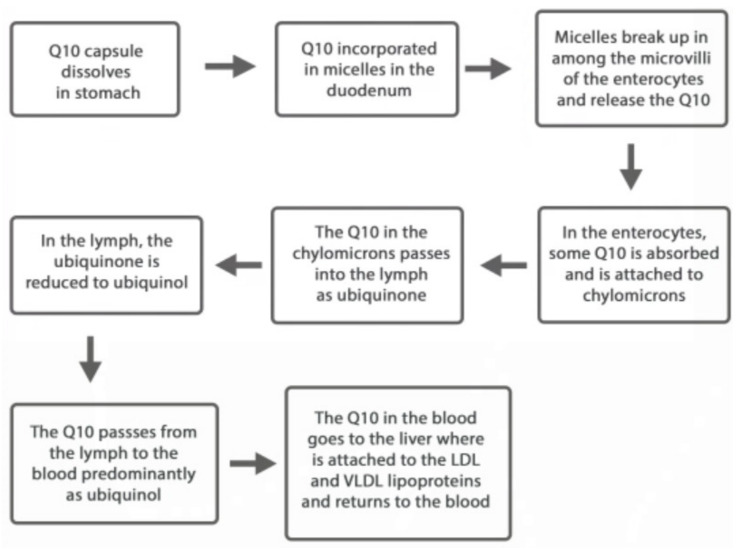
A lack of understanding of the processes determining the absorption and subsequent metabolism of coenzyme Q (CoQ) has resulted in some manufacturers' making incorrect claims regarding the bioavailability of their CoQ supplements, with potential consequences for the use of such products in clinical trials. The purpose of the present review article is, therefore, to describe the various stages of exogenous CoQ metabolism, from its first ingestion, stomach transit, absorption from the small intestine into the lymphatic system, transport in blood, and access into cells. In particular, the importance of CoQ crystal dispersion in the initial formulation is emphasised, the absence of which reduces bioavailability by 75%. In addition, evidence comparing the relative bioavailability and efficacy of ubiquinone and ubiquinol forms of CoQ has been reviewed.
由于对决定辅酶Q(CoQ)吸收及后续代谢过程缺乏了解,一些制造商对其CoQ补充剂的生物利用度做出了错误宣称,这可能会对这类产品在临床试验中的使用产生影响。因此,本综述文章的目的是描述外源性CoQ代谢的各个阶段,从首次摄入、在胃中的转运、从小肠吸收进入淋巴系统、在血液中的运输以及进入细胞。特别强调了CoQ晶体分散在初始制剂中的重要性,缺乏这一点会使生物利用度降低75%。此外,还综述了比较CoQ的泛醌形式和泛醇形式的相对生物利用度及功效的证据。