State Key Laboratory of Transducer Technology, Institute of Electronics, Chinese Academy of Sciences, Beijing, 100190, China.
University of Chinese Academy of Sciences, Beijing, 10090, China.
Commun Biol. 2021 Jan 26;4(1):121. doi: 10.1038/s42003-020-01607-8.
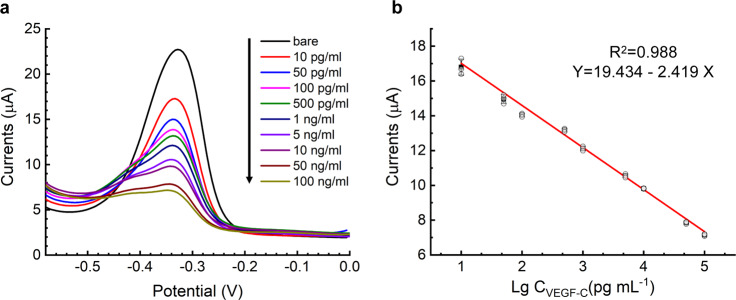
Detecting vascular endothelial growth factor C (VEGF-C), a kind of tumor biomarker, is of significant clinical importance in evaluating the prognosis of patients with cancer. However, laboratory analyses are usually not suitable for point-of-care testing because they are expensive and time consuming. In response to these challenges, we fabricated an origami paper-based microfluidic electrochemical device. To improve the specificity of VEGF-C detection, nanocomposites, synthesized by new methylene blue (NMB), amino-functional single-walled carbon nanotubes (NH-SWCNTs), and gold nanoparticles (AuNPs), were used to modify the surface of working electrodes. Results of electrochemical detection showed that the immunosensor had excellent linearity, ranging from 0.01 to 100 ng mL (R = 0.988), and the limit of detection was 10 pg mL. To confirm the high specificity of the device under real-world conditions, we evaluated the device using clinical serum samples from our hospital. The results demonstrated that the device had an excellent performance and could provide a platform for real-time detection of cancers.
检测血管内皮生长因子 C(VEGF-C)是一种肿瘤生物标志物,对于评估癌症患者的预后具有重要的临床意义。然而,由于实验室分析昂贵且耗时,通常不适合即时检测。针对这些挑战,我们制作了一种折纸纸基微流控电化学装置。为了提高 VEGF-C 检测的特异性,我们使用了由新亚甲基蓝(NMB)、氨基功能化单壁碳纳米管(NH-SWCNTs)和金纳米粒子(AuNPs)合成的纳米复合材料来修饰工作电极的表面。电化学检测结果表明,该免疫传感器具有出色的线性范围,从 0.01 到 100ng/mL(R=0.988),检测限为 10pg/mL。为了在实际条件下确认设备的高特异性,我们使用来自我们医院的临床血清样本对设备进行了评估。结果表明,该设备具有出色的性能,可以为癌症的实时检测提供平台。