Zhou Jie, Jin Xuejing, Sheng Zhumei, Zhang Zhifen
Reproductive Endocrine Center, Hangzhou Women's Hospital, Hangzhou, Zhejiang 310008, P.R. China.
Exp Ther Med. 2021 Mar;21(3):179. doi: 10.3892/etm.2021.9610. Epub 2021 Jan 5.
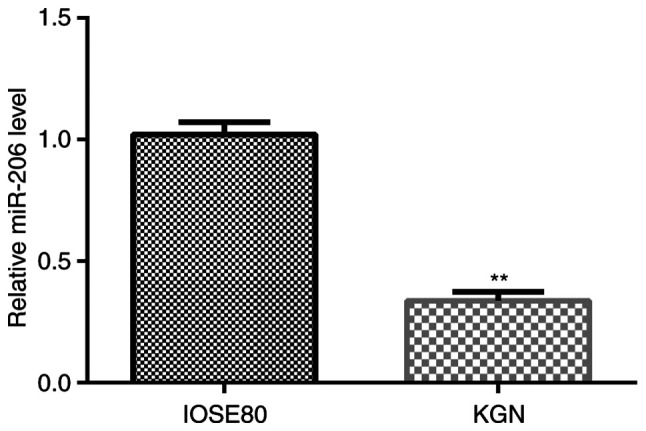
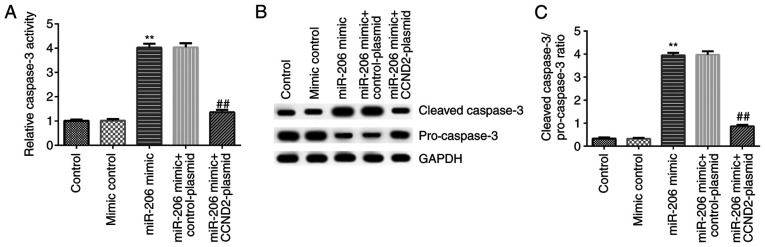
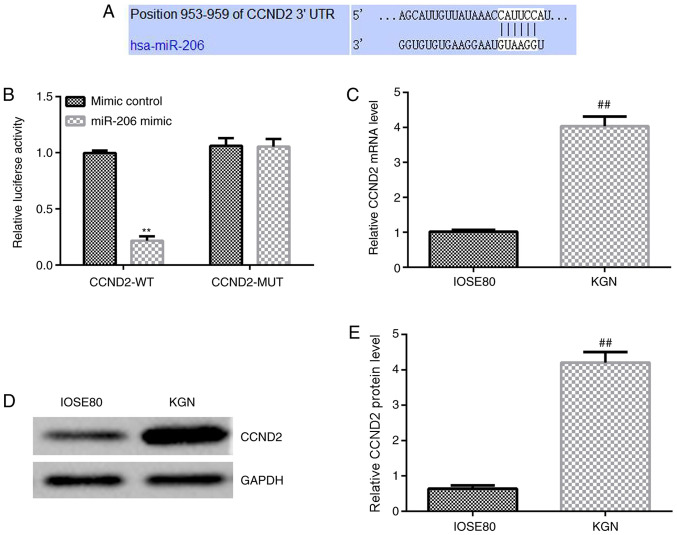
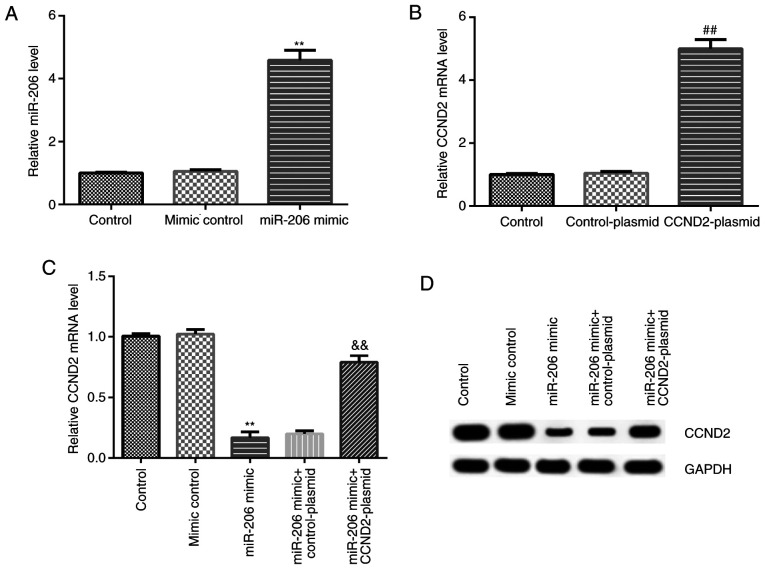
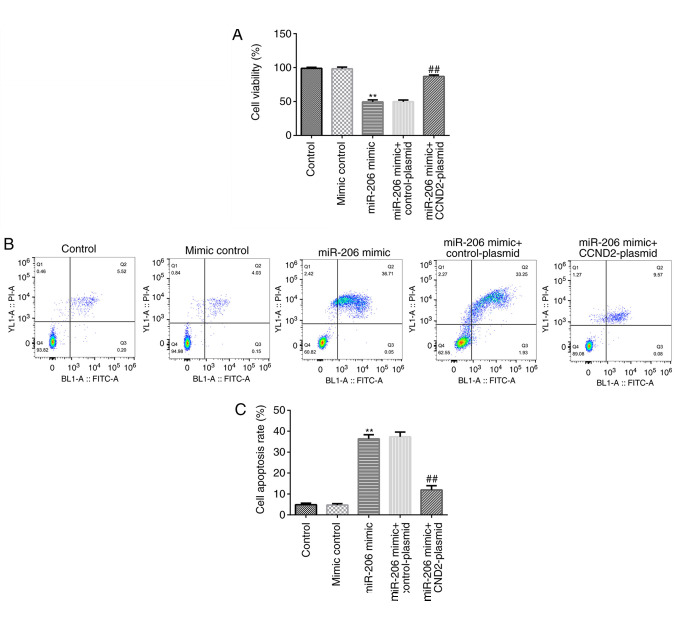
An increasing number of studies have reported that microRNAs (miRNAs) have an important role in polycystic ovary syndrome (PCOS). Downregulation of miR-206 in patients with PCOS has been found, however, its specific role remains unclear. The present study aimed to investigate the roles of miR-206 in (PCOS) and to determine the underlying molecular mechanisms. Reverse transcription-quantitative PCR (RT-qPCR) was performed to analyze the expression levels of miR-206 in normal ovarian surface epithelial IOSE80 cells and human ovarian granulosa cell-like KGN cells. TargetScan was used to predict the target gene of miR-206, which was subsequently verified using a dual-luciferase reporter gene assay. The mRNA expression levels of cyclin D2 (CCND2) and the transfection efficiencies of the miR-206 mimic and CCDN2 overexpression plasmid were determined using RT-qPCR analysis. The protein expression levels of CCND2, cleaved-caspase-3 and pro-caspase-3 were analyzed using western blotting, and an MTT assay and flow cytometric analysis were used to evaluate the cell viability and levels of apoptosis, respectively, in the cells following transfection. Finally, the activity of caspase-3 was analyzed using a caspase-3 activity assay kit. The results of the present study revealed that the expression levels of miR-206 were downregulated in KGN cells compared with IOSE80 cells. CCND2 was predicted and verified to be a direct target gene of miR-206, and the mRNA and protein expression levels of CCND2 were discovered to be upregulated in KGN cells compared with IOSE80 cells. The miR-206 mimic and CCND2 overexpression plasmid significantly upregulated the expression levels of miR-206 and CCND2, respectively, in KGN cells. The miR-206 mimic also downregulated the expression levels of CCND2 in KGN cells, while this effect was reversed following the transfection with the CCND2 overexpression plasmid. Compared with the mimic control group, the miR-206 mimic significantly decreased the cell viability, induced the levels of apoptosis, increased the activity of caspase-3, upregulated cleaved-caspase-3 protein expression levels and downregulated pro-caspase-3 protein expression levels in KGN cells following transfection; these effects were reversed following the overexpression of CCND2. In conclusion, the findings of the present study suggested that miR-206 may serve an important role in PCOS through modulating ovarian granulosa cell viability and apoptosis.
越来越多的研究报道,微小RNA(miRNA)在多囊卵巢综合征(PCOS)中发挥重要作用。已发现PCOS患者中miR-206表达下调,然而,其具体作用仍不清楚。本研究旨在探讨miR-206在PCOS中的作用,并确定其潜在的分子机制。采用逆转录定量PCR(RT-qPCR)分析miR-206在正常卵巢表面上皮IOSE80细胞和人卵巢颗粒细胞样KGN细胞中的表达水平。使用TargetScan预测miR-206的靶基因,随后通过双荧光素酶报告基因测定进行验证。采用RT-qPCR分析细胞周期蛋白D2(CCND2)的mRNA表达水平以及miR-206模拟物和CCND2过表达质粒的转染效率。采用蛋白质印迹法分析CCND2、裂解型半胱天冬酶-3和前体半胱天冬酶-3的蛋白表达水平,并分别采用MTT法和流式细胞术分析转染后细胞的活力和凋亡水平。最后,使用半胱天冬酶-3活性检测试剂盒分析半胱天冬酶-3的活性。本研究结果显示,与IOSE80细胞相比,KGN细胞中miR-206的表达水平下调。预测并验证CCND2是miR-206的直接靶基因,且与IOSE80细胞相比,KGN细胞中CCND2的mRNA和蛋白表达水平上调。miR-206模拟物和CCND过表达质粒分别显著上调了KGN细胞中miR-206和CCND2的表达水平。miR-206模拟物也下调了KGN细胞中CCND2的表达水平,而在用CCND2过表达质粒转染后这种作用被逆转。与模拟对照组相比,转染后miR-206模拟物显著降低了KGN细胞的活力,诱导了凋亡水平,增加了半胱天冬酶-3的活性,上调了裂解型半胱天冬酶-3蛋白表达水平并下调了前体半胱天冬酶-3蛋白表达水平;在CCND2过表达后这些作用被逆转。总之,本研究结果表明,miR-206可能通过调节卵巢颗粒细胞的活力和凋亡在PCOS中发挥重要作用。