Biancardi Beatrice, Mancini Maurizio, Lerner Paul, Pelachaud Catherine
CNRS-ISIR, Sorbonne University, Paris, France.
School of Computer Science and Information Technology, University College Cork, Cork, Ireland.
Front Robot AI. 2019 Sep 24;6:93. doi: 10.3389/frobt.2019.00093. eCollection 2019.
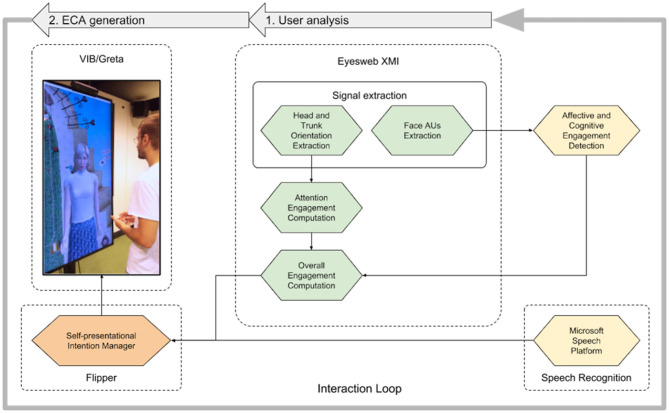
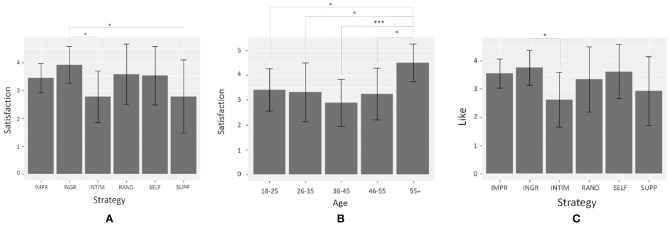
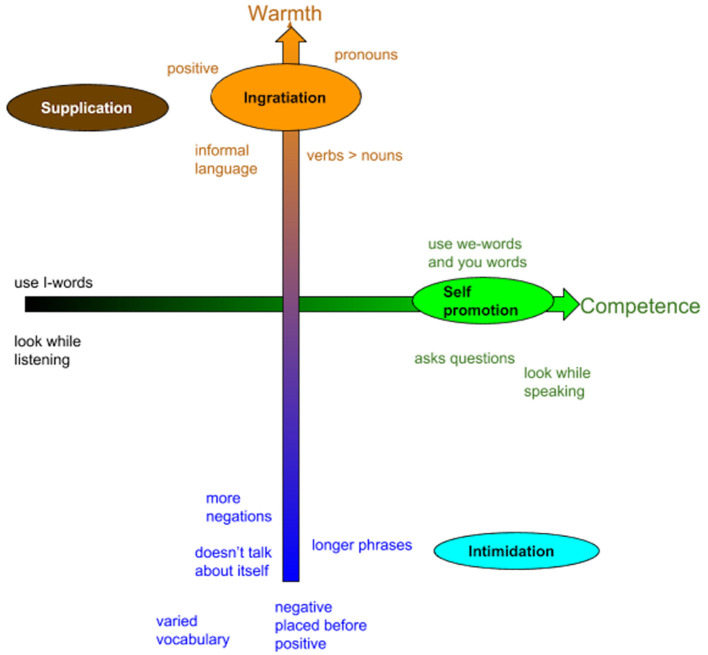
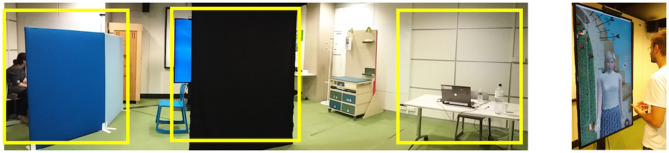
In this paper we present a computational model for managing the impressions of warmth and competence (the two fundamental dimensions of social cognition) of an Embodied Conversational Agent (ECA) while interacting with a human. The ECA can choose among four different self-presentational strategies eliciting different impressions of warmth and/or competence in the user, through its verbal and non-verbal behavior. The choice of the non-verbal behaviors displayed by the ECA relies on our previous studies. In our first study, we annotated videos of human-human natural interactions of an expert on a given topic talking to a novice, in order to find associations between the warmth and competence elicited by the expert's non-verbal behaviors (such as type of gestures, arms rest poses, smiling). In a second study, we investigated whether the most relevant non-verbal cues found in the previous study were perceived in the same way when displayed by an ECA. The computational learning model presented in this paper aims to learn in real-time the best strategy (i.e., the degree of warmth and/or competence to display) for the ECA, that is, the one which maximizes user's engagement during the interaction. We also present an evaluation study, aiming to investigate our model in a real context. In the experimental scenario, the ECA plays the role of a museum guide introducing an exposition about video games. We collected data from 75 visitors of a science museum. The ECA was displayed in human dimension on a big screen in front of the participant, with a Kinect on the top. During the interaction, the ECA could adopt one of 4 self-presentational strategies during the whole interaction, or it could select one strategy randomly for each speaking turn, or it could use a reinforcement learning algorithm to choose the strategy having the highest reward (i.e., user's engagement) after each speaking turn.
在本文中,我们提出了一种计算模型,用于在具身对话代理(ECA)与人类交互时管理其温暖感和能力感(社会认知的两个基本维度)。ECA可以通过其言语和非言语行为,在四种不同的自我呈现策略中进行选择,从而在用户中引发不同的温暖感和/或能力感。ECA所展示的非言语行为的选择依赖于我们之前的研究。在我们的第一项研究中,我们对一位专家就给定主题与新手进行的自然人际互动视频进行了标注,以便找出专家的非言语行为(如手势类型、手臂休息姿势、微笑)所引发的温暖感和能力感之间的关联。在第二项研究中,我们调查了在第一项研究中发现的最相关的非言语线索由ECA展示时,是否会被以相同的方式感知。本文提出的计算学习模型旨在实时学习ECA的最佳策略(即展示的温暖程度和/或能力程度),也就是在互动过程中能使用户参与度最大化的策略。我们还进行了一项评估研究,旨在在实际情境中研究我们的模型。在实验场景中,ECA扮演博物馆导游的角色,介绍一场关于电子游戏的展览。我们从一家科学博物馆的75名参观者那里收集了数据。ECA以人体尺寸显示在参与者面前的大屏幕上,顶部有一个Kinect。在互动过程中,ECA可以在整个互动过程中采用4种自我呈现策略之一,或者在每个说话轮次随机选择一种策略,或者使用强化学习算法在每个说话轮次后选择具有最高奖励(即用户参与度)的策略。