Department of Health Policy and Management, Johns Hopkins Bloomberg School of Public Health, Baltimore, Maryland.
Department of Internal Medicine, Yale University School of Medicine, New Haven, Connecticut.
JAMA Netw Open. 2021 Jan 4;4(1):e2034890. doi: 10.1001/jamanetworkopen.2020.34890.
Prior research suggests an association between burden of disease and National Institutes of Health (NIH) funding. The allocation of NIH funding should reflect, to some extent, the health needs of the population, along with other factors.
To examine the factors associated with NIH funding in 2019 for 46 diseases.
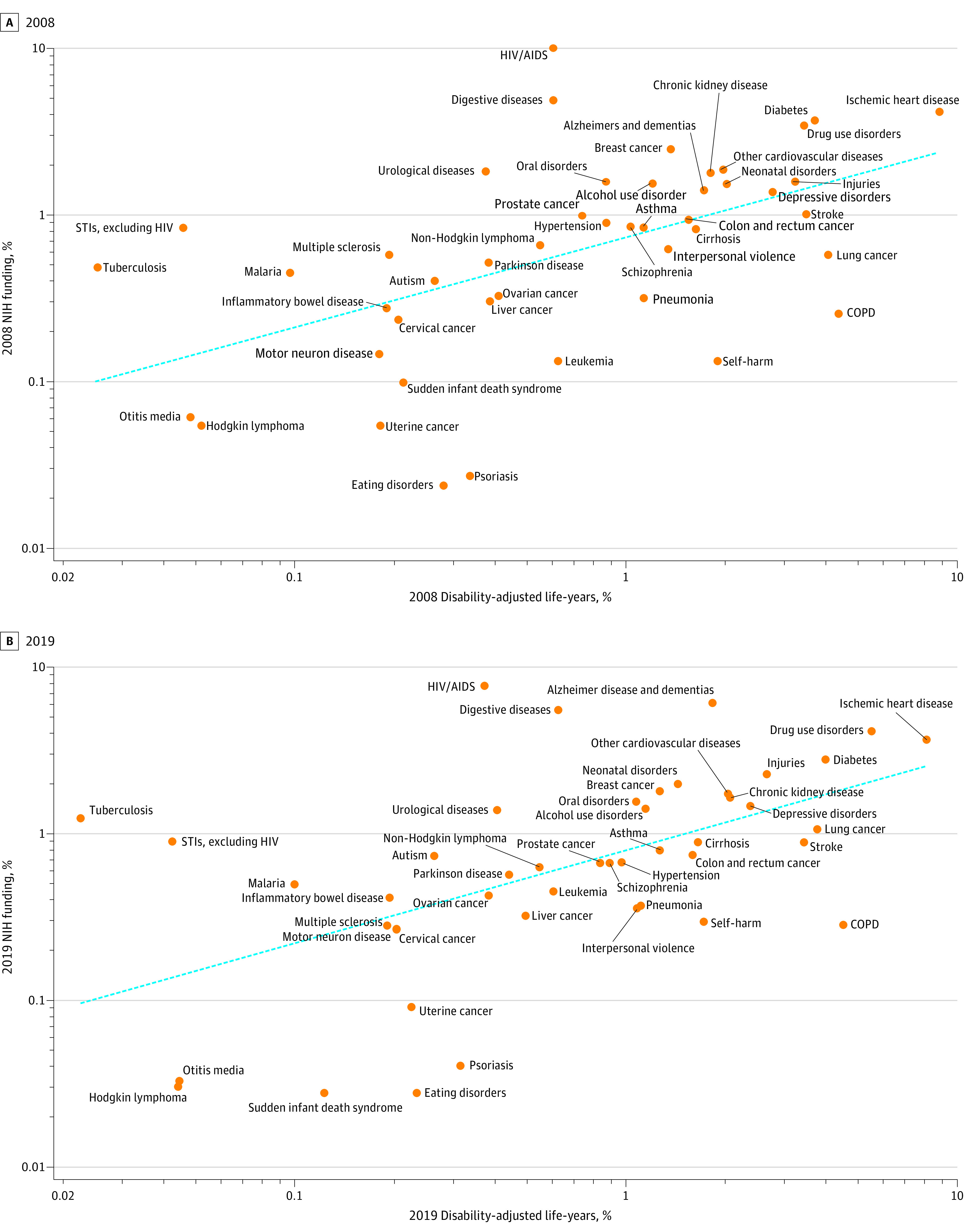
DESIGN, SETTING, AND PARTICIPANTS: This cohort study used disability-adjusted life-years to measure the 2008 and 2019 US burden of disease and compared them with NIH categoric funding for 46 diseases.
Disability-adjusted life-years to measure the 2008 and 2019 US burden of disease, 2016 health spending, and 2008 NIH funding levels for 46 diseases.
2019 NIH funding levels for 46 diseases.
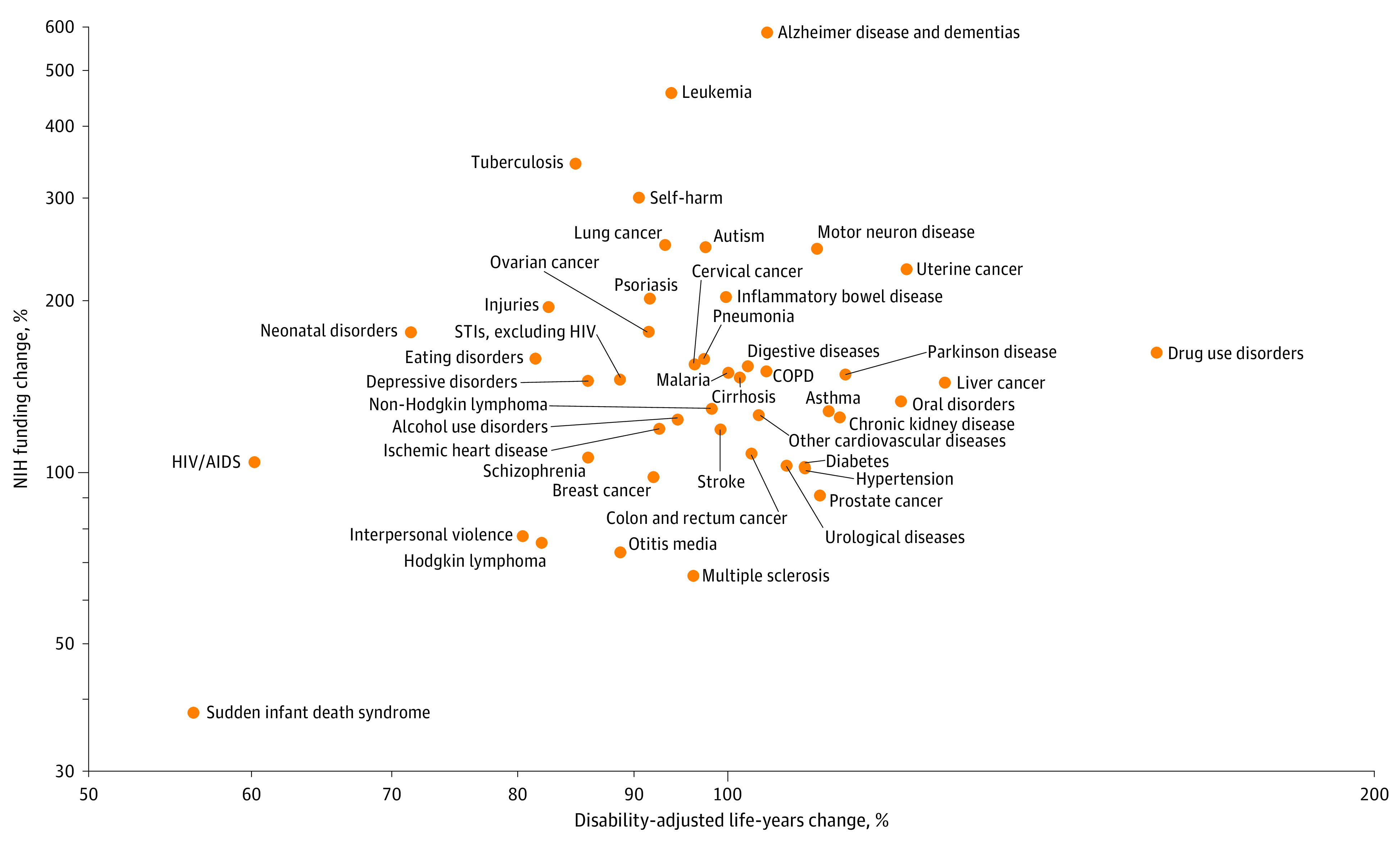
The 46 diseases accounted for 62 392 713 of 94 399 784 disability-adjusted life-years (66.1%) in 2008 and 75 706 718 of 111 074 472 disability-adjusted life-years (68.2%) in 2019, representing more than 66% of all disability-adjusted life-years in both years. By dollar volume, Alzheimer and dementia increased the most, with approximately $1.8 billion more funding in 2019 than 2008 (from $530 million in 2008 to $2398 million in 2019, a 352% increase), whereas interpersonal violence had the greatest decrease, $95 million, in 2019 NIH funding (from $236 million in 2008 to $141 million in 2019, a 40% decrease). For the 46 diseases in this study, the variable with the greatest association with NIH funding in 2019 was the level of NIH funding in 2008, with a simple correlation of 0.88. Burden of disease and changes in burden of disease were not statistically significantly associated with NIH funding levels once the prior level of funding was included in the model. The models suggested that a 1% higher level of NIH funding in 2008 was associated with a 0.91% higher level of NIH funding in 2019.
In this study, NIH spending for most diseases seemed to be based primarily on the level of NIH spending more than 10 years earlier, despite changes in burden of disease. Congress and the NIH should examine the allocation process to ensure NIH investments are responsive to changes in the health of the population.
先前的研究表明,疾病负担与美国国立卫生研究院(NIH)的资金之间存在关联。NIH 资金的分配应在一定程度上反映人口的健康需求,以及其他因素。
研究与 2019 年 46 种疾病 NIH 资助相关的因素。
设计、地点和参与者:本队列研究使用残疾调整生命年来衡量 2008 年和 2019 年美国的疾病负担,并将其与 46 种疾病的 NIH 分类资助进行比较。
残疾调整生命年来衡量 2008 年和 2019 年美国的疾病负担、2016 年卫生支出以及 46 种疾病 2008 年 NIH 资助水平。
2019 年 46 种疾病的 NIH 资助水平。
在 2008 年,这 46 种疾病占 94399784 个残疾调整生命年的 62392713 个(66.1%),而在 2019 年,这 46 种疾病占 111074472 个残疾调整生命年的 75706718 个(68.2%),占这两年所有残疾调整生命年的比例均超过 66%。就美元金额而言,阿尔茨海默病和痴呆症的增幅最大,2019 年的资金比 2008 年增加了约 18 亿美元(从 2008 年的 5.3 亿美元增至 2019 年的 23.98 亿美元,增幅为 352%),而人际暴力的 NIH 资金则减少了最多,为 9500 万美元(从 2008 年的 2.36 亿美元降至 2019 年的 1.41 亿美元,降幅为 40%)。在这项研究的 46 种疾病中,与 2019 年 NIH 资助关系最密切的变量是 2008 年 NIH 资助的水平,其简单相关性为 0.88。疾病负担和疾病负担的变化与 NIH 资助水平没有统计学上的显著关联,一旦将之前的资助水平纳入模型。这些模型表明,2008 年 NIH 资助水平每增加 1%,2019 年 NIH 资助水平就会相应增加 0.91%。
在这项研究中,尽管疾病负担发生了变化,但大多数疾病的 NIH 支出似乎主要基于 10 多年前 NIH 支出的水平。国会和 NIH 应该审查拨款程序,以确保 NIH 的投资能够对人口健康的变化做出反应。