Berglas Eli, Musheyev David, Lavi Aaron B, Berglas Rachel S, Berglas Rachel, Kabarriti Abdo E
Department of Urology, State University of New York Downstate Health Sciences University, New York City, USA.
Albert Einstein College of Medicine, Bronx, NY, USA.
Lancet Reg Health Am. 2025 Apr 2;45:101081. doi: 10.1016/j.lana.2025.101081. eCollection 2025 May.
Disease burden has been used to predict National Institutes of Health (NIH) funding but included diseases with little underlying relationship. Here we focus on cancers to create a more appropriate model to allow for more targeted scrutinization of funding allocation.
An ecological study using NIH funding data (2008-2023) was performed. Inclusion of cancers was based on their presence in the NIH Research Portfolio Online Reporting Tool and the 2021 Global Burden of Disease (GBD) study. Disability-adjusted life years (DALY) were collected and to evaluate the impact of public interest, Google Trends data was used. Multivariable linear regression determined appropriate funding based on disease burden and public interest. To quantify how each cancer's funding differed from model predictions residual values were used to calculate the percent over/under funding.
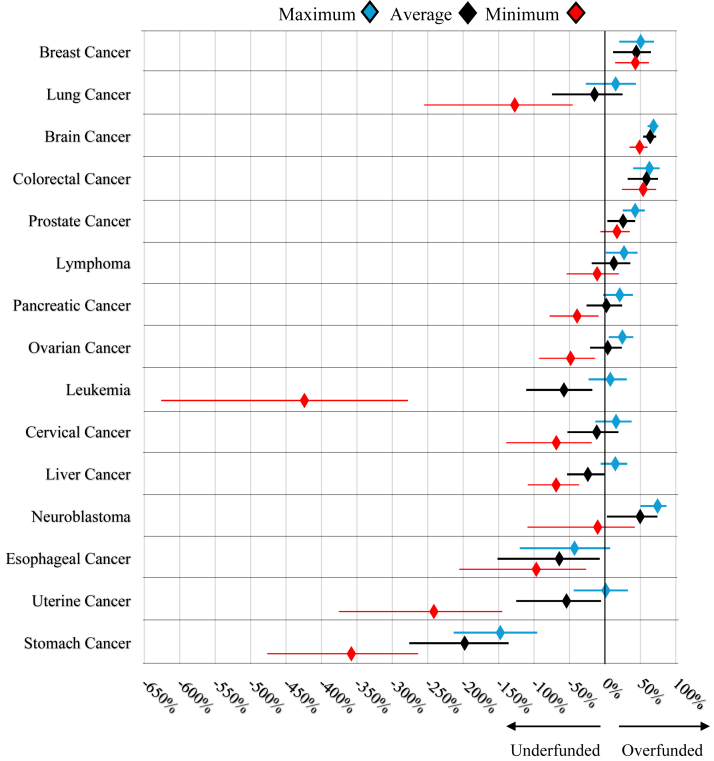
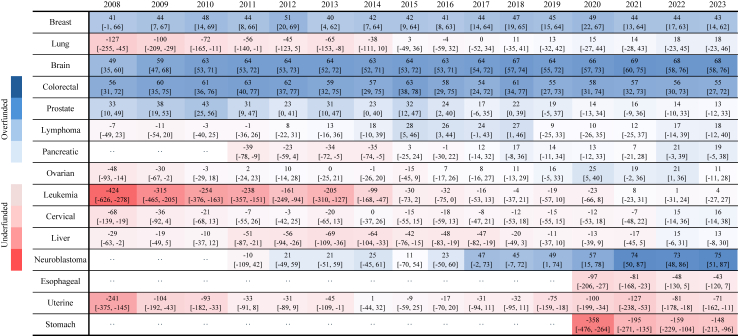
Fifteen cancers met inclusion criteria. Neuroblastoma had the greatest ratio of funding to DALYs per 100,000 people (US$14,000,000) while lung cancer had the lowest (US$300,000). Stomach cancer was the most underfunded (197.9% [95% CI: 136.0%, 276.2%]) while brain cancer was the most overfunded (64.1% [95% CI: 53.8%, 72.1%]). Even at their lowest funding values in the study period brain, breast, and colorectal cancer all had greater than 40% overfunding. Contrarily, the lowest annual funding for leukemia, uterine, and stomach cancer received less than 150% of expected funding. Despite its overfunding brain cancer had an increase in DALYs in the study period.
Modeling by disease category demonstrated disparities in funding indicating the need for reevaluation for possible funding inequities. The year-by-year approach taken in this study will drive the ability for future research to better understand NIH funding decisions. Additionally, the role of public interest in research funding needs to be further evaluated to ensure that popularity does not override disease burden, in funding decisions.
No Funding.
疾病负担已被用于预测美国国立卫生研究院(NIH)的资金分配,但其中包括一些几乎没有内在关联的疾病。在此,我们聚焦于癌症,以创建一个更合适的模型,以便对资金分配进行更有针对性的审查。
利用NIH资金数据(2008 - 2023年)进行了一项生态学研究。癌症的纳入基于其在NIH研究项目在线报告工具以及2021年全球疾病负担(GBD)研究中的存在情况。收集了伤残调整生命年(DALY),并使用谷歌趋势数据来评估公众关注度的影响。多变量线性回归根据疾病负担和公众关注度确定适当的资金分配。为了量化每种癌症的资金与模型预测值的差异,使用残差值来计算资金超支/不足的百分比。
15种癌症符合纳入标准。神经母细胞瘤每10万人的资金与DALY之比最高(1400万美元),而肺癌最低(30万美元)。胃癌资金缺口最大(197.9% [95%置信区间:136.0%,276.2%]),而脑癌资金超支最多(64.1% [95%置信区间:53.8%,72.1%])。即使在研究期间处于最低资金水平,脑癌、乳腺癌和结直肠癌的资金超支也都超过40%。相反,白血病、子宫癌和胃癌的年度最低资金不到预期资金的150%。尽管脑癌资金超支,但在研究期间其DALY有所增加。
按疾病类别进行建模显示了资金分配的差异,表明需要重新评估是否存在资金分配不公平的情况。本研究采用的逐年分析方法将推动未来研究更好地理解NIH资金分配决策的能力。此外,需要进一步评估公众关注度在研究资金分配中的作用,以确保在资金分配决策中,受欢迎程度不会凌驾于疾病负担之上。
无资金支持。