Department of Rheumatology, George Washington University, School of Medicine and Health Sciences, 2300 M street, NW, Washington, DC, 20037, USA.
Rheumatol Int. 2021 Mar;41(3):503-508. doi: 10.1007/s00296-020-04769-0. Epub 2021 Jan 27.
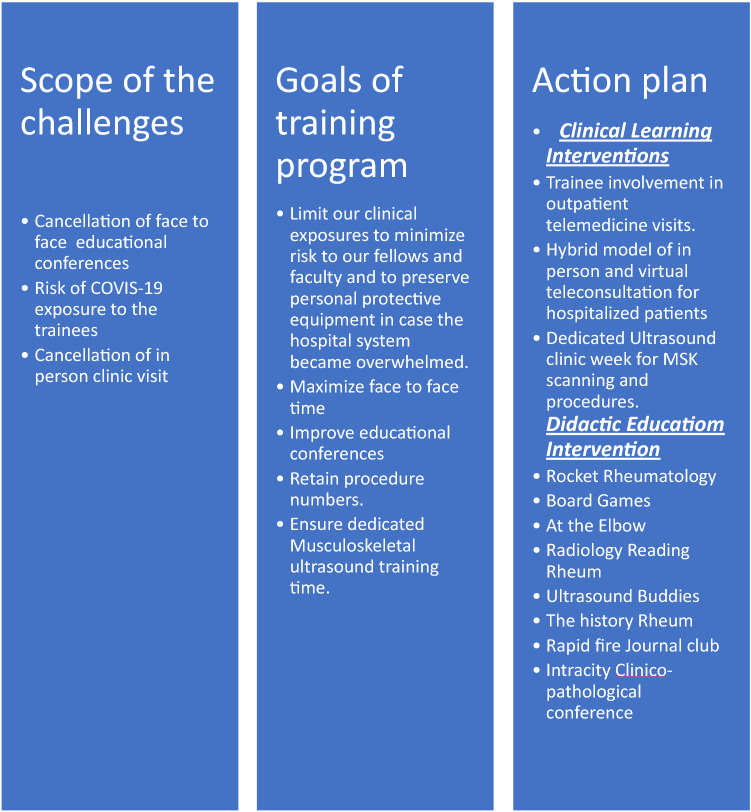
During the COVID-19 pandemic, rheumatology educational programs around the world, face the daunting challenge of maintaining education for their trainees. Reduced in-person clinic exposures and social distancing requirements have significantly affected trainee education. Similar to programs around the USA, in early March 2020, our program was faced with an urgent need to pivot both our clinical and educational programs to virtual platforms. Within these limitations, we harnessed innovative educational models and restructured our curriculum to ensure adequate clinical and didactic exposure. We divided trainee's clinical rotations into four blocks, which include Inpatient consult service, Outpatient in-person and procedure clinics, Telehealth Clinics and Research/Elective week. By assigning specific rotations, we were able to ensure fellows were seeing adequate numbers of patients both through telemedicine and inperson while ensuring we complied with social distancing requirements. We further were able to ensure that trainee hands-on procedure training was not compromised. Acknowledging challenges presented by the COVID-19 pandemic and learner engagement in virtual environment, we designed an innovative educational portfolio. Utilizing synchronous and asynchronous learning methods, we have developed multiple complementary educational initiatives including: Rocket Rheumatology, Board Games, At the Elbow, Radiology Reading Rheum, Ultrasound Buddies, The History Rheum, and Rapid-Fire Journal Club. Virtual learning methods will become a cornerstone of medical education moving forwards. The GW Division of Rheumatology has rapidly incorporated innovative educational tools into our curriculum. Our approach will help Rheumatology training programs across the globe enhance rheumatology training.
在 COVID-19 大流行期间,世界各地的风湿病学教育项目面临着为学员维持教育的艰巨挑战。减少面对面的临床接触和保持社交距离的要求对学员教育产生了重大影响。与美国各地的项目类似,在 2020 年 3 月初,我们的项目面临着一个紧迫的需求,即将我们的临床和教育项目迅速转移到虚拟平台上。在这些限制下,我们利用创新的教育模式和重新构建课程,以确保有足够的临床和理论接触。我们将学员的临床轮转分为四个部分,包括住院咨询服务、门诊面对面和操作诊所、远程医疗诊所和研究/选修周。通过指定特定的轮转,我们能够确保学员通过远程医疗和面对面的方式看到足够数量的患者,同时确保我们遵守保持社交距离的要求。我们还能够确保学员的实践操作培训不受影响。认识到 COVID-19 大流行带来的挑战和学习者在虚拟环境中的参与,我们设计了一个创新的教育组合。利用同步和异步学习方法,我们开发了多个互补的教育计划,包括:火箭风湿病学、棋盘游戏、肘部、放射科阅读风湿病学、超声伙伴、风湿病学历史和快速射击期刊俱乐部。虚拟学习方法将成为医学教育向前发展的基石。GW 风湿病学分部已迅速将创新的教育工具纳入我们的课程。我们的方法将帮助全球的风湿病学培训项目加强风湿病学培训。