Division of Toxicology, Wageningen University and Research, Stippeneng 4, 6708 WE Wageningen, The Netherlands.
PamGene International B.V., P.O. Box 1345, 5200 BJ 's-Hertogenbosch, The Netherlands.
Int J Mol Sci. 2021 Jan 25;22(3):1180. doi: 10.3390/ijms22031180.
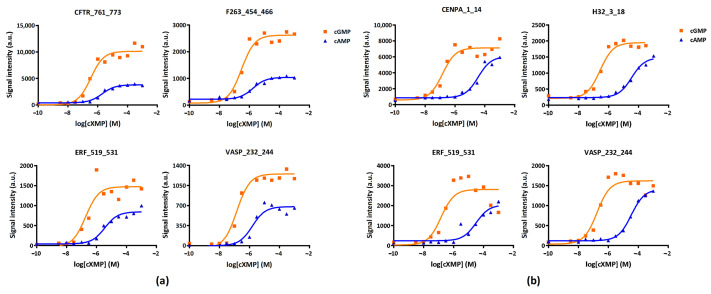
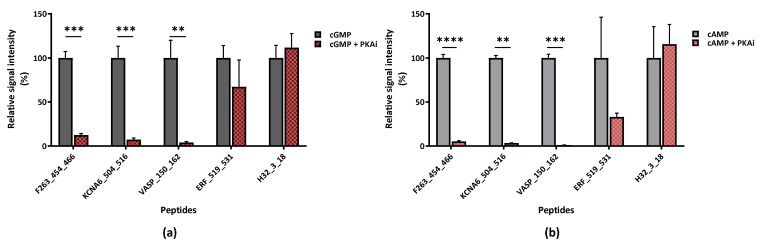
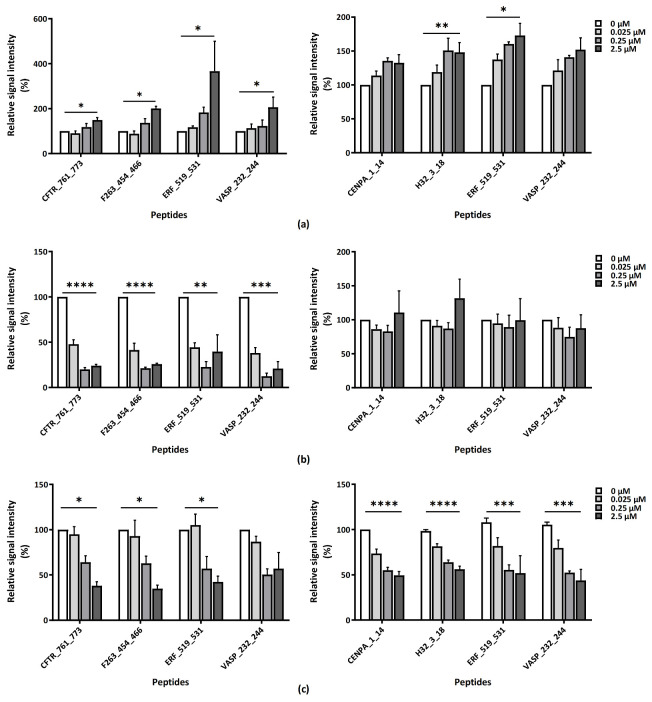
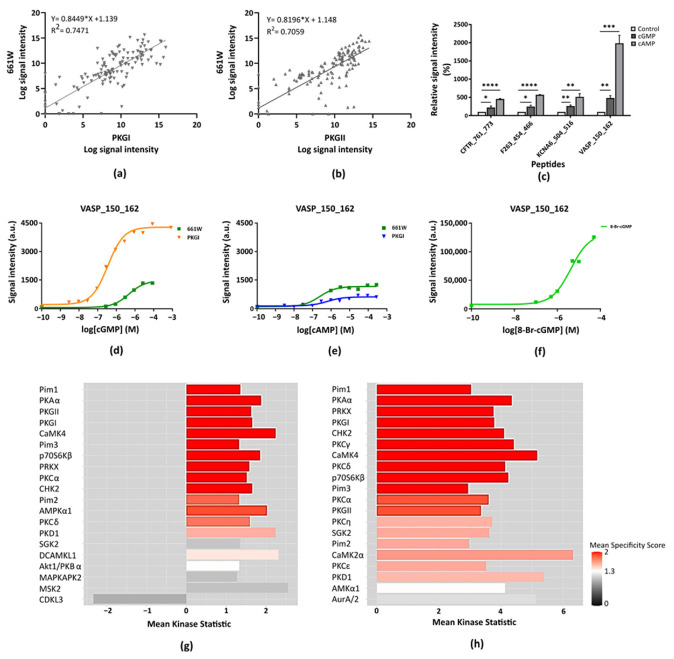
Inherited retinal degenerative diseases (IRDs), which ultimately lead to photoreceptor cell death, are characterized by high genetic heterogeneity. Many IRD-associated genetic defects affect 3',5'-cyclic guanosine monophosphate (cGMP) levels. cGMP-dependent protein kinases (PKGI and PKGII) have emerged as novel targets, and their inhibition has shown functional protection in IRDs. The development of such novel neuroprotective compounds warrants a better understanding of the pathways downstream of PKGs that lead to photoreceptor degeneration. Here, we used human recombinant PKGs in combination with PKG activity modulators (cGMP, 3',5'-cyclic adenosine monophosphate (cAMP), PKG activator, and PKG inhibitors) on a multiplex peptide microarray to identify substrates for PKGI and PKGII. In addition, we applied this technology in combination with PKG modulators to monitor kinase activity in a complex cell system, i.e. the retinal cell line 661W, which is used as a model system for IRDs. The high-throughput method allowed quick identification of substrates for PKGI and PKGII. The response to PKG modulators helped us to identify, in addition to ten known substrates, about 50 novel substrates for PKGI and/or PKGII which are either specific for one enzyme or common to both. Interestingly, both PKGs are able to phosphorylate the regulatory subunit of PKA, whereas only PKGII can phosphorylate the catalytic subunit of PKA. In 661W cells, the results suggest that PKG activators cause minor activation of PKG, but a prominent increase in the activity of cAMP-dependent protein kinase (PKA). However, the literature suggests an important role for PKG in IRDs. This conflicting information could be reconciled by cross-talk between PKG and PKA in the retinal cells. This must be explored further to elucidate the role of PKGs in IRDs.
遗传性视网膜退行性疾病(IRDs)最终导致光感受器细胞死亡,其特征是遗传异质性高。许多与 IRD 相关的遗传缺陷会影响 3',5'-环鸟苷酸(cGMP)水平。cGMP 依赖性蛋白激酶(PKGI 和 PKGII)已成为新的靶标,其抑制作用已在 IRDs 中显示出功能保护作用。因此,开发这种新型神经保护化合物需要更好地了解 PKG 下游导致光感受器变性的途径。在这里,我们使用人重组 PKG 与 PKG 活性调节剂(cGMP、3',5'-环腺苷酸(cAMP)、PKG 激活剂和 PKG 抑制剂)一起在多通道肽微阵列上鉴定 PKGI 和 PKGII 的底物。此外,我们将该技术与 PKG 调节剂结合应用于复杂细胞系统(即用于 IRD 模型系统的视网膜细胞系 661W)中的激酶活性监测。高通量方法可快速鉴定 PKGI 和 PKGII 的底物。对 PKG 调节剂的反应帮助我们鉴定了除十个已知底物外,约 50 个新的 PKGI 和/或 PKGII 底物,这些底物要么对一种酶特异,要么对两种酶都通用。有趣的是,两种 PKG 都能够磷酸化 PKA 的调节亚基,而只有 PKGII 能够磷酸化 PKA 的催化亚基。在 661W 细胞中,结果表明 PKG 激活剂会导致 PKG 轻微激活,但 cAMP 依赖性蛋白激酶(PKA)的活性显著增加。然而,文献表明 PKG 在 IRDs 中具有重要作用。这种矛盾的信息可以通过视网膜细胞中 PKG 和 PKA 之间的串扰来调和。这需要进一步探索,以阐明 PKG 在 IRDs 中的作用。