Department of Neurosurgery, Massachusetts General Hospital, Harvard Medical School, Boston, MA, USA.
Brain and Cognitive Sciences, Massachusetts Institute of Technology, Boston, MA, USA.
Nature. 2021 Mar;591(7851):610-614. doi: 10.1038/s41586-021-03184-0. Epub 2021 Jan 27.
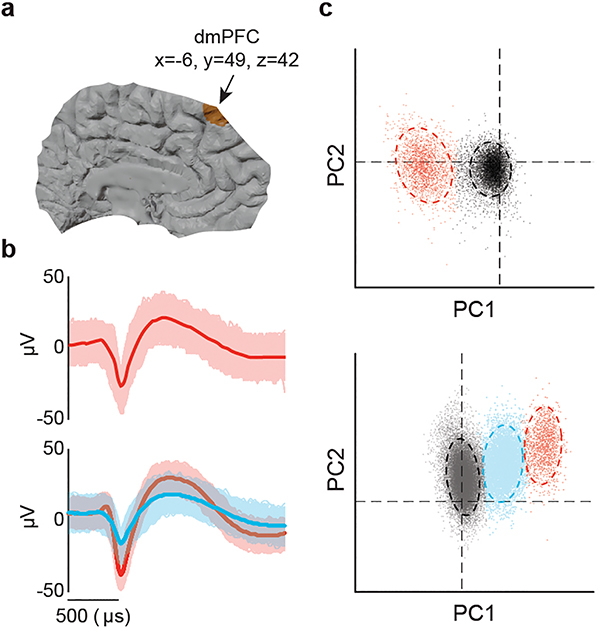
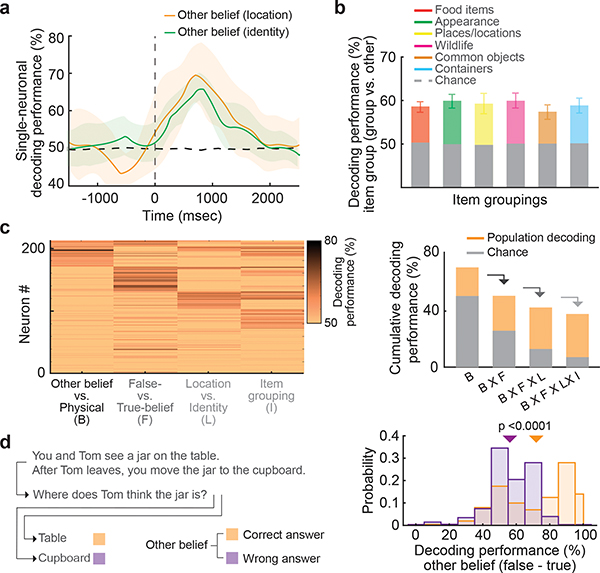
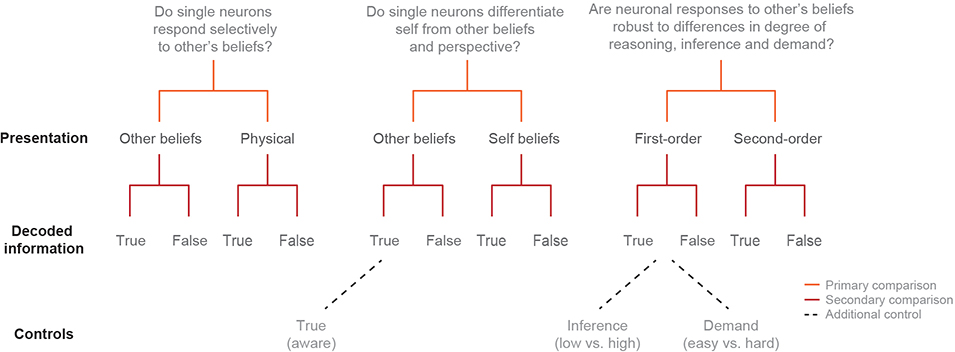
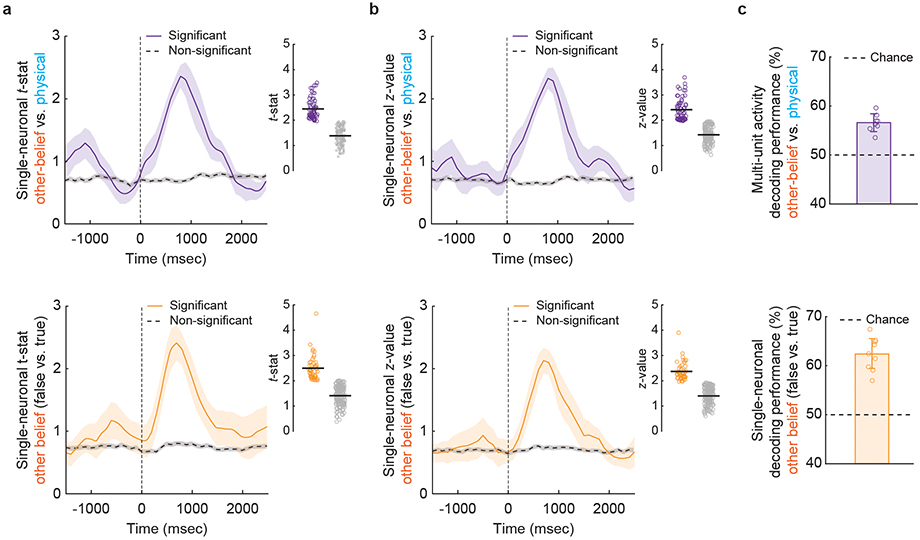
Human social behaviour crucially depends on our ability to reason about others. This capacity for theory of mind has a vital role in social cognition because it enables us not only to form a detailed understanding of the hidden thoughts and beliefs of other individuals but also to understand that they may differ from our own. Although a number of areas in the human brain have been linked to social reasoning and its disruption across a variety of psychosocial disorders, the basic cellular mechanisms that underlie human theory of mind remain undefined. Here, using recordings from single cells in the human dorsomedial prefrontal cortex, we identify neurons that reliably encode information about others' beliefs across richly varying scenarios and that distinguish self- from other-belief-related representations. By further following their encoding dynamics, we show how these cells represent the contents of the others' beliefs and accurately predict whether they are true or false. We also show how they track inferred beliefs from another's specific perspective and how their activities relate to behavioural performance. Together, these findings reveal a detailed cellular process in the human dorsomedial prefrontal cortex for representing another's beliefs and identify candidate neurons that could support theory of mind.
人类的社会行为在很大程度上取决于我们对他人进行推理的能力。这种心理理论能力在社会认知中起着至关重要的作用,因为它不仅使我们能够形成对他人隐藏的思想和信念的详细理解,还能理解他们的想法可能与我们自己的想法不同。尽管人类大脑的许多区域与社会推理及其在各种心理社会障碍中的破坏有关,但支持人类心理理论的基本细胞机制仍未定义。在这里,我们使用人类背内侧前额叶皮层的单细胞记录来识别可靠地编码关于他人信念的信息的神经元,这些信息在丰富多样的场景中是一致的,并且可以区分自我和他人相关的代表。通过进一步跟踪它们的编码动态,我们展示了这些细胞如何表示他人信念的内容,并准确预测它们是真还是假。我们还展示了它们如何从另一个人的特定角度追踪推断出的信念,以及它们的活动如何与行为表现相关。总之,这些发现揭示了人类背内侧前额叶皮层中代表他人信念的详细细胞过程,并确定了可能支持心理理论的候选神经元。