Division of Gastroenterology, Union Hospital, Tongji Medical College, Huazhong University of Science and Technology, Wuhan 430022, Hubei Province, China.
World J Gastroenterol. 2021 Jan 7;27(1):69-79. doi: 10.3748/wjg.v27.i1.69.
Endoscopic ultrasound-guided celiac plexus neurolysis (EUS-CPN) has gained popularity as a minimally invasive approach and is currently widely used to treat pancreatic cancer-associated pain. However, response to treatment is variable.
To identify the efficacy of EUS-CPN and explore determinants of pain response in EUS-CPN for pancreatic cancer-associated pain.
A retrospective study of 58 patients with abdominal pain due to inoperable pancreatic cancer who underwent EUS-CPN were included. The efficacy for palliation of pain was evaluated based on the visual analog scale pain score at 1 wk and 4 wk after EUS-CPN. Univariable and multivariable logistic regression analyses were performed to explore predictors of pain response.
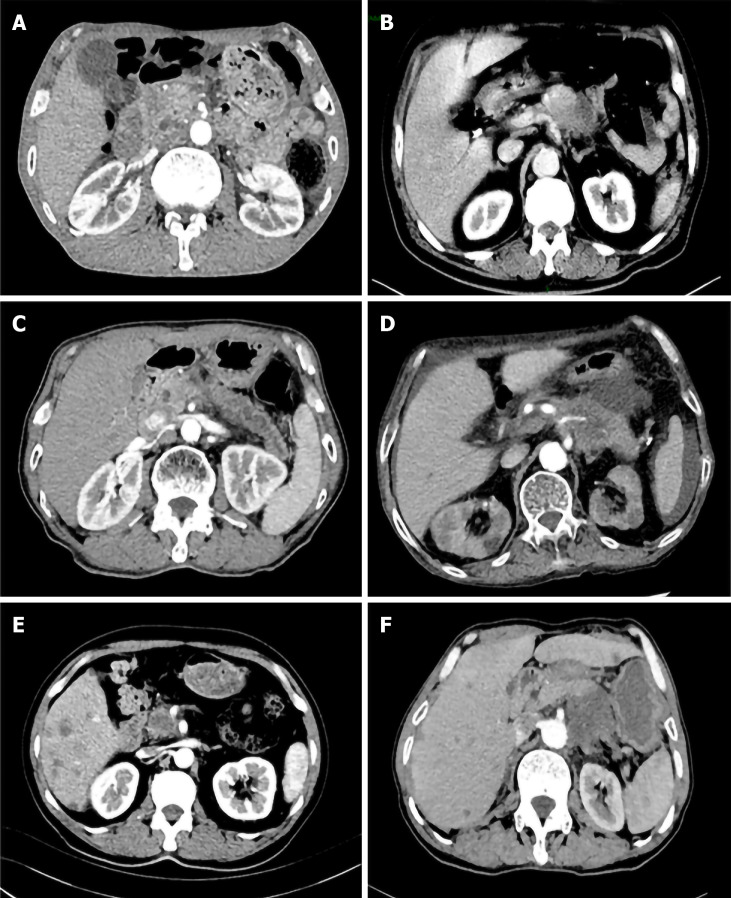
A good pain response was obtained in 74.1% and 67.2% of patients at 1 wk and 4 wk, respectively. Tumors located in the body/tail of the pancreas and patients receiving bilateral treatment were weakly associated with a good outcome. Multivariate analysis revealed patients with invisible ganglia and metastatic disease were significant factors for a negative response to EUS-CPN at 1 wk and 4 wk, respectively, particularly for invasion of the celiac plexus (odds ratio (OR) = 13.20, = 0.003 for 1 wk and OR = 15.11, = 0.001 for 4 wk). No severe adverse events were reported.
EUS-CPN is a safe and effective form of treatment for intractable pancreatic cancer-associated pain. Invisible ganglia, distant metastasis, and invasion of the celiac plexus were predictors of less effective response in EUS-CPN for pancreatic cancer-related pain. For these patients, efficacy warrants attention.
内镜超声引导腹腔神经丛松解术(EUS-CPN)作为一种微创方法已经得到普及,目前广泛用于治疗胰腺癌相关疼痛。然而,治疗反应是可变的。
确定 EUS-CPN 的疗效,并探讨影响 EUS-CPN 治疗胰腺癌相关疼痛反应的因素。
回顾性分析了 58 例因无法手术的胰腺癌导致腹痛而行 EUS-CPN 的患者。根据 EUS-CPN 后 1 周和 4 周的视觉模拟评分(VAS)评估疼痛缓解的疗效。采用单变量和多变量逻辑回归分析探讨疼痛反应的预测因素。
分别有 74.1%和 67.2%的患者在 1 周和 4 周时获得了良好的疼痛缓解。肿瘤位于胰体/尾部和接受双侧治疗的患者与良好的结局相关。多变量分析显示,不可见神经节和转移性疾病的患者在 EUS-CPN 后 1 周和 4 周时分别是负面反应的显著因素,特别是对腹腔神经丛的侵犯(优势比(OR)= 13.20, = 0.003 对于 1 周,OR = 15.11, = 0.001 对于 4 周)。未报告严重不良事件。
EUS-CPN 是治疗难治性胰腺癌相关疼痛的一种安全有效的方法。不可见神经节、远处转移和腹腔神经丛侵犯是 EUS-CPN 治疗胰腺癌相关疼痛反应效果不佳的预测因素。对于这些患者,疗效需要引起关注。