Department of Endoscopy, National Institute of Medical Sciences and Nutrition Salvador Zubiran, México City, México.
Department of Gastroenterology, National Institute of Medical Sciences and Nutrition Salvador Zubiran, México City, México.
Endosc Ultrasound. 2013 Jul;2(3):153-6. doi: 10.7178/eus.06.007.
The objective of this study is to compare the efficacy of central (single) vs bilateral (2-injections) endoscopic ultrasound (EUS)-celiac plexus neurolysis (CPN) for palliation of patients with pain related to pancreatic cancer.
Patients with unresectable pancreatic cancer were included. Central EUS CPN was used in the first group and bilateral EUS CPN in the second. The measurement of pain was made with a visual analog pain scale (VAPS) applied before and after the procedure. Follow-up was made at weeks 2 and 4 after the procedure. The use of morphine before and after EUS CPN was evaluated. Complications related to the procedure were recorded.
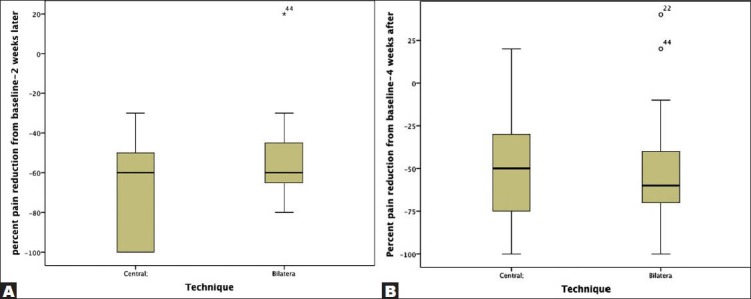
A total of 53 patients underwent EUS CPN, 21 (39.6%) with the central technique and 32 (60.4%) with bilateral injection; 29 were women (54.7%) and the median age was 59 (30-85) years. The tumor was located in the head of the pancreas in 24 (45.3%) patients, the neck in 14 (26.4%), the body in 26 (49.1%) and in the tail of the pancreas in 8 (15.1%). Nearly, 14 (26.4%) patients had more than one pancreatic segment involved. There was no difference in the median (range) percent pain reduction from baseline-4 weeks later was 50% (0-100) vs 60% (0-100), for central and bilateral techniques, respectively; P = 0.18. In total, 60.4% of patients had a reduction of 50% punctuation in the VAPS. No major complications were detected.
EUS CPN is useful for the management of pain in patients with unresectable pancreatic cancer, but there is no significant difference between central vs bilateral techniques.
本研究旨在比较内镜超声(EUS)腹腔神经丛阻滞(CPN)的中心(单针)与双侧(2 针)技术在缓解胰腺癌相关疼痛患者中的疗效。
纳入无法切除的胰腺癌患者。第一组采用中心 EUS CPN,第二组采用双侧 EUS CPN。在操作前后使用视觉模拟疼痛量表(VAPS)测量疼痛程度。在操作后 2 周和 4 周进行随访。评估 EUS CPN 前后吗啡的使用情况。记录与操作相关的并发症。
共有 53 例患者接受了 EUS CPN,其中 21 例(39.6%)采用中心技术,32 例(60.4%)采用双侧注射技术;29 例为女性(54.7%),中位年龄为 59 岁(30-85 岁)。肿瘤位于胰头部 24 例(45.3%)、颈部 14 例(26.4%)、体部 26 例(49.1%)和胰尾部 8 例(15.1%)。近 14 例(26.4%)患者有多个胰段受累。从基线到 4 周后疼痛缓解的中位数(范围)百分比,中心技术组和双侧技术组分别为 50%(0-100)和 60%(0-100),差异无统计学意义(P = 0.18)。总的来说,60.4%的患者 VAPS 评分降低 50%。未发现严重并发症。
EUS CPN 可有效治疗无法切除的胰腺癌患者的疼痛,但中心与双侧技术之间无显著差异。