Department of Pharmacy, State University of Bangladesh, Dhaka, Bangladesh.
Pharmacology and Toxicology Research Division, Health Med Science Research Limited, Dhaka, Bangladesh.
Front Public Health. 2021 Jan 11;8:567395. doi: 10.3389/fpubh.2020.567395. eCollection 2020.
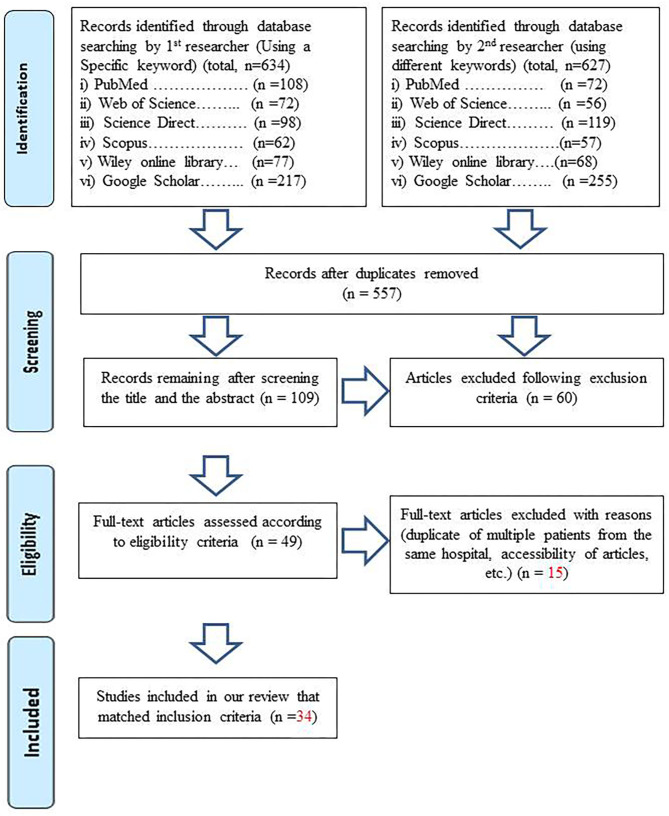
Clinical characteristics are essential for the correct diagnosis of diseases. The current review aimed to summarize the global clinical characteristics of the COVID-19 patients systematically and identify their diagnostic challenges to help the medical practitioners properly diagnose and for better management of COVID-19 patients. We conducted a systematic search in PubMed, Web of Science, Scopus, Science Direct, and Google Scholar databases for original articles containing clinical information of COVID-19 published up to 7th May 2020. Two researchers independently searched the databases to extract eligible articles. A total of 34 studies from 8 different countries with 10889 case-patients were included for clinical characteristics. The most common clinical symptoms were cough 59.6, fever 46.9, fatigue 27.8, and dyspnea 20.23%. The prominent laboratory findings were lymphocytopenia 55.9, elevated levels of CRP 61.9, aspartate aminotransferase 53.3, LDH 40.8, ESR 72.99, serum ferritin 63, IL-6 52, and prothrombin time 35.47%, and decreased levels of platelets 17.26, eosinophils 59.0, hemoglobin 29, and albumin 38.4%. CT scan of the chest showed an abnormality in 93.50% cases with bilateral lungs 71.1%, ground-glass opacity 48%, lesion in lungs 78.3%, and enlargement of lymph node 50.7%. Common comorbidities were hypertension, diabetes, obesity, and cardiovascular diseases. The estimated median incubation period was 5.36 days, and the overall case fatality rate was 16.9% (Global case fatality outside China was 22.24%: USA 21.24%, Italy 25.61%, and others 0%; whereas the case fatality inside the Hubei Province of China was found to be 11.71%). Global features on the clinical characteristics of COVID-19 obtained from laboratory tests and CT scan results will provide useful information to the physicians to diagnose the disease and for better management of the patients as well as to address the diagnostic challenges to control the infection.
临床特征对于疾病的正确诊断至关重要。本综述旨在系统总结全球 COVID-19 患者的临床特征,并确定其诊断挑战,以帮助医务人员正确诊断和更好地管理 COVID-19 患者。我们在 PubMed、Web of Science、Scopus、Science Direct 和 Google Scholar 数据库中进行了系统检索,以获取截至 2020 年 5 月 7 日发表的包含 COVID-19 临床信息的原始文章。两名研究人员独立搜索数据库以提取合格文章。共有来自 8 个国家的 34 项研究和 10889 例病例纳入临床特征分析。最常见的临床症状是咳嗽 59.6%、发热 46.9%、乏力 27.8%和呼吸困难 20.23%。突出的实验室发现是淋巴细胞减少 55.9%、C 反应蛋白升高 61.9%、天门冬氨酸氨基转移酶升高 53.3%、乳酸脱氢酶升高 40.8%、红细胞沉降率升高 72.99%、血清铁蛋白升高 63%、白细胞介素 6 升高 52%和凝血酶原时间升高 35.47%,血小板减少 17.26%、嗜酸性粒细胞减少 59.0%、血红蛋白减少 29%和白蛋白减少 38.4%。胸部 CT 扫描显示 93.50%的病例异常,其中双侧肺部受累 71.1%、磨玻璃样混浊 48%、肺部病变 78.3%和淋巴结肿大 50.7%。常见的合并症有高血压、糖尿病、肥胖和心血管疾病。估计中位潜伏期为 5.36 天,总病死率为 16.9%(中国境外病死率为 22.24%:美国为 21.24%,意大利为 25.61%,其他国家为 0%;而中国湖北省的病死率为 11.71%)。从实验室检查和 CT 扫描结果获得的 COVID-19 全球临床特征将为医生提供有用的信息,以诊断疾病和更好地管理患者,并解决诊断挑战以控制感染。