State Key Laboratory of Cardiovascular Disease FuWai HospitalNational Center for Cardiovascular DiseasesNational Clinical Research Center for Cardiovascular Diseases, Chinese Academy of Medical Sciences and Peking Union Medical College Beijing China.
Department of Cardiology XuanWu HospitalCapital Medical University Beijing China.
J Am Heart Assoc. 2021 Feb 2;10(3):e018869. doi: 10.1161/JAHA.120.018869. Epub 2021 Jan 28.
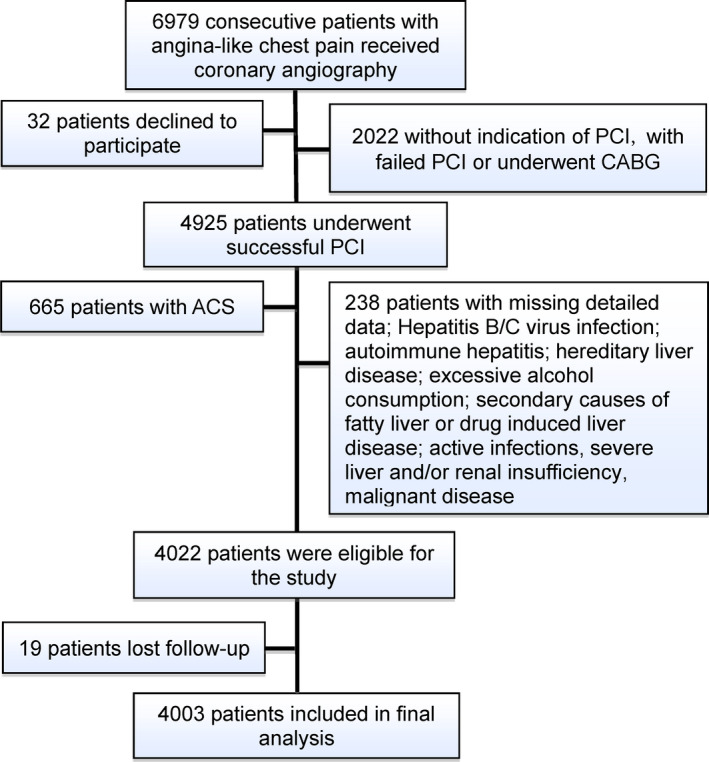
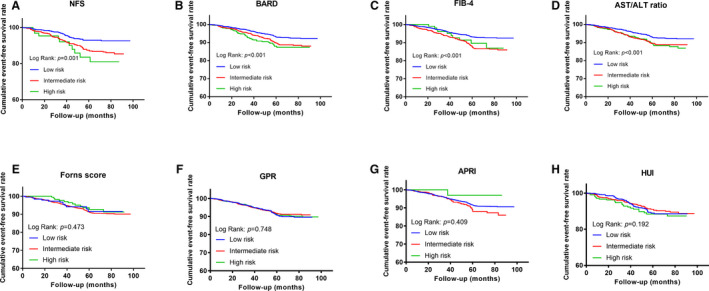
Background Previous studies have suggested a strong association of liver fibrosis scores (LFSs) with cardiovascular outcomes in patients with different cardiovascular diseases. Nonetheless, it is basically blank regarding the prognostic significance of LFSs in patients following percutaneous coronary intervention (PCI). This study sought to examine the potential role of LFSs in predicting long-term outcomes in a large cohort of patients with stable coronary artery disease after elective PCI. Methods and Results In this multicenter, prospective study, we consecutively enrolled 4003 patients with stable coronary artery disease undergoing PCI. Eight currently available noninvasive LFSs were assessed for each subject. All patients were followed up for the occurrence of cardiovascular events including cardiovascular death, nonfatal myocardial infarction, and stroke. During an average follow-up of 5.0±1.6 years, 315 (7.87%) major cardiovascular events were recorded. Subjects who developed cardiovascular events were more likely to have intermediate or high LFSs, including nonalcoholic fatty liver disease fibrosis score; fibrosis-4 score; body mass index, aspartate aminotransferase/alanine aminotransferase ratio, diabetes mellitus score (BARD); and aspartate aminotransferase/alanine aminotransferase ratio. Furthermore, compared with subjects with low scores, those with intermediate plus high score levels had significantly increased risk of cardiovascular events (adjusted hazard ratios ranging 1.57-1.92). Moreover, the addition of non-alcoholic fatty liver disease fibrosis score; fibrosis-4 score; or body mass index, aspartate aminotransferase/alanine aminotransferase ratio, diabetes mellitus score into a model with established cardiovascular risk factors significantly improved the prediction ability. Conclusions High LFSs levels might be useful for predicting adverse prognosis in patients with stable coronary artery disease following PCI, suggesting the possibility of the application of LFSs in the risk stratification before elective PCI.
先前的研究表明,在患有不同心血管疾病的患者中,肝纤维化评分(LFS)与心血管结局之间存在很强的关联。然而,在接受经皮冠状动脉介入治疗(PCI)的患者中,LFS 对预后的意义基本上还是空白。本研究旨在探讨 LFS 在择期 PCI 后稳定型冠状动脉疾病患者中预测长期结局的潜在作用。
在这项多中心前瞻性研究中,我们连续纳入了 4003 例接受 PCI 的稳定型冠状动脉疾病患者。为每位患者评估了 8 种目前可用的非侵入性 LFS。所有患者均进行了心血管事件(包括心血管死亡、非致死性心肌梗死和卒中)的随访。在平均 5.0±1.6 年的随访期间,记录了 315 例(7.87%)主要心血管事件。发生心血管事件的患者更有可能具有中高危 LFS,包括非酒精性脂肪性肝病纤维化评分;纤维化-4 评分;体重指数、天门冬氨酸氨基转移酶/丙氨酸氨基转移酶比值、糖尿病评分(BARD);以及天门冬氨酸氨基转移酶/丙氨酸氨基转移酶比值。此外,与低评分者相比,中高危评分者发生心血管事件的风险显著增加(校正后的危险比范围为 1.57-1.92)。此外,将非酒精性脂肪性肝病纤维化评分;纤维化-4 评分;或体重指数、天门冬氨酸氨基转移酶/丙氨酸氨基转移酶比值、糖尿病评分加入到一个包含已确立的心血管危险因素的模型中,可显著提高预测能力。
高 LFS 水平可能有助于预测 PCI 后稳定型冠状动脉疾病患者的不良预后,提示 LFS 有可能用于择期 PCI 前的危险分层。