Division of Experimental Hematology and Cancer Biology, Department of Pediatrics, University of Cincinnati College of Medicine, Cincinnati, Ohio, USA.
Neuroscience Graduate Program, University of Cincinnati College of Medicine, Cincinnati, Ohio, USA.
Glia. 2021 Aug;69(8):1837-1851. doi: 10.1002/glia.23969. Epub 2021 Jan 28.
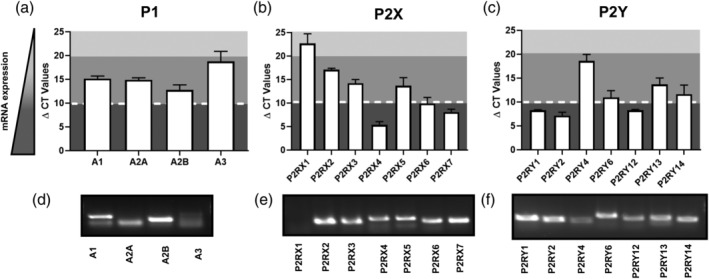
To facilitate analyses of purinergic signaling in peripheral nerve glia, we review recent literature and catalog purinergic receptor mRNA expression in cultured mouse Schwann cells (SCs). Purinergic signaling can decrease developmental SC proliferation, and promote SC differentiation. The purinergic receptors P2RY2 and P2RX7 are implicated in nerve development and in the ratio of Remak SCs to myelinating SCs in differentiated peripheral nerve. P2RY2, P2RX7, and other receptors are also implicated in peripheral neuropathies and SC tumors. In SC tumors lacking the tumor suppressor NF1, the SC pathway that suppresses SC growth through P2RY2-driven β-arrestin-mediated AKT signaling is aberrant. SC-released purinergic agonists acting through SC and/or neuronal purinergic receptors activate pain responses. In all these settings, purinergic receptor activation can result in calcium-independent and calcium-dependent release of SC ATP and UDP, growth factors, and cytokines that may contribute to disease and nerve repair. Thus, current research suggests that purinergic agonists and/or antagonists might have the potential to modulate peripheral glia function in development and in disease.
为了促进周围神经胶质细胞中嘌呤能信号的分析,我们回顾了最近的文献,并对培养的小鼠雪旺细胞(SCs)中的嘌呤能受体 mRNA 表达进行了编目。嘌呤能信号可以减少发育中的 SC 增殖,并促进 SC 分化。嘌呤能受体 P2RY2 和 P2RX7 参与神经发育以及分化后的周围神经中 Remak SC 与髓鞘形成 SC 的比例。P2RY2、P2RX7 和其他受体也与周围神经病变和 SC 肿瘤有关。在缺乏肿瘤抑制因子 NF1 的 SC 肿瘤中,通过 P2RY2 驱动的β-arrestin 介导的 AKT 信号抑制 SC 生长的 SC 途径异常。SC 释放的嘌呤能激动剂通过 SC 和/或神经元嘌呤能受体激活疼痛反应。在所有这些情况下,嘌呤能受体的激活可能导致 SC ATP 和 UDP、生长因子和细胞因子的钙不依赖性和钙依赖性释放,这些物质可能导致疾病和神经修复。因此,目前的研究表明,嘌呤能激动剂和/或拮抗剂可能具有调节周围神经胶质细胞在发育和疾病中的功能的潜力。