Center for Health Equity and Innovation, Health Research and Solutions, Cook County Health, Chicago, Illinois, United States of America.
Department of Medicine, Rush University Medical Center, Chicago, Illinois, United States of America.
PLoS One. 2021 Jan 28;16(1):e0240202. doi: 10.1371/journal.pone.0240202. eCollection 2021.
During the early phases of the COVID-19 pandemic in the U.S., African-American or Hispanic communities were disproportionately impacted. To better understand the epidemiology and relative effects of COVID-19 among hospitalized Hispanic patients, we compared individual and census-tract level characteristics of patients diagnosed with COVID-19 to those diagnosed with influenza, another viral infection with respiratory transmission. We evaluated temporal changes in epidemiology related to a shelter-in-place mandate.
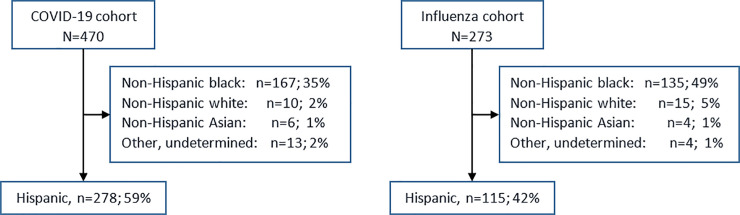
We evaluated patients hospitalized at Cook County Health, the safety-net health system for the Chicago metropolitan area. Among self-identified hospitalized Hispanic patients, we compared those with influenza (2019-2020 season) to COVID-19 infection during March 16, 2020-May 11, 2020. We used multivariable analysis to identify differences in individual and census-tract level characteristics between the two groups.
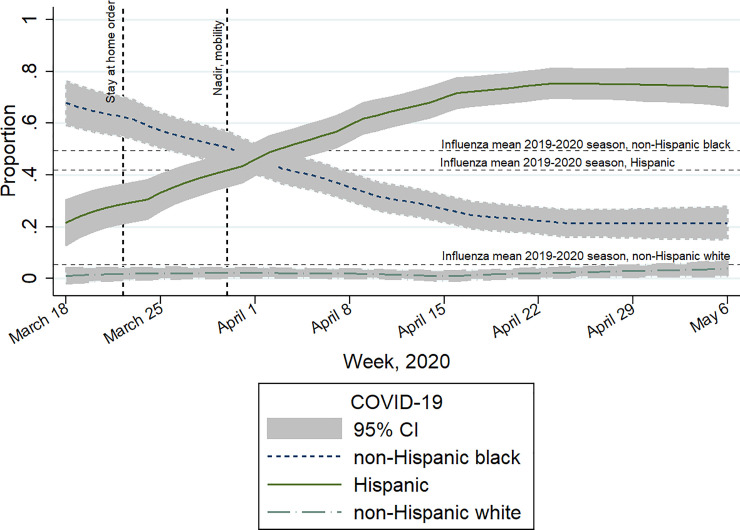
Relative to non-Hispanic blacks and whites, COVID-19 rapidly increased among Hispanics during promotion of social-distancing policies. Whereas non-Hispanic blacks were more likely to be hospitalized for influenza, Hispanic patients predominated among COVID-19 infections (40% relative increase compared to influenza). In the comparative analysis of influenza and COVID-19, Hispanic patients with COVID-19 were more likely to reside in census tracts with higher proportions of residents with the following characteristics: Hispanic; no high school diploma; non-US citizen; limited English speaking ability; employed in manufacturing or construction; and overcrowding. By multivariable analysis, Hispanic patients hospitalized with COVID-19 compared to those with influenza were more likely to be male (adjusted OR = 1.8; 95% CI 1.1 to 2.9), obese (aOR = 2.5; 95% CI 1.5 to 4.2), or reside in a census tract with ≥40% of residents without a high-school diploma (aOR = 2.5; 95% CI 1.3 to 4.8).
The rapid and disproportionate increase in COVID-19 hospitalizations among Hispanics after the shelter-in-place mandate indicates that public health strategies were inadequate in protecting this population-in particular, for those residing in neighborhoods with lower levels of educational attainment.
在美国 COVID-19 大流行的早期阶段,非裔或西班牙裔社区受到的影响不成比例。为了更好地了解西班牙裔住院患者 COVID-19 的流行病学和相对影响,我们将 COVID-19 患者与另一种具有呼吸道传播的病毒性流感患者进行了个体和人口普查区特征比较。我们评估了与就地避难所命令相关的流行病学的时间变化。
我们评估了在库克县卫生系统(芝加哥大都市区的医疗保障系统)住院的患者。在自我认定的住院西班牙裔患者中,我们将那些患有流感(2019-2020 季节)的人与 2020 年 3 月 16 日至 2020 年 5 月 11 日之间的 COVID-19 感染进行了比较。我们使用多变量分析来确定两组之间个体和人口普查区特征的差异。
与非西班牙裔黑人和白人相比,在社会隔离政策推广期间,西班牙裔人群中 COVID-19 的发病率迅速上升。虽然非西班牙裔黑人更有可能因流感住院,但西班牙裔患者在 COVID-19 感染中占主导地位(与流感相比增加了 40%)。在流感和 COVID-19 的比较分析中,患有 COVID-19 的西班牙裔患者更有可能居住在居民具有以下特征的人口普查区:西班牙裔;没有高中文凭;非美国公民;英语能力有限;从事制造业或建筑业;和过度拥挤。通过多变量分析,与流感相比,因 COVID-19 住院的西班牙裔患者更有可能是男性(调整后的 OR = 1.8;95%CI 1.1 至 2.9)、肥胖(aOR = 2.5;95%CI 1.5 至 4.2)或居住在居民中至少有 40%没有高中文凭的人口普查区(aOR = 2.5;95%CI 1.3 至 4.8)。
就地避难所命令发布后,西班牙裔 COVID-19 住院人数迅速且不成比例地增加,这表明公共卫生策略在保护这一人群方面不足,尤其是对于居住在教育程度较低的社区的人群。