Department of African American Studies and Sociology, University of Illinois Urbana-Champaign, Champaign, IL 61820, USA.
Carle Illinois College of Medicine, University of Illinois Urbana-Champaign, Champaign, IL 61801, USA.
Int J Environ Res Public Health. 2023 Mar 23;20(7):5248. doi: 10.3390/ijerph20075248.
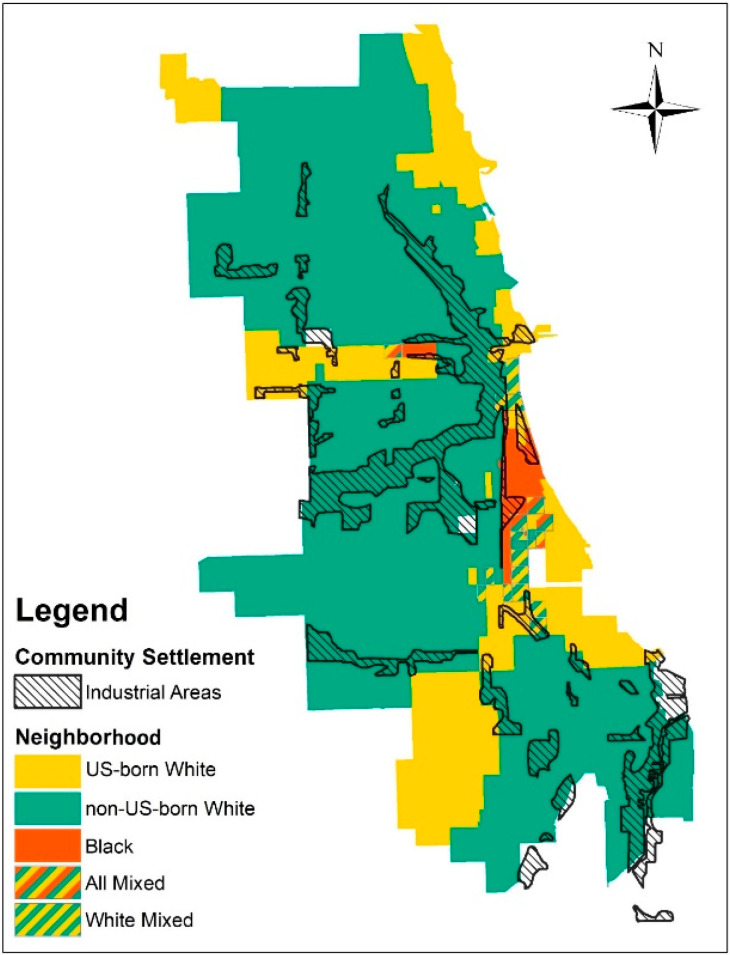
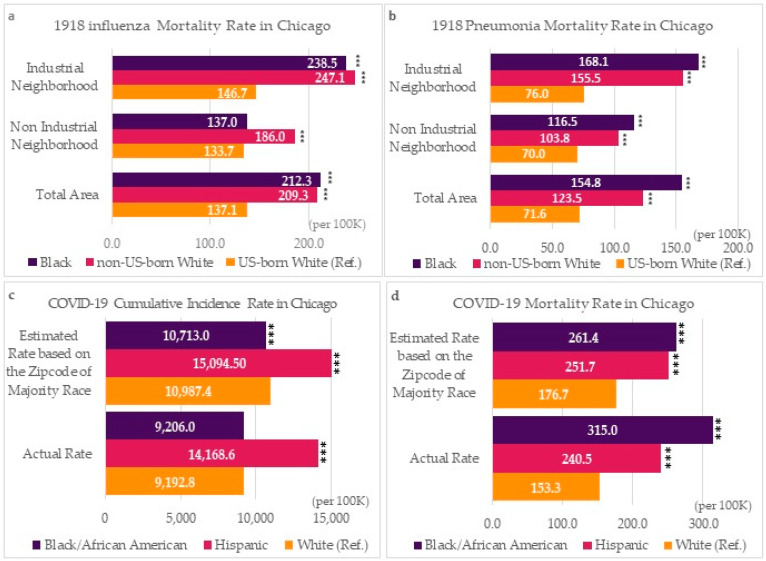
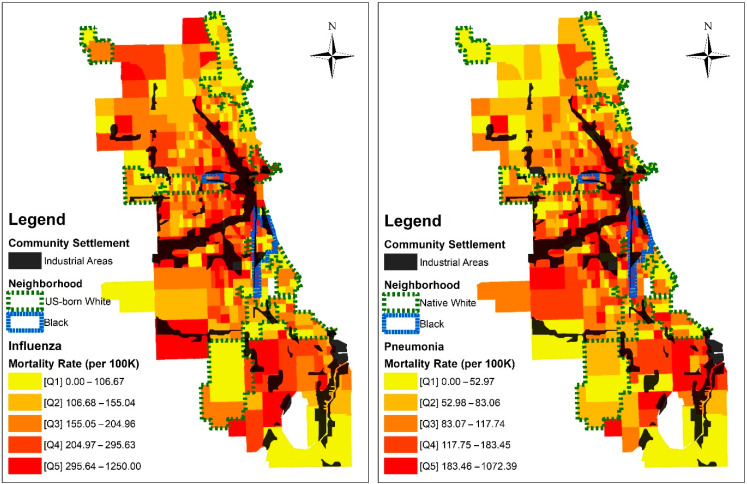
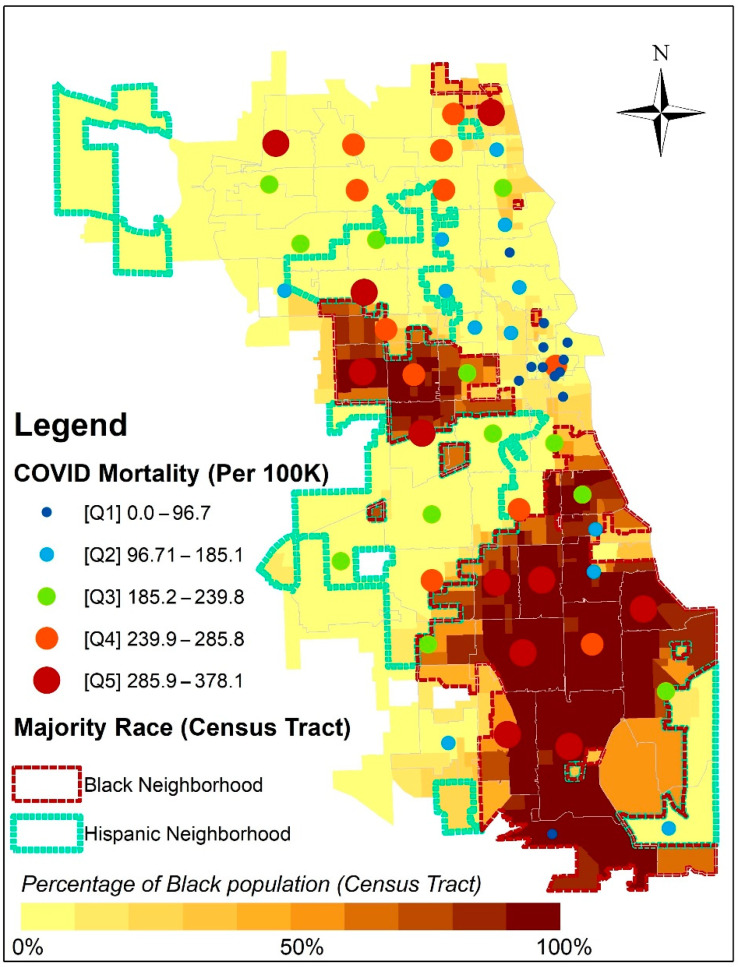
During historical and contemporary crises in the U.S., Blacks and other marginalized groups experience an increased risk for adverse health, social, and economic outcomes. These outcomes are driven by structural factors, such as poverty, racial residential segregation, and racial discrimination. These factors affect communities' exposure to risk and ability to recover from disasters, such as pandemics. This study examines whether areas where descendants of enslaved Africans and other Blacks lived in Chicago were vulnerable to excess death during the 1918 influenza pandemic and whether these disparities persisted in the same areas during the COVID-19 pandemic. To examine disparities, demographic data and influenza and pneumonia deaths were digitized from historic weekly paper maps from the week ending on 5 October 1918 to the week ending on 16 November 1918. Census tracts were labeled predominantly Black or white if the population threshold for the group in a census tract was 40% or higher for only one group. Historic neighborhood boundaries were used to aggregate census tract data. The 1918 spatial distribution of influenza and pneumonia mortality rates and cases in Chicago was then compared to the spatial distribution of COVID-19 mortality rates and cases using publicly available datasets. The results show that during the 1918 pandemic, mortality rates in white, immigrant and Black neighborhoods near industrial areas were highest. Pneumonia mortality rates in both Black and immigrant white neighborhoods near industrial areas were approximately double the rates of neighborhoods with predominantly US-born whites. Pneumonia mortality in Black and immigrant white neighborhoods, far away from industrial areas, was also higher (40% more) than in US-born white neighborhoods. Around 100 years later, COVID-19 mortality was high in areas with high concentrations of Blacks based on zip code analysis, even though the proportion of the Black population with COVID was similar or lower than other racial and immigrant groups. These findings highlight the continued cost of racial disparities in American society in the form of avoidable high rates of Black death during pandemics.
在美国历史和当代的危机中,黑人和其他边缘化群体面临着更高的不良健康、社会和经济后果的风险。这些后果是由结构性因素驱动的,如贫困、种族居住隔离和种族歧视。这些因素影响到社区面临风险的程度以及从灾害(如大流行病)中恢复的能力。本研究考察了在芝加哥,非洲裔奴隶的后代和其他黑人居住的地区在 1918 年流感大流行期间是否容易出现超额死亡,以及这些差异在同一地区是否在 2019 年冠状病毒病大流行期间仍然存在。为了研究差异,从 1918 年 10 月 5 日那一周到 11 月 16 日那一周的每周纸质地图上数字化了人口统计数据和流感和肺炎死亡人数。如果一个普查区内的人口阈值对于一个群体来说是 40%或更高,那么普查区就被标记为主要是黑人或白人。使用历史上的社区边界来汇总普查区数据。然后,将 1918 年芝加哥流感和肺炎死亡率和病例的空间分布与使用公开数据集的 COVID-19 死亡率和病例的空间分布进行比较。结果表明,在 1918 年大流行期间,靠近工业区的白人、移民和黑人社区的死亡率最高。靠近工业区的黑人和移民白人社区的肺炎死亡率大约是主要是美国出生的白人社区的两倍。远离工业区的黑人和移民白人社区的肺炎死亡率也更高(高出 40%),比美国出生的白人社区高。大约 100 年后,根据邮政编码分析,COVID-19 的死亡率在黑人群体高度集中的地区很高,尽管黑人群体的 COVID 比例与其他种族和移民群体相似或更低。这些发现突显了美国社会中种族差异的持续代价,表现为大流行病期间黑人的高死亡率是可以避免的。